


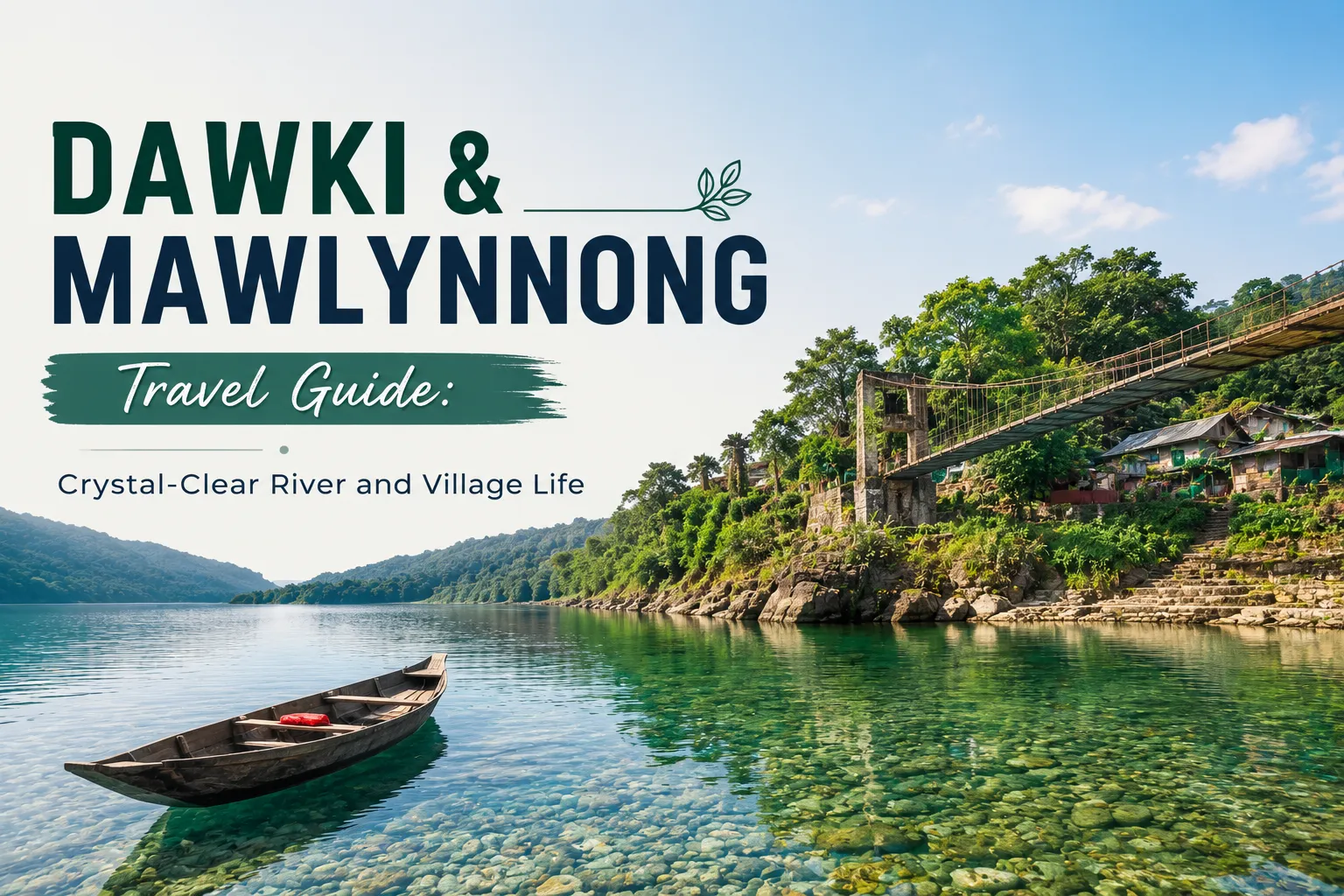
Dawki and Mawlynnong show two distinct parts of Meghalaya. And that’s precisely why they complement each other. The first is a river station at the border of India and Bangladesh. The second is a tiny Khasi village with a reputation for communal cleanliness.
The shining star in the sights of Dawki Meghalaya is the Umngot River. Scheduled to show the best of itself in a mix of dry weather, optimum sunlight and river character, the water may look fully transparent producing those classic shots where boats hover over an apparent bed of the river. That doesn’t mean it’s clear all year, of course, and Meghalaya Tourism specifically suggests wintertime.
Then we have Mawlynnong Meghalaya where the attraction is not so much a single landmark but more about village life, cleanliness, greenery and community ethos. This has been called as Asia’s cleanest village perhaps owing to the accolades earned through recognizing it with Discover India in 2003.
Together they offer a good contrast: river and outdoors at Dawki, then village life and living root architecture around Mawlynnong. Here’s how to do it without overloading a single day.
Dawki — The Crystal Clear River
Dawki, in Meghalaya’s West Jaintia Hills, sits near the India-Bangladesh border. The town and its environs are most famous for the Umngot River, which has become one of Meghalaya’s defining natural sights. An official Meghalaya government publication states the following regarding Dawki- “On the banks of Umngot. Known for its transparent water”.
The river is the reason most travellers add Dawki to their Meghalaya trip. When the water is transparent, the shallow depth, sunlight, bed and comparatively less sediment culminate in an overall sea-glass effect.
But don’t arrive expecting a water colour just like those you see in all those photos on instagram.
Rainfall may add more sediment to the river and also make the water less transparent. Clouds can affect how the water appears and situations on the river can change from one period to the next. In heavy monsoon rain, the Umngot could look very different from the amazingly clear imagery often used in association with Dawki.
Within the encompassing Dawki village belt there is also a significant border situation. The India-Bangladesh border is landscape continuous and provides another dimension to the visit, but local and security instructions around border areas must be followed.
Boating at Umngot River
Dawki boating provides one of the easiest options to explore Umngot. An average boat trip offers you the experience of being on the water rather than just looking at it from the side, with the hill slopes, greenery and the colour of water varying behind.
It is entirely condition-dependent. On a sunny, near-dry day, the river may be quite visually clear. Alternatively, the very same section of river may be very dark or very muddy after large rains.
In terms of safety, follow instructions of local boat operators, wear life jackets and do not get into water just because it looks peaceful. To ensure safety the government of Meghalaya has provided instructions to tourists to assess weather and water conditions, avoid unsafe river sites and wear safety equipment.
Boating availability, prices and operation times may change, so check locally on the day rather than from a converted travel blog for fixed timetable or prices.
Best Time for Clear Water
While I have not personally experienced the waters around Dawki in the winter months, if clear water is your driving motivation for a visit to Dawki, the drier months are probably going to be your best option. Currently reports from Meghalaya Tourism list winter (Nov-February) as the optimal time to visit for clear water around Dawki and Shnongpdeng.
A useful seasonal overview:
- Winter: Better odds of clear river conditions and comfortable sightseeing.
- Spring: Pleasant greenery and generally easier road travel than peak monsoon.
- Monsoon: Lush landscapes, but heavy rain can reduce river clarity and create difficult road conditions.
- Post-monsoon: Green scenery remains, while river conditions can gradually become more favourable.
Even in the ‘good’ season, no promises. Think of the season as increasing the probability of the Blue/Green you want rather than promising what shade of blue/green will appear.
Mawlynnong — Asia’s Cleanest Village
Mawlynnong is a village in the East Khasi Hills of the Indian state of Meghalaya. It is very close to the border of Bangladesh. But it was really cleanliness that shot this village to fame.
Give that statement a bit of context. The tourism department and guidebooks use the epithet unceasingly, and according to Incredible India, Mawlynnong was named Asia’s cleanest village in 2003 and India’s cleanest village in 2005. Tracing the Asia-wide praise even further back, the same report credits Discover India.
In the event of a current travel article, this is better understood as a referenced global reputation / tourism classification, one that has been thoroughly used rather than being an officially re-rankable today,even if perpetually acknowedgable.
The real reason behind Mawlynnong’s attraction is probably the community participation. Bamboo bins, waste disposal, rainwater harvesting and bans on plastics have all been advocated by this village for years.
Therefore the best way to enjoy Mawlynnong village is to take it easy. Stroll and take shots of the beautiful width of the village instead of rushing through them. Watch the locals to see how life goes on in the village and take into account that this is an actual living place, not a theme park tailor-made for visitors.
Living Root Bridge at Mawlynnong
Another place worth visiting close to Mawlynnong is the Riwai Living Root Bridge.
The bridges are built over time by luring and training the aerial roots of rubber fig trees until the roots grow into a functional bridge. This is a remarkable example of local ecological engineering, in the sense that living material becomes part of the infrastructure.
The bridge near Mawlynnong is not as high up and narrow as the dense cover of the famous Nongriat Double Decker Root Bridge near Sohra. It’s a single level bridge and can be reached from anywhere in the blessed land of Mawlynnong including from where you reach off the zigzag roads path from the top end as indicated in the image (hit downhill steep). According to Meghalaya Tourism’s website, there is only one route to reach the access point and is about 3 km away before reaching the Holy place of Mawlynnong.
If you’re interested in the wider story behind Meghalaya’s living bridges, continue to our [Meghalaya’s living root bridges] guide for the Nongriat trek and Double Decker Root Bridge.
Wear footwear with good grip and allow extra time if the path is wet. More importantly, don’t climb on roots or damage the structure for a photograph.
Sky View Tower
The Sky View Tower is where the above two merge and what Asia day To day as a Sky Walk, sits me on a different plane altogether. From here at the top you get a great view of the Bangladesh side of the border and the rest of the hills around.
Weather naturally affects visibility. On a foggy or rainy day, the border might not look as vividly defined as the travel brochures depict.
There may be variations in visitor arrangements and charges, so check locally before planning your rounds of the tower.
Dawki vs Mawlynnong — What Is the Difference?
| Factor | Dawki | Mawlynnong |
| Main attraction | Umngot River and boating | Village, cleanliness and living-root bridge |
| Best for | River scenery, boating and border landscapes | Village walks, photography and eco-conscious travel |
| Typical experience | Outdoors and water-focused | Slower, cultural and community-focused |
| Nature/landscape | River, hills and border country | Green village, forest and rural landscapes |
| Suggested visit | 2–4 hours | 2–4 hours |
| Who should visit? | Couples, families, photographers and outdoor travellers | Families, culture lovers and first-time Meghalaya visitors |
| Day trip? | Yes, particularly with Mawlynnong | Yes, particularly with Dawki |
The simplest decision: if you only have time for one, choose Dawki for the river and Mawlynnong for village culture. If you have a full day, visiting both makes more sense.
Dawki-Mawlynnong Day Trip Plan
A combined day trip from Shillong is feasible, but would be a long drive day and not a leisurely sightseeing day. However, Meghalaya Tourism itself offers Mawlynnong/Dawki as a day trip circuit, with its published tour taking about half a day in the morning and then the rest of the day.
Recommended route
Shillong → Mawlynnong → Dawki → Shillong
Start early from Shillong.
Morning — Mawlynnong
Use the morning to walk round the village and visit the Riwai Living Root Bridge. If you want to go up to the Sky View Tower, leave enough time.
Late morning/early afternoon — Dawki
Proceed on to Dawki. Take your time rather than rushing through in a fixed scheduled transfer.
Afternoon — Umngot River
Enjoy lunch as is convenient then relax by the river. Should boat operation be available and the weather favorable, go for the boat ride at this point.
Late afternoon — Return to Shillong
Begin the return journey with sufficient daylight and road-time allowance.
Avoid trying to fit into too many waterfalls, caves or viewpoints far away from schedule. Delays caused by traffic, weather conditions or road works and sightseeing stops will add significant time.
How to Reach Dawki and Mawlynnong
The best way for most people is to take a private taxi or simply rent a car with a driver. This way you can take breaks whenever you wish and won’t need to negotiate several internal transfers.
The traditional route can be planned broadly as:
Shillong → Mawlynnong → Dawki → Shillong
Nevertheless, road conditions may change. In June 2026, the Meghalaya government had recommended that travelers traveling to Dawki and its neighboring tourist destinations should prefer the Shillong-Jowai-Amlarem-Dawki route instead (safer route) due to road conditions.
That is particularly important during the rainy season.
Shared transport is useful for customers traveling on a budget, but it becomes less practical when travelling to a number of destinations within a single day. You should check availability locally, not rely on older reference online information.
It is better to hire a driver for the day if you want to visit both places comfortably.
For a broader Meghalaya itinerary, use our Meghalaya Travel Guide to connect this trip with the state’s other major destinations.
Where to Stay Near Dawki
You need not be in Dawki all the time.
In the surrounding area there are options such as homestays, guesthouses, eco-stays and other small scale properties; Shillong offers a much broader spectrum of accommodation options.
Stay in Dawki or nearby
Choose this if:
- You want more time beside the river.
- You want an early start for boating.
- You prefer a quieter evening outside Shillong.
- You are continuing towards other Jaintia Hills attractions.
Stay near Mawlynnong
This is ideal for those who would like to walk through the village more slowly and not run through it as a sightseeing stop.
Return to Shillong
“Most straightforward for a brief Meghalaya break when Dawki and Mawlynnong are included in an extended day-trip itinerary.
Search for Dawki hotels, not just the bottom of the scale before you price. Search location of the property, the road access, reviews recently read and conditions cancel, especially if you go in the rain.
Where to Eat
Food is a pain, once you leave shillong so don’t expect to have a huge variety of restaurants on the dawki- Mawlynnong circuit!
Seek Khasi cuisine if it is offered locally. Travelers may find that restaurant or market stalls serve traditional food centered on rice, pork, chicken, fish and native grown vegetables, depending on the location, and time of year.
For a full-day road trip:
- Have breakfast before leaving Shillong.
- Carry drinking water and a few snacks.
- Allow time for lunch rather than squeezing it between attractions.
- Ask locally about food availability before heading into more rural areas.
- Avoid unnecessary single-use plastic.
It’s better to have a little nice meal at the right time than wasting an hour to find a chef’s restaurant that probably does not open on that day.
Best Time to Visit Dawki & Mawlynnong
There is not a best season for both destinations.
The comfort-seeking traveller should find October to March the best time to visit with comfortable travelling, village visits and clearer waters. Window Tourism recommended autumn and winter for living-root-bridge experience and winter for the clearer waters of Dawki.
Spring a good middle ground in case you want some “green” without the heavy rains
The monsoon creates lush scenery and rain-fed environments, however it can also create wet and slippery footpaths, murkier waters in rivers, mudslides and a slower journey along the road. Meghalaya State Government recommends tourists to “be vigilant and plan your travel according to weather and road conditions and at such times your travel may be delayed”.
If it’s the iconic transparent waters of the Umngot that really matter to you, pick the driest possible season and still visit the area by confirming the state of local rivers just before your departure.
How Many Days Do You Need?
1 Day
Best for: travellers staying in Shillong.
Head to Mawlynnong early in the morning, go on to Dawki, capital of the Majha Tamah (tribe) and if weather is fine, take a boat ride along the river, and come back to Shillong.
It can be done, but don’t expect it to be a quick day.
2 Days
Best for: travellers who dislike rushed itineraries.
First day visiting Mawlynnong and surroundings, move towards Dawki/Shnongpdeng for river stay and visit.
3 Days
Best for: a more relaxed Meghalaya itinerary.
Wrap the Mawlynnong, Dawki route with Jaintia Hills or other parts of Meghalaya, instead of glutton catching all on a single road trip.
Practical Dawki & Mawlynnong Travel Tips
- Carry some cash, particularly for smaller local transactions.
- Check the weather forecast before leaving.
- Carry rain protection even outside peak monsoon.
- Wear comfortable shoes with good grip.
- Check local boating conditions before entering the river.
- Don’t swim in unfamiliar or deep sections of the Umngot.
- Don’t litter or leave plastic behind.
- Respect village rules and local customs.
- Treat Mawlynnong as a residential community, not simply a photo backdrop.
- Allow extra road time during rain.
- Don’t assume online photographs represent current river conditions.
- Keep identification and relevant travel documents accessible when travelling close to the international border.
- Follow instructions from local authorities and the BSF around restricted border areas.
FAQs
1. What is Dawki famous for?
Best known for the Umngot River and its excellent clarity in good conditions. It is near the India-Bangladesh border and is a popular boating location.
2. Is Dawki worth visiting?
Yes, particularly if you enjoy river scenery and outdoor experiences. Just remember that the famous clear-water effect depends on weather, rainfall and river conditions.
3. When is Dawki water the clearest?
The drier and winter months generally offer better conditions. Meghalaya Tourism recommends winter, particularly November to February, for clearer water around Dawki and Shnongpdeng.
4. Is Dawki boating available throughout the year?
Boating is an established activity, but operations can be affected by weather, river conditions and local safety decisions. Check locally before travelling.
5. Why is Mawlynnong famous?
Mawlynnong is famous for its cleanliness, community-led environmental practices, rural setting and nearby living root bridge.
6. Is Mawlynnong really Asia’s cleanest village?
The description comes from its historical recognition and has become a widely used tourism label. It is safer to describe Mawlynnong as widely known for its “Asia’s Cleanest Village” reputation, rather than presenting it as a current official global ranking.
7. How far is Mawlynnong from Dawki?
The two destinations are close enough to combine in one road trip, but exact driving distance and time vary by route and road conditions. Allow plenty of flexibility, particularly during the monsoon.
8. Can Dawki and Mawlynnong be covered in one day?
Yes. A combined day trip from Shillong is a recognised itinerary, but it is a full day on the road.
9. Where should I stay for a Dawki-Mawlynnong trip?
Stay in Shillong for convenience, near Mawlynnong for a slower village experience, or around Dawki/Shnongpdeng if spending more time by the river.
Conclusion
Dawki and Mawlynnong can make a great combination precisely because they provide two contrasting experiences. Dawki Meghalaya is centered around the Umngot River, varying water levels, boat rides, and the imposing hills along the India-Bangladesh border. Mawlynnong provides a tranquil, communal atmosphere with a focus on village life, eco-friendly action and the incredible living root bridges close at hand.
For a first trip to the area, these two are a fantastic full-day trip from Shillong. With a little more time, however, taking your time and hanging out for the night in the Dawki/Shnongpdeng area makes the experience much more memorable.
To travel with a realistic expectation: it is sunny and the water is clean, it is muddy and the roads are always longer than you thought they should be, Mawlynnong is worth the visit rather than the photo.
4 responses to “Dawki & Mawlynnong Travel Guide: Crystal-Clear River and Village Life”
[…] For detailed planning, see our Dawki & Mawlynnong Travel Guide […]
[…] For more info: Dawki Travel Guide […]
[…] Planning a Dawki & Mawlynnong trip? → Explore our Dawki & Mawlynnong Travel Guide: Crystal-Clear River and Village Life […]
[…] Explore the charm of Dawki and Mawlynnong. […]