


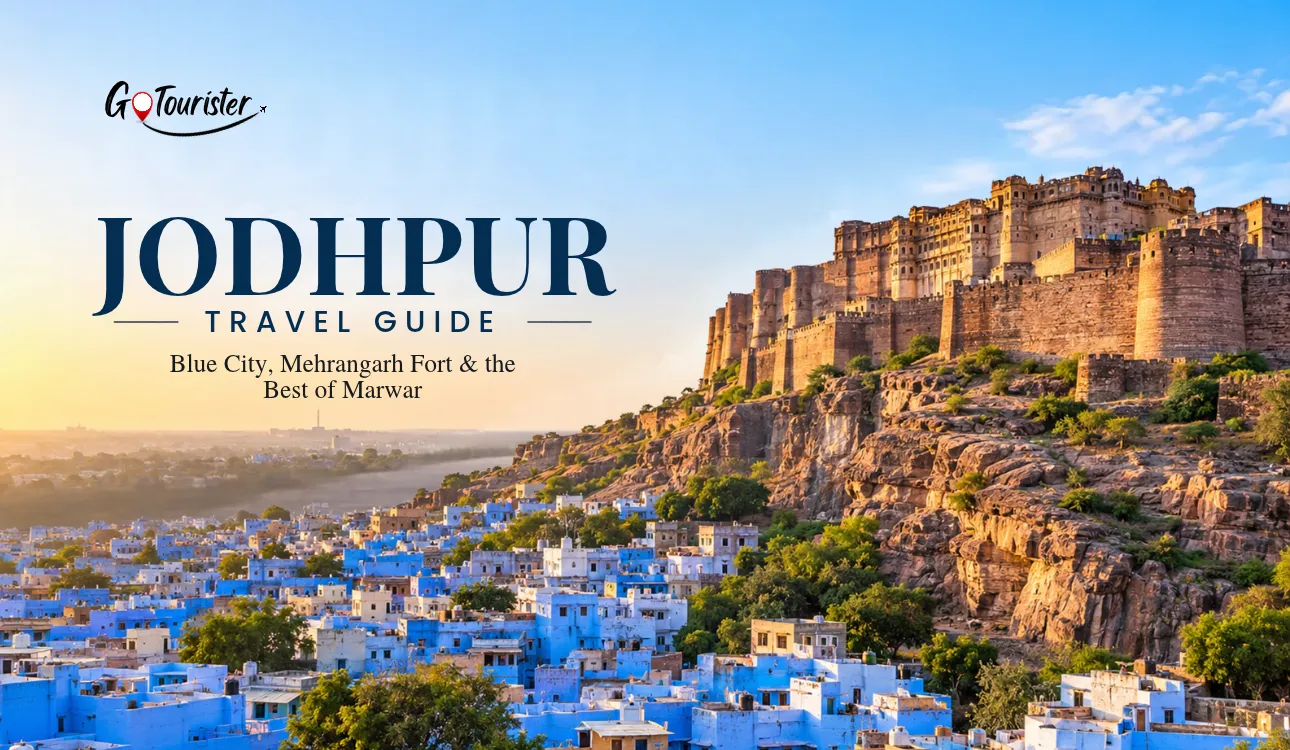
Jodhpur is the kind of Rajasthan destination that makes sense once you understand how its pieces fit together. The old city sits beneath Mehrangarh Fort, blue-painted neighbourhoods spread across the historic centre, and grander sights such as Umaid Bhawan Palace and Jaswant Thada sit beyond the busiest market lanes.
For a first visit, two full days is the sweet spot. One day is enough to see the headline sights if you keep moving; three days gives you time to slow down and add an excursion beyond the city.
This Jodhpur travel guide covers what to know before you go: when to visit, how to reach Jodhpur, where to stay, what to eat, how to get around, how much to budget and how to build a realistic one-, two- or three-day itinerary.
Jodhpur at a glance
| Quick fact | What to know |
| Best for | Forts, Marwar history, architecture, food, markets and photography |
| Ideal first visit | 2 full days |
| Short visit | 1 full day can cover the major sights |
| More relaxed trip | 3 days, with time for an excursion |
| Best weather window | Generally October to March |
| Main landmark | Mehrangarh Fort |
| Historic core | Old City around the Clock Tower and Sardar Market |
| Airport | Jodhpur Airport |
| Rail station | Jodhpur Junction |
| Currency | Indian rupee (INR) |
| Known as | The Blue City; also associated with the Marwar region |
| Main planning issue | Heat, especially outside the cooler months |
Jodhpur’s climate is worth taking seriously. India Meteorological Department climate data shows average maximum temperatures rising from about 25°C in January to more than 41°C in May, while July and August are considerably wetter. October can still be hot during the daytime even though mornings and evenings become more comfortable.
Why visit Jodhpur?
Jodhpur is worth adding to a Rajasthan itinerary because several different travel experiences are concentrated in a relatively compact city.
1. Mehrangarh Fort dominates everything
The first thing to understand about Jodhpur is that Mehrangarh is not simply another fort on a Rajasthan sightseeing list. It is the visual and historical centre of the city.
Rajasthan Tourism describes the fort as rising about 125 metres above Jodhpur and highlights its courtyards, carved stonework, latticed windows and palace interiors. The Mehrangarh Museum Trust’s collection includes arms and armour, textiles, paintings, furniture, decorative arts and royal objects.
The fort also gives you one of the clearest explanations for Jodhpur’s Blue City nickname: from above, the dense blue-painted neighbourhoods of the old city become part of the landscape.
2. The old city is more than a photo backdrop
Around the Clock Tower, Sardar Market and the lanes beneath Mehrangarh, Jodhpur becomes a working city rather than a collection of monuments.
Markets sell spices, textiles, jewellery, leather goods and traditional footwear. Rajasthan Tourism specifically highlights Sadar Market for spices, traditional clothing and jewellery, while Incredible India identifies Nai Sarak, Mochi Bazaar, Kapra Bazaar, Sarafa Bazaar and Sojati Gate among the city’s shopping areas.
This is where it pays to leave some unstructured time in your itinerary.
3. Marwar history gives the city a distinct identity
Jodhpur was founded in 1459 by Rao Jodha and became the centre of the Marwar kingdom. That history remains visible in the fort, royal memorials, palaces, markets and surrounding historic sites.
A useful way to think about Jodhpur is therefore not simply as a “blue city”, but as the historic capital of Marwar whose blue old city happens to be one of its most recognisable visual signatures.
4. Food is part of the attraction
Jodhpur is particularly good for travellers who enjoy snacks and regional food rather than only formal restaurant dining.
Local specialities worth looking for include mirchi bada, pyaaz kachori, mawa kachori and makhaniya lassi. Incredible India specifically identifies mirchi bada and makhaniya lassi with Jodhpur’s food culture.
What does “Blue City” actually mean?
Jodhpur’s Blue City nickname refers primarily to the concentration of blue-painted houses in the historic old city below Mehrangarh Fort.
But there is an important caveat: there is no single universally established explanation for why the houses are blue.
Incredible India gives the commonly repeated explanation that Brahmin households traditionally painted their houses blue, with the colour also associated with keeping homes cooler. Other accounts connect traditional lime washes containing copper compounds with protection against insects and termites.
For visitors, the practical point is simpler: Jodhpur is not uniformly blue. The strongest concentrations are in parts of the historic city, and the visual effect is particularly striking from elevated viewpoints around Mehrangarh.
Do not plan your trip around finding one mythical “Blue City street”. The blue houses are part of a living neighbourhood, not a purpose-built attraction.
Important: If you want to explore the blue neighbourhoods systematically, use a dedicated Jodhpur Blue City walking route rather than trying to reproduce one inside this general guide.
How many days do you need in Jodhpur?
One day
One day works if Jodhpur is a stop on a larger Rajasthan trip.
Prioritise:
- Mehrangarh Fort
- Jaswant Thada
- the Old City
- Clock Tower and Sardar Market
- Toorji Ka Jhalra
- one good local meal
You will need to keep the day organised and avoid spending too long at any one stop.
Two days
Two full days is the best starting point for most first-time visitors.
It gives you enough time for the major sights without turning the trip into a checklist.
A practical split is:
- Day 1: Mehrangarh Fort, Jaswant Thada and Old City
- Day 2: Umaid Bhawan Palace Museum, markets, Rao Jodha Desert Rock Park and additional Old City time
Three days
A third day is useful if you prefer a slower pace or want to add a nearby experience.
Use it for one excursion rather than trying to add every possible attraction around Jodhpur.
Best time to visit Jodhpur
For most sightseeing-focused trips, October to March is the most comfortable period, but even within this window conditions vary.
IMD climatological data shows average maximum temperatures of about 25°C in January, 28°C in February, 34°C in March and 36°C in October. By May, the long-term average maximum is around 41°C. July and August are substantially wetter.
October and November
A strong period for sightseeing.
Days can still be warm, particularly in October, but conditions generally become much more manageable than the summer months.
October also has an important caveat for festival travellers: the Marwar Festival is scheduled for 24–25 October 2026, according to Rajasthan Tourism and Incredible India.
Jodhpur RIFF is separately scheduled for 22–26 October 2026 at Mehrangarh Fort and around Jodhpur.
If your trip coincides with these events, check accommodation and event information well in advance.
December to February
These months are generally the most comfortable for daytime sightseeing, although winter mornings and evenings can be cool.
Pack layers rather than assuming Rajasthan will be hot at every hour of the day.
March
March can still be pleasant early in the month but temperatures rise quickly. IMD data shows a long-term March average maximum of around 34°C, with historical March extremes above 40°C.
April to June
Expect serious heat.
IMD climatological data puts the average maximum around 39°C in April and 41°C in May. Historical April records have exceeded 45°C.
If you visit during this period, build sightseeing around early mornings and later afternoons rather than attempting a full day outdoors.
July to September
The monsoon brings more rain and somewhat lower average temperatures, but Jodhpur remains warm. IMD climate data records considerably more rainfall in July and August than in the preceding or following months.
This can be a useful period for travellers who prioritise lower-season travel and don’t mind weather variability.
Best places to visit in Jodhpur
1. Mehrangarh Fort
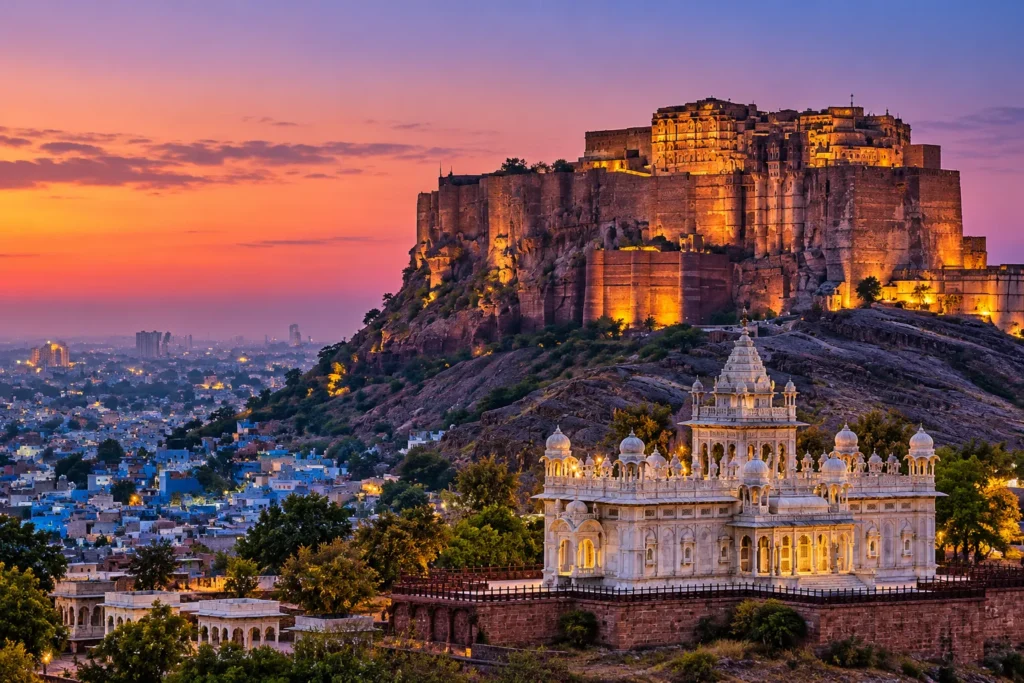
Allow: roughly half a day for a meaningful visit.
Mehrangarh should be the anchor of your Jodhpur itinerary.
The museum occupies historic palace spaces and contains collections covering paintings, textiles, arms, armour, decorative arts and royal objects. The official Mehrangarh Museum Trust currently lists museum hours as 09:00–17:00, with ticket sales closing at 17:00. Its current listed museum admission is ₹200 for domestic visitors and ₹800 for international visitors, with concession categories also available. These are time-sensitive figures and should be checked again before travel.
The official trust also advises that monument entry is permitted up to 30 minutes before closing and notes that holiday arrangements can change.
Planning tip: Don’t put the fort at the end of an overloaded sightseeing day. Give it the time it deserves.
Official Mehrangarh Museum Trust information and tickets
2. Jaswant Thada
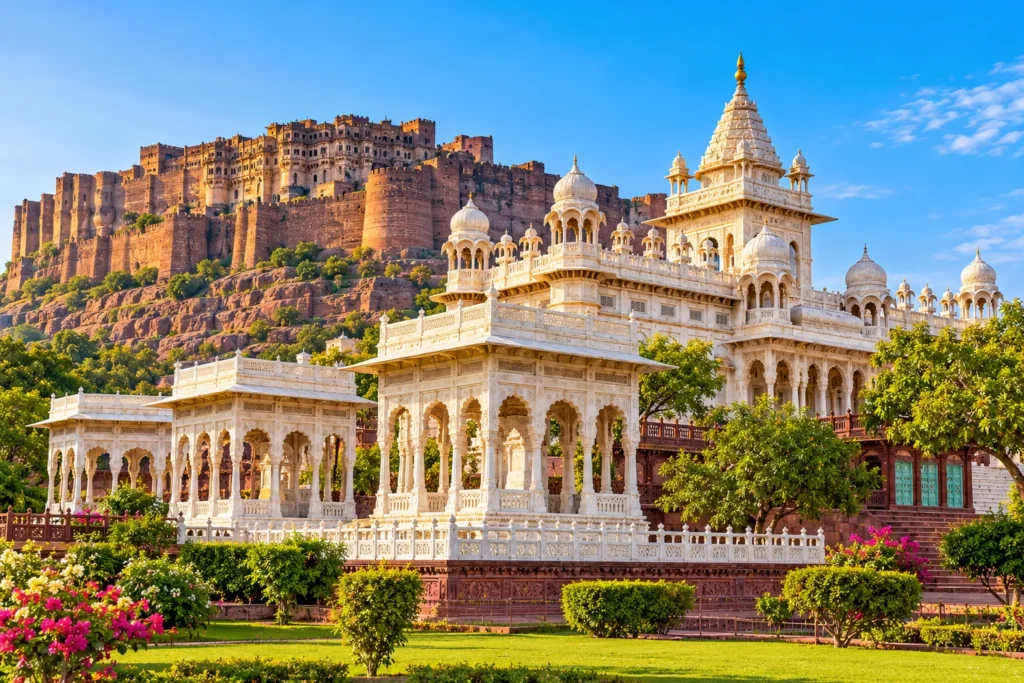
Jaswant Thada is a white-marble memorial associated with the Jodhpur royal family and makes a natural companion to Mehrangarh.
The Mehrangarh Museum Trust currently lists visiting hours as 09:00–17:00, with admission of ₹50 for domestic visitors and ₹100 for international visitors. Prices and timings can change, so verify them before your visit.
Its scale and atmosphere are very different from the fort, which is precisely why the two work well together.
3. Old City, Clock Tower and Sardar Market
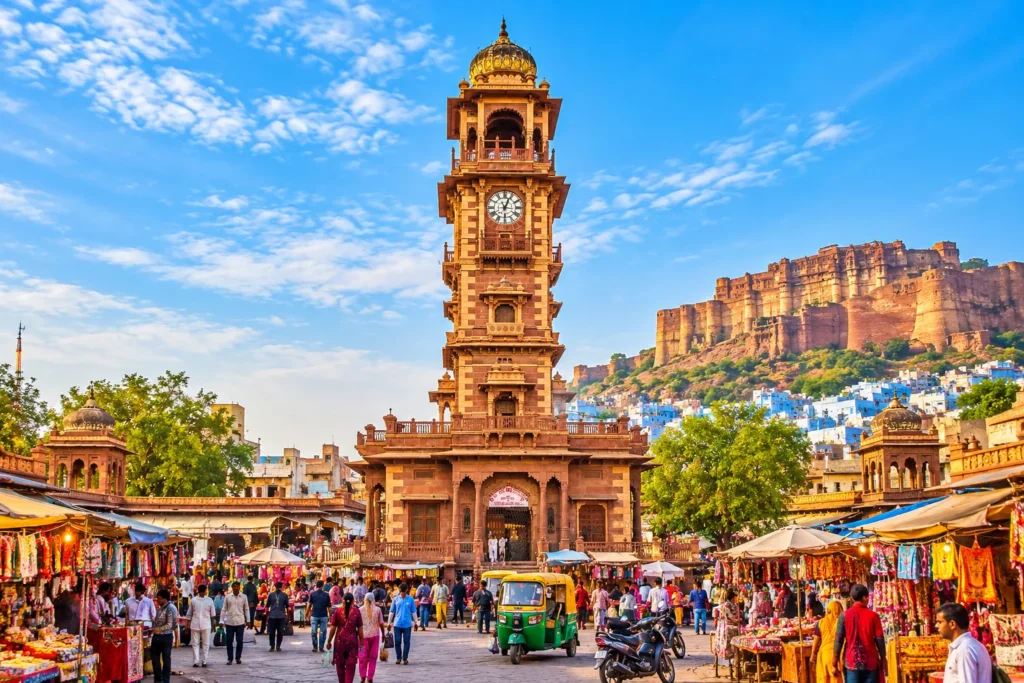
This is where to spend time between formal sightseeing stops.
The Clock Tower is a recognisable landmark, while Sardar Market spreads through the surrounding commercial lanes. Rajasthan Tourism identifies the Clock Tower as a starting or ending point for heritage walks through the Blue City.
Come here to browse rather than simply photograph the clock tower and leave.
4. Toorji Ka Jhalra
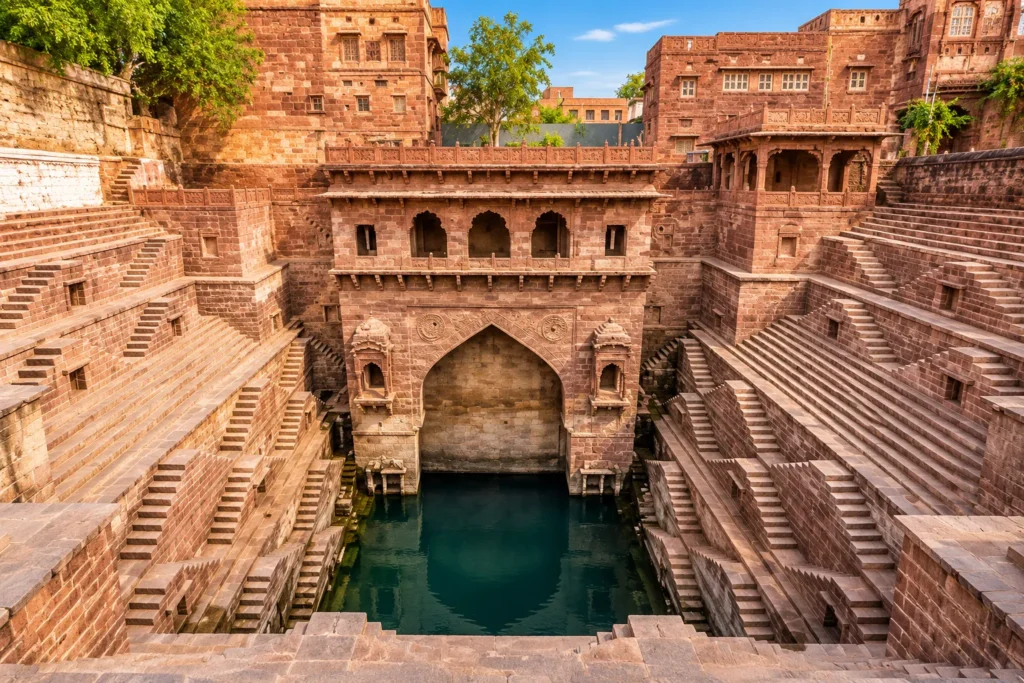
This historic stepwell is close to the Old City and makes an easy addition to a walking-focused afternoon.
Incredible India describes it as an 18th-century-era stepwell associated with Jodhpur’s historic water-management traditions and currently lists it as open 24 hours. Because access arrangements can change, check locally if you are planning a visit at an unusual hour.
5. Umaid Bhawan Palace Museum
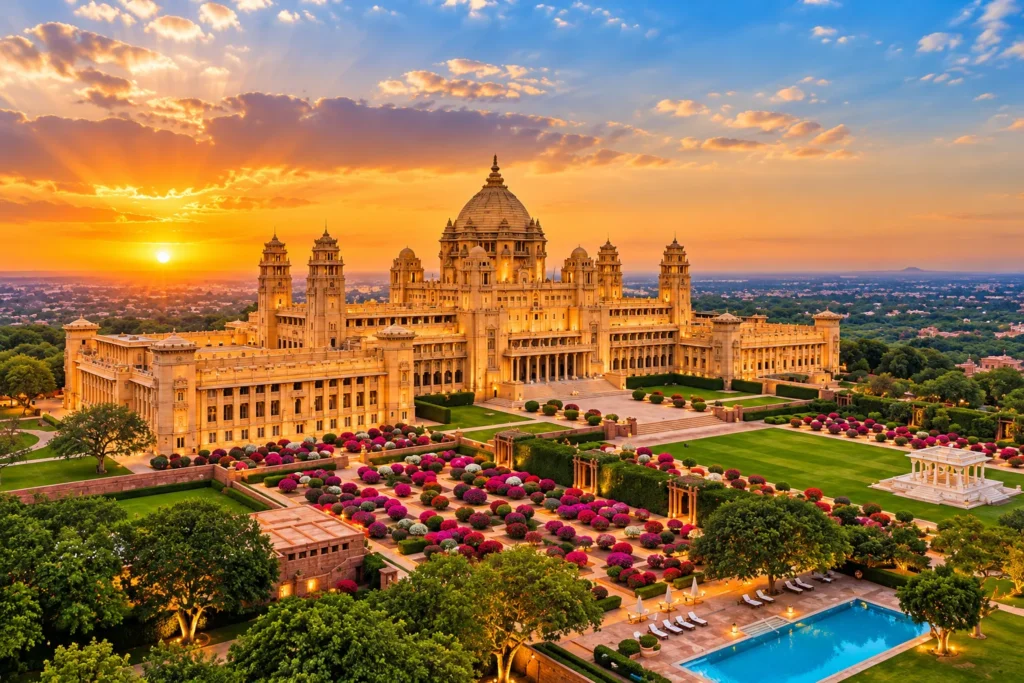
Umaid Bhawan gives you a different side of Jodhpur’s royal history.
Rajasthan Tourism notes that the palace was commissioned by Maharaja Umaid Singh during a period of famine and took many years to complete. Its architecture combines Indo-Saracenic, Classical Revival and Art Deco influences.
Only part of the complex is accessible to ordinary visitors, so think of this as a palace museum visit, not an opportunity to tour the entire private/residential property.
6. Rao Jodha Desert Rock Park
Immediately beside Mehrangarh, this park is useful for travellers who want to see the landscape around the fort rather than only its architecture.
The Mehrangarh Museum Trust says the park covers about 70 hectares and was created to restore the ecology of a rocky wasteland. Its currently listed admission is ₹100, with separate naturalist-guided walks available. Seasonal hours are currently listed as 07:00–18:30 from April to September and 08:00–17:30 from October to March.
Because the terrain is exposed and rocky, choose your timing with the weather in mind.
7. Mandore
Mandore was an earlier capital of the Marwar region and remains useful for understanding the history beyond Jodhpur’s best-known fort.
Rajasthan Tourism highlights its historic cenotaphs, temples, museum and other remains.
It is a good addition when you have a second full day or more.
How to reach Jodhpur
By air
Jodhpur has its own airport, operated under the Airports Authority of India.
The current AAI airport information provides an official flight-schedule page, but also warns that flight times are tentative and travellers should verify schedules with their airline.
AAI currently lists general taxi, prepaid taxi and car-rental services among the transport options at Jodhpur Airport.
For flights, don’t rely on a static travel guide for today’s route network. Search your actual travel date and confirm the flight directly with the airline.
Jodhpur Airport — Airports Authority of India
By train
Jodhpur Junction is one of the major practical entry points for travellers moving around Rajasthan and northern/western India.
Train availability and schedules are date-specific, so use the current Indian Railways/IRCTC booking system for your travel date rather than relying on fixed journey-time claims in a destination guide.
For a multi-city Rajasthan trip, train travel can be particularly useful because Jodhpur works naturally as a stop between other major destinations.
By road
Road travel is convenient when Jodhpur forms part of a private-car or self-drive Rajasthan itinerary.
It is particularly useful if you want flexibility for stops between cities or plan to combine Jodhpur with nearby destinations.
For long road journeys, compare the total driving time with train or flight options rather than choosing a car simply because a kilometre figure looks manageable.
How to get around Jodhpur
You do not need a car for every part of Jodhpur.
Walking
Walking works best in the Old City, particularly around:
- Clock Tower
- Sardar Market
- Toorji Ka Jhalra
- nearby historic lanes
The lanes can be uneven, crowded and occasionally congested, so comfortable footwear matters.
Auto-rickshaws
Autos are useful for short urban journeys and places where walking is inconvenient.
Agree on the fare before departure if the ride is not metered or booked through an app.
Taxi or app-based cab
A car is more useful for:
- airport transfers
- Umaid Bhawan
- Mandore
- attractions spread farther apart
- day trips outside the city
You generally do not need a private car sitting with you throughout an Old City sightseeing day.
A practical combination
For many visitors, the most efficient arrangement is:
walk + auto/taxi for short transfers + a car only when visiting outlying attractions or taking a day trip.
Where to stay in Jodhpur
The right area depends more on your travel style than on finding the single “best” neighbourhood.
Old City / Clock Tower area
Best for: first-time visitors, atmosphere, markets, short stays and travellers who want to walk to many sights.
Advantages:
- close to Sardar Market
- easy access to the historic lanes
- plenty of heritage-style accommodation
- strong choice for fort/Old City sightseeing
Trade-offs:
- busy streets
- traffic and noise
- narrow lanes can make vehicle access awkward
- not every property is equally convenient for luggage or cars
If the atmosphere is your priority, this is the obvious area to investigate first.
Near Mehrangarh / Fort Road
Best for: travellers prioritising fort access and views.
This area can be particularly appealing if your accommodation has a genuine fort-facing outlook.
Check vehicle access carefully before booking. A spectacular location is less useful if getting luggage to the property is difficult.
Ratanada
Best for: travellers who prefer a more conventional urban base, families and people who want easier road access.
Ratanada is less immersed in the historic atmosphere than the Old City but can make practical sense for a longer stay.
Sardarpura
Best for: restaurants, shopping and a more modern city environment.
It is a useful alternative if you don’t specifically want to sleep in the historic core.
How to choose
First two-night trip, start your hotel search around the Old City if you value the atmosphere.
For a family or longer stay, prioritise easy road access, quieter surroundings and room comfort.
For a luxury-focused trip, look at heritage and palace properties outside the most congested Old City lanes.
Hotel rates vary substantially by date, room type, season, events and booking conditions, so this guide deliberately does not quote a supposedly universal “Jodhpur hotel price.”
What to eat in Jodhpur
Jodhpur’s food culture is particularly well suited to grazing through small portions rather than treating every meal as a formal restaurant occasion.
Mirchi bada
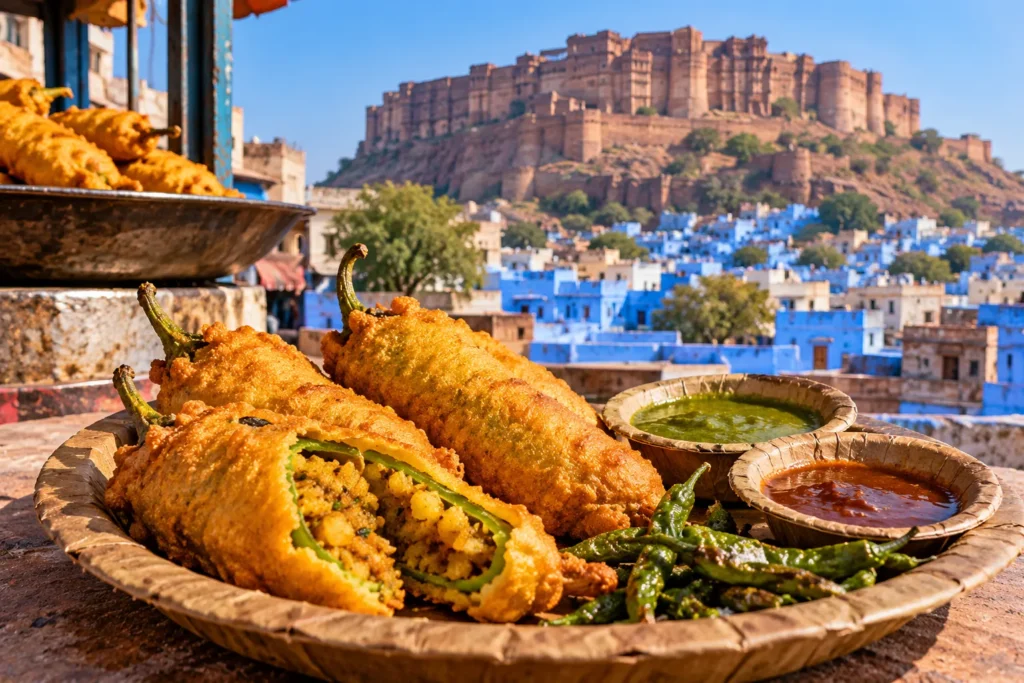
A battered, fried green chilli filled with spiced potato. It is one of the city’s best-known snacks and is specifically highlighted by Incredible India.
Pyaaz kachori
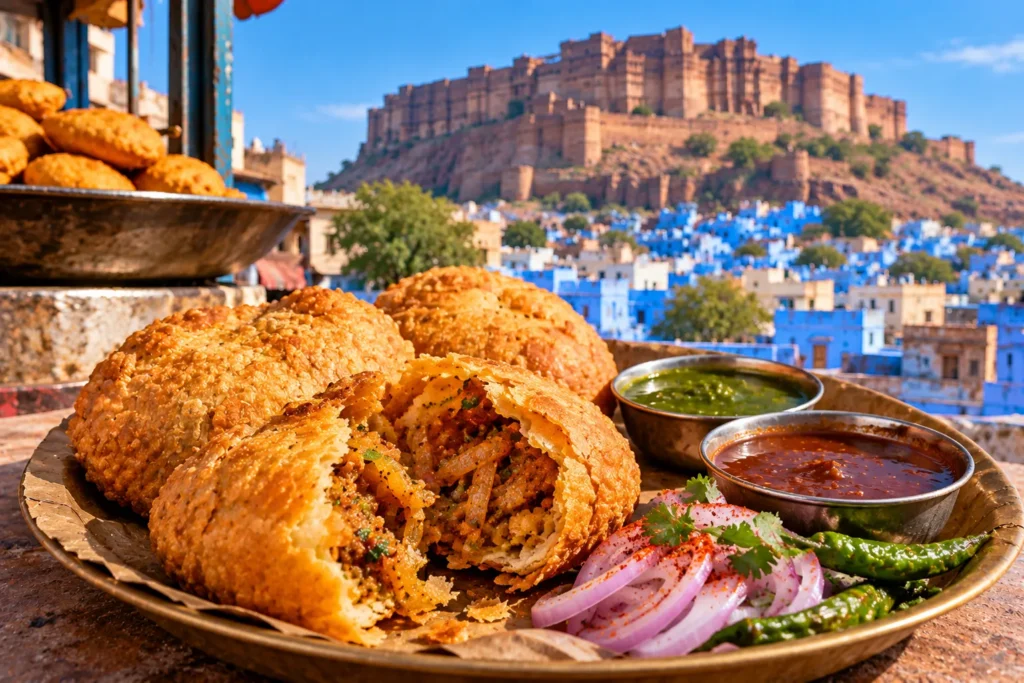
A crisp, deep-fried pastry filled with a spiced onion mixture.
Have it as a breakfast or snack rather than assuming every local speciality needs to appear on a dinner plate.
Mawa kachori
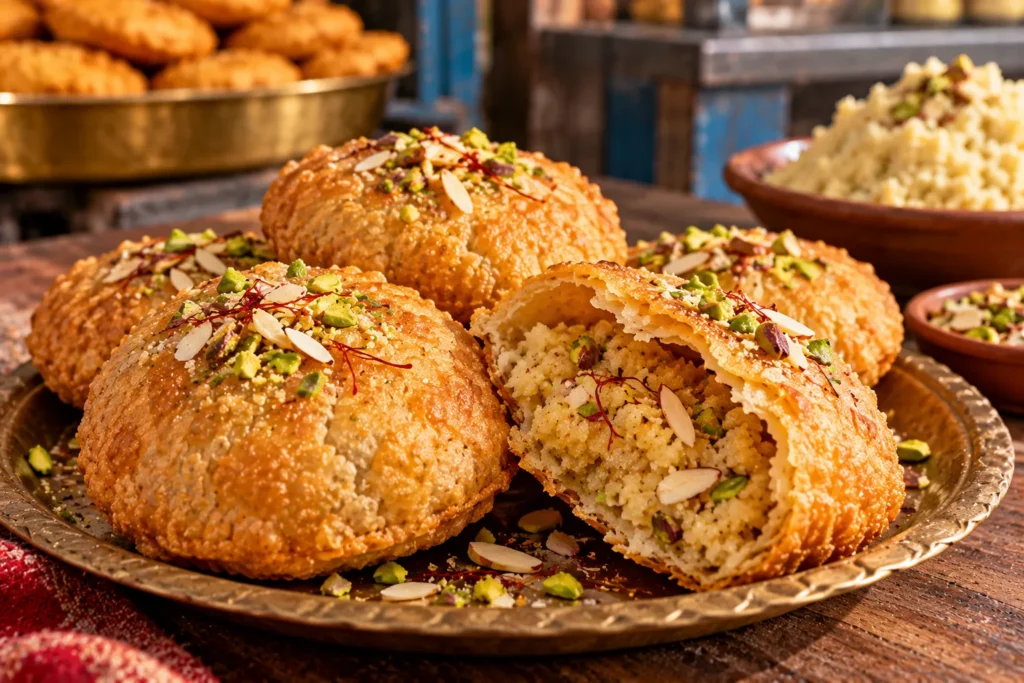
A sweeter kachori variation associated with Rajasthan and Jodhpur’s snack culture.
Makhaniya lassi
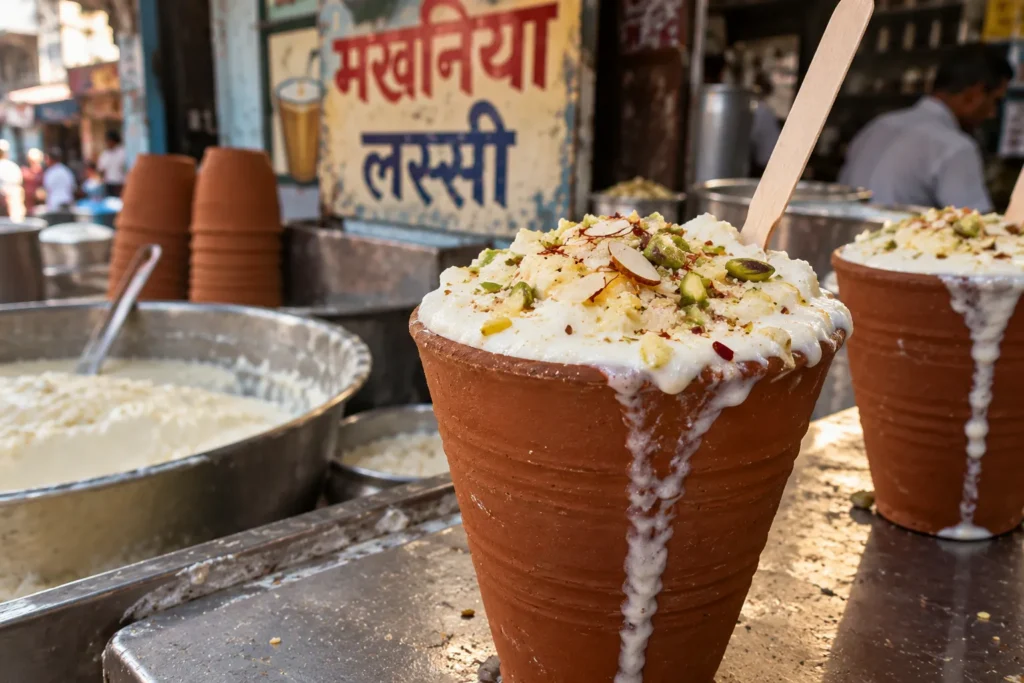
A rich, sweet lassi traditionally topped with ingredients such as cream, butter and dry fruits. Incredible India identifies it as one of Jodhpur’s signature food experiences.
Rajasthani thali and regional dishes
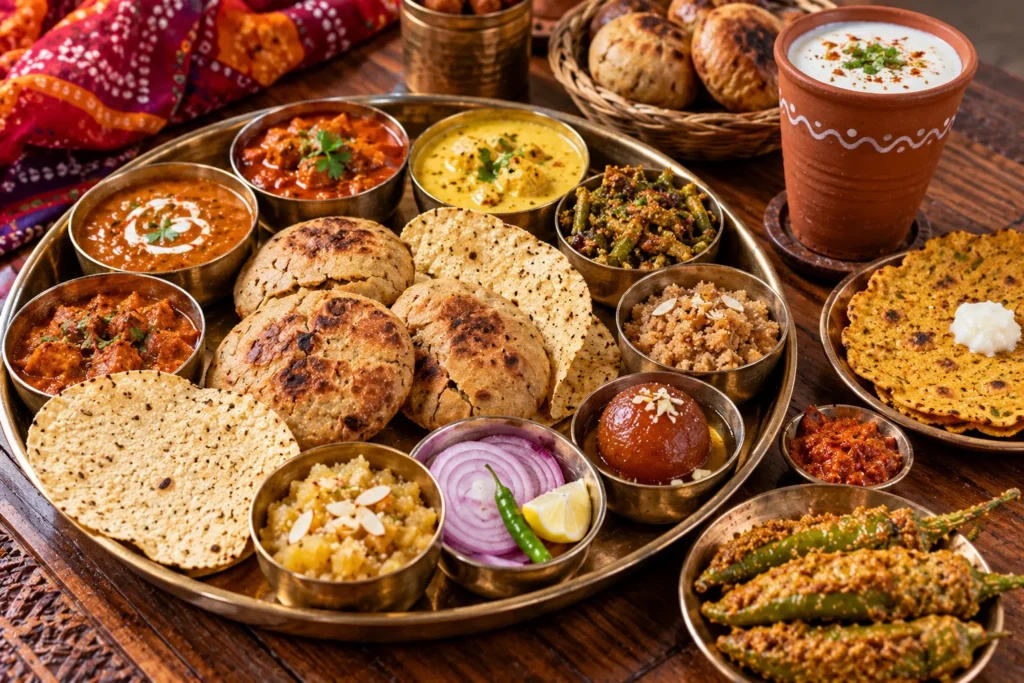
If you want a proper meal rather than street food, look for a Rajasthani thali and dishes such as dal baati churma, gatte ki sabzi and ker sangri.
For non-vegetarian diners, laal maas is another well-known Rajasthani dish, though recipes and spice levels vary considerably.
Food tip
For street food, I prefer busy stalls with high turnover. You can sample more than one speciality without committing to a huge meal.
Shopping in Jodhpur
Shopping is most interesting when you treat Jodhpur’s markets as working commercial areas rather than a single tourist bazaar.
Sardar Market
Near the Clock Tower, Sardar Market is a natural starting point for browsing spices, textiles, jewellery, handicrafts and other goods. Rajasthan Tourism specifically highlights the market’s traditional clothing, spices and jewellery.
Nai Sarak
Incredible India identifies Nai Sarak with bandhej/bandhani textiles and leather goods.
Mochi Bazaar
A useful area to investigate if you want traditional Jodhpuri footwear such as mojaris/juttis.
Sojati Gate
Useful for handicrafts, souvenirs, textiles and local shopping.
What to buy
Depending on your interests, look for:
- bandhani/bandhej textiles
- leheriya textiles
- mojari footwear
- silver jewellery
- spices
- handicrafts
- leather goods
- traditional decorative pieces
Quality varies, particularly with textiles and jewellery. Compare several shops before buying anything expensive.
How much does a Jodhpur trip cost?
There is no single meaningful “Jodhpur trip cost” because accommodation, travel class, dining style and sightseeing choices can change the total dramatically.
The figures below are planning estimates rather than quoted current prices. They exclude your journey to and from Jodhpur and are intended to help build a budget, not to represent guaranteed market rates.
Budget-conscious traveller
Assumptions:
- simple guesthouse/budget room
- local meals and snacks
- walking plus autos
- mostly self-guided sightseeing
- standard attraction admissions
Planning range: roughly ₹2,000–₹3,500 per person per day, excluding intercity travel.
Comfortable mid-range trip
Assumptions:
- comfortable hotel or heritage-style property
- mix of local food and restaurants
- taxis/ride-hailing for some sightseeing
- paid attractions
- occasional guided experience
Planning range: roughly ₹4,000–₹7,000 per person per day, excluding intercity travel and assuming two people share a room.
Higher-end trip
A palace or luxury heritage hotel, private vehicle, private guide and higher-end dining can move the cost far beyond these ranges.
Rather than publishing a misleading fixed number, check live accommodation and transport prices for your dates.
A useful way to build your own budget
Calculate:
Accommodation + food + local transport + attraction tickets + activities + contingency
Then add your flight/train to Jodhpur separately.
As a reference point, the official Mehrangarh Museum Trust currently lists domestic museum admission at ₹200 and international admission at ₹800, while Jaswant Thada is currently ₹50 for domestic visitors and ₹100 for international visitors. These figures are subject to change.
Practical Jodhpur travel tips
Start outdoor sightseeing early
This matters even outside summer.
Fort walls, open parks, market lanes and exposed viewpoints can become tiring in direct sun. Put your longest outdoor activity in the cooler part of the day whenever practical.
Wear proper shoes
Jodhpur sightseeing involves stone surfaces, steps, uneven lanes and walking through markets.
Comfortable shoes will serve you better than footwear chosen purely for photographs.
Carry water
Keep water with you, especially when exploring the fort and exposed areas around it.
Dress appropriately for religious and heritage sites
Carry clothing that is respectful for temples, religious spaces and memorial sites. A lightweight scarf or shawl can also be useful.
Don’t assume every blue house is a tourist attraction
The Blue City is a residential neighbourhood.
Photograph public streets and architecture respectfully, and don’t enter private homes or photograph residents closely without permission.
Leave room for food stops
A Jodhpur itinerary can become unnecessarily rigid if every hour is assigned to a monument.
The Old City is best experienced with time to stop for a snack, browse a shop or sit somewhere for a drink.
Check official timings immediately before visiting
Opening hours and ticket prices are particularly vulnerable to changes around festivals, holidays, maintenance and special events.
The Mehrangarh Museum Trust, for example, currently publishes its own ticket and timing information and notes that holiday arrangements can differ.
Jodhpur itinerary: 1 day, 2 days or 3 days
One-day Jodhpur itinerary
This is the version to use if Jodhpur is a short stop.
Morning: Mehrangarh Fort
Start with Mehrangarh before the day’s heat builds.
Spend enough time inside the museum and palace areas rather than treating the fort as a quick photo stop.
Late morning: Jaswant Thada
Continue to Jaswant Thada after the fort.
The two sights work naturally together geographically and historically.
Afternoon: rest and lunch
Have lunch and take a break during the hottest part of the day.
Late afternoon: Old City
Explore:
- Clock Tower
- Sardar Market
- Toorji Ka Jhalra
- selected Old City lanes
Finish with a local snack or dinner.
What to skip: trying to force Umaid Bhawan, Mandore and every possible viewpoint into the same day.
Two-day Jodhpur itinerary
Day 1: Fort + Old City
Morning
- Mehrangarh Fort
- museum and palace interiors
Late morning
- Jaswant Thada
Afternoon
- lunch
- rest
Late afternoon/evening
- Clock Tower
- Sardar Market
- Toorji Ka Jhalra
- Old City exploration
- dinner
This day gives Jodhpur’s history and historic core priority.
Day 2: Palace + landscape + markets
Morning
- Umaid Bhawan Palace Museum
Late morning/afternoon
- lunch
- additional market or city sightseeing
Later afternoon
- Rao Jodha Desert Rock Park, subject to current opening hours and weather
Evening
- return to the Old City or spend the evening around your accommodation
This is deliberately less packed than many online itineraries. Two days work better when you don’t spend them racing between ten attractions.
Optional three-day Jodhpur itinerary
Use the third day for a single nearby experience rather than adding another long list of city sights.
Possible options include:
- Osian for temples and desert scenery
- Bishnoi-region experiences for rural and cultural encounters
- Khejarli and surrounding villages for Marwar’s environmental and community history
- another slower day in Jodhpur if you prefer not to travel
For dedicated planning, see the site’s separate guides on:
- Jodhpur to Osian
- Bishnoi village Jodhpur
- Jodhpur Blue City walking route
- Jodhpur to Jaisalmer
Those guides should contain the detailed routes, transport options and practical logistics rather than duplicating them here.
Nearby places and day trips from Jodhpur
Jodhpur works well as a base for exploring parts of the wider Marwar region.
Osian
Known for historic temples and desert surroundings. It can work as a half- or full-day excursion depending on what you want to see.
For detailed transport, timing and route planning, use the dedicated Jodhpur to Osian guide.
Bishnoi region
The villages and landscapes around Jodhpur offer a different perspective on Marwar, particularly for travellers interested in rural life, craft and environmental traditions.
Use the dedicated Bishnoi village Jodhpur guide for the practical details.
Jaisalmer
Jodhpur is frequently paired with Jaisalmer in Rajasthan itineraries.
Because the journey between the two is substantial enough to affect your itinerary, see the dedicated Jodhpur to Jaisalmer guide rather than treating it as a casual day trip.
Other Marwar experiences
Depending on time, travellers can also look towards Mandore, Khejarli, local craft communities and other sites around the Jodhpur region.
The key is not to turn every nearby place into another rushed checklist.
Jodhpur travel FAQs
1. Is Jodhpur worth visiting?
Yes, particularly if you are interested in forts, Marwar history, architecture, food and traditional markets. The combination of Mehrangarh Fort, the historic Old City and blue-painted neighbourhoods gives Jodhpur a distinctive character within a Rajasthan itinerary.
2. How many days are enough for Jodhpur?
Two full days is a practical recommendation for a first visit. One day covers the major highlights at a faster pace, while three days allows time for a nearby excursion or a slower city experience.
3. What is Jodhpur famous for?
Jodhpur is best known for Mehrangarh Fort, its blue-painted Old City, Marwar heritage, Umaid Bhawan Palace, traditional markets and local food.
4. Why is Jodhpur called the Blue City?
The nickname comes from the concentration of blue-painted houses in the historic city below Mehrangarh. The exact historical reason for the colour is disputed, with commonly cited explanations involving Brahmin households, traditional lime washes, cooling and protection against insects.
5. What is the best month to visit Jodhpur?
For comfortable sightseeing, November through February is generally a particularly attractive part of the October–March travel window. October and March can also work, but temperatures are more variable.
3 responses to “Jodhpur Travel Guide: Blue City, Mehrangarh Fort & the Best of Marwar”
[…] Also Read: Jodhpur Travel Guide: Blue City, Mehrangarh Fort & the Best of Marwar […]
[…] Also Read: Jodhpur Travel Guide: Blue City, Mehrangarh Fort & the Best of Marwar […]
[…] Also Read: Jodhpur Travel Guide: Blue City, Mehrangarh Fort & the Best of Marwar […]