


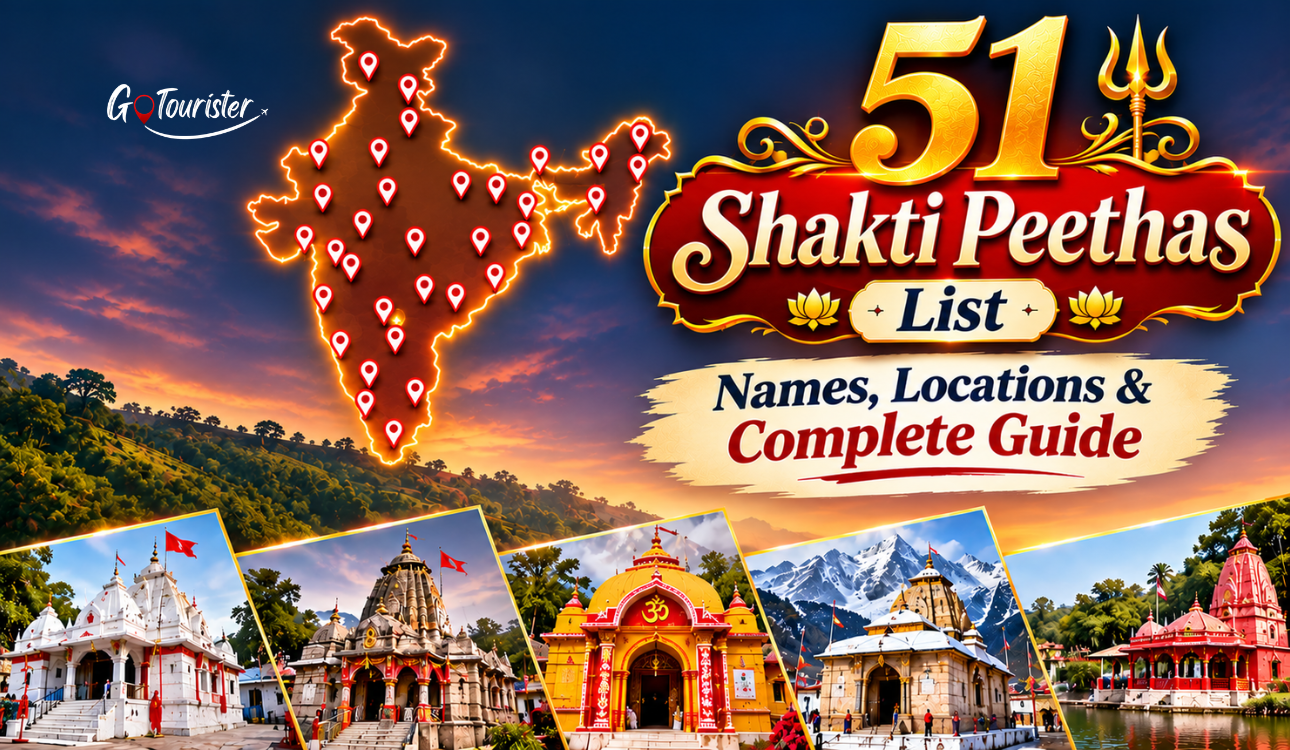
The 51 Shakti Peethas are among the most sacred pilgrimage destinations in Hinduism. Dedicated to Goddess Shakti, these holy sites are associated with the divine story of Goddess Sati and Lord Shiva. Spread across India and neighbouring countries, the Shakti Peethas hold immense religious, cultural and spiritual importance for devotees of Goddess Durga, Kali, Parvati and other forms of the Divine Mother.
According to Hindu mythology, the Shakti Peethas were established at the places where different parts of Goddess Sati’s body or ornaments fell after Lord Vishnu used his Sudarshan Chakra to separate her body from Lord Shiva while he was carrying it across the universe.
Each Shakti Peetha is associated with a particular form of Goddess Shakti and a Bhairava, a manifestation of Lord Shiva. Devotees visit these temples to seek blessings, spiritual strength, protection, prosperity and peace.
Although different Hindu scriptures and regional traditions mention 51, 52, 64 or even 108 Shakti Peethas, the list of 51 remains one of the most widely followed traditions.
What Are the 51 Shakti Peethas?
The word Shakti means divine feminine energy, while Peetha refers to a sacred seat or spiritual centre. Therefore, Shakti Peethas are considered the sacred seats of Goddess Shakti.
According to the traditional account, King Daksha organised a grand yajna but deliberately did not invite his daughter Sati and her husband, Lord Shiva. Despite Shiva’s objections, Sati attended the ceremony, where Daksha insulted Shiva.
Unable to tolerate the humiliation of her husband, Goddess Sati sacrificed herself in the yajna fire.
When Lord Shiva learned about her death, he became overwhelmed with grief and began performing the destructive Tandava while carrying Sati’s body. To protect the universe from destruction, Lord Vishnu used his Sudarshan Chakra to divide the body. The places where the body parts and ornaments fell became sacred Shakti Peethas.
These locations gradually developed into important centres of Shakti worship.
Complete List of 51 Shakti Peethas with Locations
The following table presents a commonly followed traditional list of 51 Shakti Peethas, including their associated locations. Some ancient names have multiple modern geographical identifications, and a few locations remain disputed among religious traditions.
| No. | Shakti Peetha | Location |
|---|---|---|
| 1 | Hinglaj | Balochistan, Pakistan |
| 2 | Karavira (Kolhapur) | Kolhapur, Maharashtra |
| 3 | Sugandha | Shikarpur, Bangladesh |
| 4 | Kashmir | Kashmir region |
| 5 | Jwalamukhi | Kangra, Himachal Pradesh |
| 6 | Jalandhar | Jalandhar, Punjab |
| 7 | Vaidyanath | Deoghar, Jharkhand |
| 8 | Nepal | Kathmandu Valley, Nepal |
| 9 | Manasa | Near Mansarovar, Tibet |
| 10 | Viraja | Jajpur, Odisha |
| 11 | Gandaki | Gandaki region, Nepal |
| 12 | Bahula | Ketugram, West Bengal |
| 13 | Ujjayini | Ujjain, Madhya Pradesh |
| 14 | Chattal | Sitakunda, Bangladesh |
| 15 | Tripura | Udaipur, Tripura |
| 16 | Trisrota | Jalpaiguri region, West Bengal |
| 17 | Kamagiri (Kamakhya) | Guwahati, Assam |
| 18 | Yugadya | Kshirgram, West Bengal |
| 19 | Kalipitha | Kalighat, Kolkata, West Bengal |
| 20 | Prayaga | Prayagraj, Uttar Pradesh |
| 21 | Jayanti | Nartiang, Meghalaya |
| 22 | Kirita | Kiritkona, Murshidabad, West Bengal |
| 23 | Varanasi | Varanasi, Uttar Pradesh |
| 24 | Kanyashrama | Kanyakumari, Tamil Nadu |
| 25 | Kurukshetra | Kurukshetra, Haryana |
| 26 | Manivedika | Pushkar, Rajasthan |
| 27 | Shrishaila | Srisailam, Andhra Pradesh |
| 28 | Kanchi | Kanchipuram, Tamil Nadu |
| 29 | Kalamadhava | Central India, identification disputed |
| 30 | Shona | Amarkantak region, Madhya Pradesh |
| 31 | Ramagiri | Chitrakoot region, identification disputed |
| 32 | Vrindavan | Vrindavan, Uttar Pradesh |
| 33 | Shuchi | Suchindram, Tamil Nadu |
| 34 | Panchasagara | Exact location disputed |
| 35 | Karatoya-tata | Bogura region, Bangladesh |
| 36 | Shriparvata | Location disputed; multiple regional identifications |
| 37 | Vibhasha | Tamluk, West Bengal |
| 38 | Prabhasa | Somnath, Gujarat |
| 39 | Bhairava-parvata | Ujjain, Madhya Pradesh |
| 40 | Janasthana | Nashik, Maharashtra |
| 41 | Godavari-tira | Godavari river region, Andhra Pradesh |
| 42 | Ratnavali | Khanakul region, Hooghly, West Bengal |
| 43 | Mithila | Mithila region, India–Nepal |
| 44 | Nalahati | Nalhati, West Bengal |
| 45 | Kalighata | Kalighat, Kolkata, West Bengal |
| 46 | Vakreshvara | Bakreshwar, West Bengal |
| 47 | Yashora | Jessore region, Bangladesh |
| 48 | Attahasa | Labhpur, West Bengal |
| 49 | Nandipura | Sainthia, West Bengal |
| 50 | Lanka | Trincomalee, Sri Lanka |
| 51 | Virata | Viratnagar, Rajasthan |
Important: This is one traditional identification of the 51 Peethas, not a universally agreed geographical register. Names such as Karavira, Shriparvata, Kashmir, Ramagiri and Panchasagara have competing identifications. The precise temple and associated body part can differ between scriptures and regional traditions.
Major Shakti Peethas in India
India is home to several prominent Shakti Peethas that attract millions of devotees every year. Some temples are particularly important for their ancient history, religious traditions and annual festivals.
1. Kamakhya Temple – Assam
Located on Nilachal Hill in Guwahati, the Kamakhya Temple is one of the most important centres of Shakti worship in India. It is associated with the yoni of Goddess Sati and is a major pilgrimage destination for followers of Shaktism and Tantra.
The temple is especially famous for the annual Ambubachi Mela, which celebrates the symbolic menstruation of Goddess Kamakhya.
2. Kalighat Temple – West Bengal
The Kalighat Kali Temple in Kolkata is one of the most recognised religious destinations associated with Goddess Kali. It is traditionally connected with the Shakti Peetha at Kalighat and attracts devotees throughout the year.
Kali Puja and Durga Puja are among the major occasions when the temple receives large numbers of visitors.
3. Jwalamukhi Temple – Himachal Pradesh
Situated in Kangra district, the Jwalamukhi Temple is famous for its naturally burning flames that emerge from openings in the rock.
Unlike many other Hindu temples, the main form of worship here centres on the sacred flames rather than a conventional idol. The temple is associated with the tongue of Goddess Sati in popular Shakti Peetha traditions.
4. Mahakaleshwar Region and Harsiddhi Temple – Madhya Pradesh
Ujjain is an important spiritual destination in Madhya Pradesh. The Harsiddhi Temple is associated with Goddess Shakti and is traditionally identified with the Ujjayini Peetha.
The city is also famous for the Mahakaleshwar Jyotirlinga, making it an important destination for devotees visiting multiple sacred sites.
5. Vishalakshi Temple – Uttar Pradesh
Located near Manikarnika Ghat in Varanasi, the Vishalakshi Temple is dedicated to Goddess Vishalakshi.
Varanasi is considered one of the holiest cities in Hinduism, and the temple forms an important part of the city’s Shakti worship tradition.
6. Hinglaj Mata Temple – Pakistan
Hinglaj Mata Temple is situated in the Hingol National Park area of Balochistan, Pakistan. It is one of the most significant Shakti pilgrimage destinations outside India.
The temple is particularly important to Hindu communities in Pakistan and devotees who travel from different parts of the subcontinent.
Why Are the 51 Shakti Peethas Important?
The 51 Shakti Peethas represent the different manifestations of divine feminine energy. Each temple has its own mythology, traditions, rituals and religious significance.
For devotees, visiting these sacred locations is an opportunity to strengthen their spiritual connection with Goddess Shakti.
The importance of the Shakti Peethas can be understood through several aspects:
Spiritual significance: Devotees believe that worshipping at these sacred sites helps them seek divine blessings, inner strength and spiritual development.
Cultural heritage: Many Shakti Peethas preserve centuries-old traditions, regional architecture, festivals and forms of worship.
Religious diversity: The temples demonstrate how Goddess Shakti is worshipped through different names and manifestations across India and neighbouring regions.
Pilgrimage traditions: Visiting these temples is an important religious journey for many Hindu families, particularly during Navratri and other festivals dedicated to the Goddess.
Best Time to Visit Shakti Peethas
The best time to visit Shakti Peethas depends on their geographical location, weather conditions and temple festivals.
Navratri, generally celebrated twice a year, is one of the most important periods for visiting temples dedicated to Goddess Durga and Shakti.
Other important occasions include:
- Chaitra Navratri: Celebrated during March or April.
- Sharad Navratri: Celebrated during September or October.
- Durga Puja: Particularly significant in West Bengal and eastern India.
- Kali Puja: Celebrated with great devotion in West Bengal.
- Ambubachi Mela: A major annual festival at Kamakhya Temple in Assam.
For comfortable travel, devotees should also consider regional weather. Summer can be challenging in several parts of India, while monsoon conditions may affect travel to hilly and remote temples.
FAQs
How many Shakti Peethas are there in Hinduism?
The most widely known traditional list includes 51 Shakti Peethas. However, different religious scriptures and traditions mention 52, 64 and 108 Peethas.
Which is the most powerful Shakti Peetha?
There is no universally accepted ranking of Shakti Peethas. Kamakhya, Kalighat, Jwalamukhi, Hinglaj and other major temples are highly revered by devotees.
Which Shakti Peethas are located outside India?
Important traditional Shakti Peetha locations outside present-day India include Hinglaj in Pakistan, Sugandha and Jessore in Bangladesh, locations in Nepal and Tibet, and Lanka in Sri Lanka.
Which Shakti Peetha is located in Gujarat?
Prabhas Shakti Peetha is traditionally associated with the Somnath region of Gujarat. Some traditions also identify Karavira with Kolhapur, Maharashtra, while alternative identifications exist.
Are the 51 Shakti Peethas and 18 Maha Shakti Peethas the same?
No. The 51 Shakti Peethas belong to a broader traditional enumeration, while the 18 Maha Shakti Peethas are a separate list of prominent sacred seats celebrated in the Ashtadasha Shakti Peetha Stotram.
Can devotees visit all 51 Shakti Peethas?
Devotees can plan a pilgrimage covering many of the recognised sites. However, some locations are outside India, some are difficult to access, and a few have disputed modern identifications.
Conclusion
The 51 Shakti Peethas represent one of the most important pilgrimage traditions in Hinduism. From Kamakhya in Assam and Kalighat in West Bengal to Hinglaj in Pakistan and the sacred sites of Nepal and Sri Lanka, these temples preserve the spiritual legacy of Goddess Sati and Goddess Shakti.
Every Peetha has its own identity, mythology and religious importance. For devotees, exploring these sacred destinations is not simply a temple visit but a journey through India’s ancient spiritual and cultural heritage.
One response to “51 Shakti Peethas List: Names, Locations & Complete Guide”
[…] devotees search for both the 18 Maha Shakti Peethas and the 51 Shakti Peethas. Although both traditions are connected with Goddess Sati and Goddess Shakti, they represent […]