


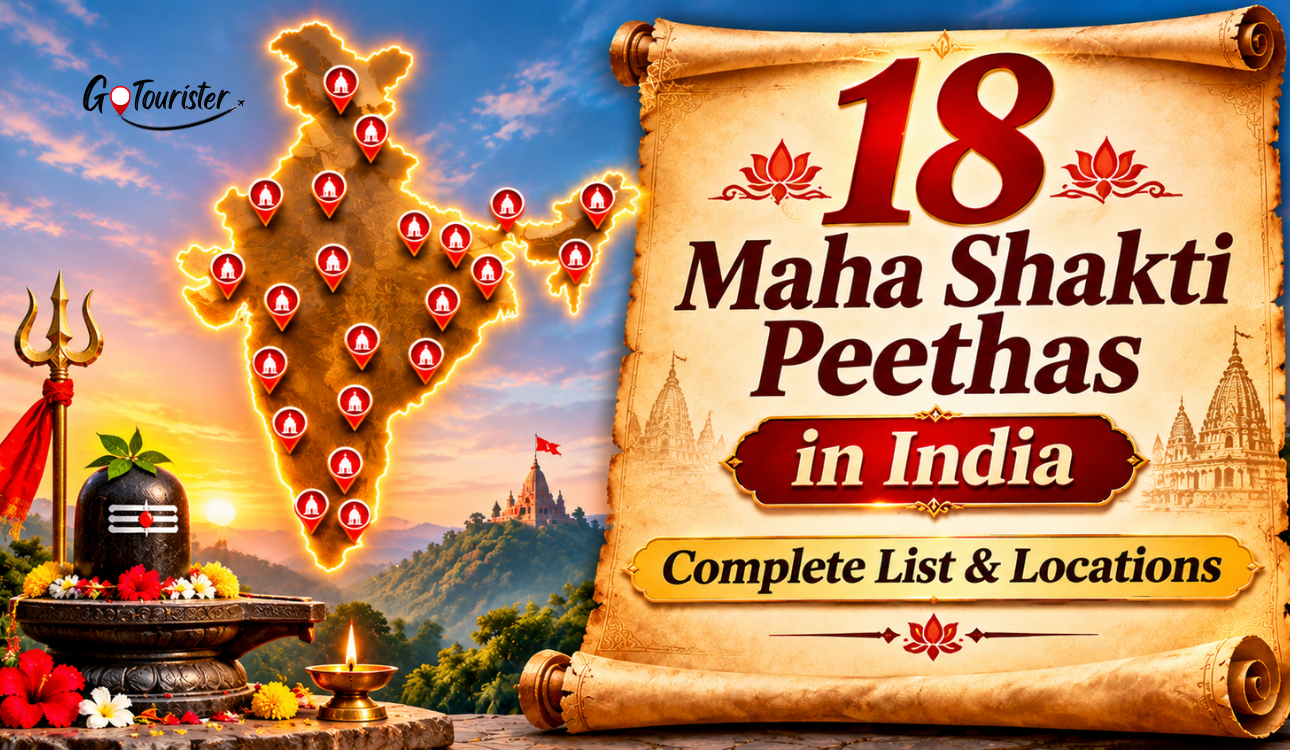
The 18 Maha Shakti Peethas, also known as Ashtadasha Maha Shakti Peethas, are among the most revered sacred destinations dedicated to Goddess Shakti in Hinduism. These temples represent the divine feminine energy and are worshipped by millions of devotees across India and other parts of the Indian subcontinent.
The eighteen sacred sites are described in the Ashtadasha Shakti Peetha Stotram, a Sanskrit devotional hymn traditionally attributed to Adi Shankaracharya. The hymn celebrates eighteen important manifestations of Goddess Shakti, including Kamakshi in Kanchipuram, Kamakhya in Assam, Mahalakshmi in Kolhapur, Jogulamba in Telangana and Vishalakshi in Varanasi.
Unlike the broader traditional list of 51 Shakti Peethas, the Ashtadasha list specifically identifies eighteen prominent sacred seats of the Goddess.
An important geographical clarification is that all eighteen are not located within present-day India. The traditional list includes Shankari Devi in Sri Lanka and Saraswati at Sharada Peeth in the Pakistan-administered region of Kashmir. The remaining sixteen are traditionally associated with locations in India.
What Are the 18 Maha Shakti Peethas?
The word Ashtadasha means eighteen in Sanskrit, while Shakti Peetha refers to a sacred seat of the Divine Mother.
The eighteen Maha Shakti Peethas are associated with different manifestations of Goddess Parvati, Durga, Kali, Lakshmi and Saraswati. Each shrine has its own religious traditions, historical importance and regional identity.
These temples are considered important centres of Shakti worship. Devotees visit them to seek blessings for prosperity, good health, knowledge, protection and spiritual growth.
The Ashtadasha Shakti Peetha Stotram is particularly important because it names eighteen sacred locations and their associated forms of the Goddess.
Complete List of 18 Maha Shakti Peethas with Locations
Here is the traditional list of all eighteen Maha Shakti Peethas, including their associated Goddess and present-day geographical location.
| No. | Maha Shakti Peetha | Goddess | Location |
|---|---|---|---|
| 1 | Shankari Devi | Shankari | Trincomalee, Sri Lanka |
| 2 | Kamakshi Amman | Kamakshi | Kanchipuram, Tamil Nadu |
| 3 | Shrinkhala Devi | Shrinkhala | Traditionally associated with Pradyumna, West Bengal |
| 4 | Chamundeshwari | Chamundi | Mysuru, Karnataka |
| 5 | Jogulamba | Jogulamba | Alampur, Telangana |
| 6 | Bhramaramba | Bhramarambika | Srisailam, Andhra Pradesh |
| 7 | Mahalakshmi | Mahalakshmi | Kolhapur, Maharashtra |
| 8 | Ekaveerika | Ekaveera / Renuka | Mahur, Maharashtra |
| 9 | Mahakali | Mahakali | Ujjain, Madhya Pradesh |
| 10 | Puruhutika | Puruhutika | Pithapuram, Andhra Pradesh |
| 11 | Girija | Girija / Biraja | Jajpur, Odisha |
| 12 | Manikyamba | Manikyamba | Draksharamam, Andhra Pradesh |
| 13 | Kamakhya | Kamakhya | Guwahati, Assam |
| 14 | Madhaveshwari | Madhaveshwari | Prayagraj, Uttar Pradesh |
| 15 | Vaishnavi | Vaishnavi | Jwalamukhi, Himachal Pradesh |
| 16 | Mangala Gauri | Mangala Gauri | Gaya, Bihar |
| 17 | Vishalakshi | Vishalakshi | Varanasi, Uttar Pradesh |
| 18 | Saraswati | Saraswati / Sharada | Sharada Peeth, Pakistan-administered Kashmir |
Note: The names and geographical identifications of certain Peethas, particularly Shrinkhala, Shankari and Saraswati, have variations across traditional accounts. The table follows a commonly circulated version of the Ashtadasha Shakti Peetha Stotram.
18 Maha Shakti Peethas: History and Significance of Each Temple
1. Shankari Devi Temple – Trincomalee, Sri Lanka
Shankari Devi is traditionally identified with one of the eighteen Maha Shakti Peethas and is associated with Trincomalee in the eastern province of Sri Lanka.
The temple is connected with the worship of Goddess Shankari, a manifestation of Goddess Parvati. Trincomalee is also famous for the historic Koneswaram Temple, situated on a scenic coastal cliff overlooking the Bay of Bengal.
Shankari Devi holds a special place in the traditional Shakti pilgrimage circuit, extending the sacred geography of the Goddess beyond present-day India.
2. Kamakshi Amman Temple – Kanchipuram, Tamil Nadu
The Kamakshi Amman Temple is one of the most important Shakti temples in South India. Located in Kanchipuram, Tamil Nadu, the temple is dedicated to Goddess Kamakshi, a powerful manifestation of Goddess Parvati.
Kanchipuram is widely known as the City of a Thousand Temples and has a long history of Hindu religious and cultural traditions.
The temple is particularly associated with Sri Chakra worship and is an important centre of Shakta philosophy. Devotees visit throughout the year, especially during Navratri and other major religious festivals.
3. Shrinkhala Devi – Pradyumna, West Bengal
Shrinkhala Devi is traditionally mentioned as the third Maha Shakti Peetha in the Ashtadasha Shakti Peetha Stotram.
The ancient name Pradyumna is commonly associated with Pandua in West Bengal, although its precise historical and geographical identification remains disputed.
The temple tradition represents the worship of Goddess Shrinkhala, whose name is associated with a chain or restraint. The site is an important example of how ancient sacred geography has developed through regional traditions and historical interpretations.
4. Chamundeshwari Temple – Mysuru, Karnataka
<escape> </escape>Located on Chamundi Hills in Mysuru, the Chamundeshwari Temple is dedicated to Goddess Chamundeshwari, a powerful form of Goddess Durga.
According to Hindu mythology, Goddess Chamundeshwari defeated the demon Mahishasura, protecting the world from his destruction. Mysuru itself derives its traditional name from Mahishasura’s association with the region.
The temple is closely connected with the famous Mysuru Dasara celebrations, during which the city becomes a major centre of cultural and religious festivities.
The temple also offers beautiful views of Mysuru city and attracts pilgrims and tourists throughout the year.
5. Jogulamba Temple – Alampur, Telangana
The Jogulamba Temple is situated in Alampur, Telangana, near the confluence of the Krishna and Tungabhadra rivers.
Goddess Jogulamba is worshipped as a fierce manifestation of Shakti. The temple is known for its distinctive religious traditions and is considered one of the most important Shakti pilgrimage sites in Telangana.
Alampur is also famous for its historic Navabrahma temples, which reflect the architectural and religious heritage of the region.
The Jogulamba Temple is particularly important for devotees following the Ashtadasha Shakti Peetha tradition.
6. Bhramaramba Temple – Srisailam, Andhra Pradesh
The Bhramaramba Temple is located within the famous Srisailam temple complex in Andhra Pradesh. It is dedicated to Goddess Bhramarambika and is one of the most important Shakti worship centres in South India.
An interesting feature of Srisailam is that the temple complex is also home to the Mallikarjuna Jyotirlinga, making it an important pilgrimage destination for both Shaivite and Shakta devotees.
The temple is situated in the scenic Nallamala Hills and is surrounded by forests and the Krishna River landscape.
7. Mahalakshmi Temple – Kolhapur, Maharashtra
The Mahalakshmi Temple, also known as Ambabai Temple, is situated in Kolhapur, Maharashtra.
Dedicated to Goddess Mahalakshmi, the temple is an important centre of worship and is traditionally known as the Karveer Peetha.
The temple’s architecture reflects the historical temple-building traditions of the region. One of its most famous features is the Kirnotsav festival, during which sunlight falls directly on the idol of Goddess Mahalakshmi during specific days of the year.
Devotees from Maharashtra and other parts of India visit the temple to seek blessings for prosperity and well-being.
8. Ekaveerika Temple – Mahur, Maharashtra
Mahur, located in Maharashtra’s Nanded district, is an important religious destination associated with Goddess Renuka, also worshipped as Ekaveerika.
The temple is situated on a hill and is connected with the legend of Sage Jamadagni and his son Lord Parashurama.
Mahur is also known for its association with Lord Dattatreya and attracts pilgrims throughout the year.
The Ekaveerika Peetha is an important destination for devotees exploring the eighteen Maha Shakti Peethas.
9. Mahakali Temple – Ujjain, Madhya Pradesh
Ujjain is one of India’s most important spiritual cities and is home to several historic temples. The Mahakali form in the Ashtadasha tradition is commonly identified with the Harsiddhi Temple.
The Harsiddhi Temple is dedicated to Goddess Harsiddhi, a powerful manifestation of Shakti.
The temple is famous for its two towering deep stambhas, or lamp pillars, which are illuminated during religious celebrations.
Ujjain is also home to the Mahakaleshwar Jyotirlinga, making it an important destination for devotees visiting multiple sacred temples.
10. Puruhutika Temple – Pithapuram, Andhra Pradesh
The Puruhutika Temple is located in Pithapuram, Andhra Pradesh, within the religious complex associated with the Kukkuteswara Swamy Temple.
Goddess Puruhutika is worshipped as a manifestation of Shakti and holds an important position in the Ashtadasha Shakti Peetha tradition.
Pithapuram is also recognised as an important pilgrimage destination because of its historical religious significance and association with the Padagaya Kshetra.
Devotees visiting the temple seek the blessings of Goddess Puruhutika for peace, protection and prosperity.
11. Girija Temple – Jajpur, Odisha
The Girija or Biraja Temple is located in Jajpur district of Odisha and is dedicated to Goddess Biraja.
The temple is an important centre of Shakti worship in eastern India and has a long history of religious traditions.
One of its distinctive features is the representation of Goddess Biraja as Mahishasuramardini, the slayer of the demon Mahishasura.
Jajpur is also associated with the sacred Nabhi Gaya pilgrimage tradition, making it an important religious destination for Hindu devotees.
12. Manikyamba Temple – Draksharamam, Andhra Pradesh
The Manikyamba Temple is situated in Draksharamam, Andhra Pradesh, within the historic Bhimeswara Swamy temple complex.
Goddess Manikyamba is worshipped as a manifestation of the Divine Mother. The temple is one of the important sacred sites associated with the eighteen Maha Shakti Peethas.
Draksharamam is also one of the five Pancharama Kshetras dedicated to Lord Shiva.
The temple’s historical architecture, religious atmosphere and traditional rituals make it an important pilgrimage destination in Andhra Pradesh.
13. Kamakhya Temple – Guwahati, Assam
The Kamakhya Temple is one of the most famous Shakti temples in India and is located on Nilachal Hill in Guwahati, Assam.
Dedicated to Goddess Kamakhya, the temple is a major centre of Shaktism and Tantric traditions.
Unlike conventional Hindu temples, the main form of worship at Kamakhya is associated with the yoni-shaped stone representing the creative power of the Goddess.
The temple is especially famous for the Ambubachi Mela, an annual festival that symbolically celebrates the menstruation of Goddess Kamakhya.
During this period, thousands of devotees, spiritual practitioners and visitors travel to Guwahati.
14. Madhaveshwari Temple – Prayagraj, Uttar Pradesh
The Madhaveshwari Peetha is traditionally associated with Prayagraj, one of the most sacred pilgrimage cities in India.
The commonly followed modern identification is Alopi Devi Temple in Alopibagh, although Madhaveshwari and Alopi Devi are not universally treated as identical in every regional tradition.
Prayagraj is famous for the Triveni Sangam, where the Ganga, Yamuna and the traditionally believed Saraswati meet.
The city holds special religious importance during the Kumbh Mela and other major Hindu festivals.
15. Vaishnavi Temple – Jwalamukhi, Himachal Pradesh
The Vaishnavi Peetha in the Ashtadasha tradition is commonly identified with the Jwalamukhi Temple in Kangra district, Himachal Pradesh.
The temple is famous for its naturally burning flames, which are worshipped as manifestations of Goddess Shakti.
The sacred flames emerge from openings in the rock and are considered highly auspicious by devotees.
Jwalamukhi is an important destination during Navratri, when thousands of pilgrims visit to seek the blessings of the Goddess.
16. Mangala Gauri Temple – Gaya, Bihar
The Mangala Gauri Temple is located on Mangalagauri Hill in Gaya, Bihar.
Dedicated to Goddess Mangala Gauri, the temple is traditionally regarded as an important Shakti Peetha and is associated with the worship of the Divine Mother.
Gaya is already a major religious destination because of the Vishnupad Temple and the Pind Daan rituals performed for departed ancestors.
The Mangala Gauri Temple adds to the city’s importance as a pilgrimage centre for devotees of Goddess Shakti.
17. Vishalakshi Temple – Varanasi, Uttar Pradesh
The Vishalakshi Temple is situated near Manikarnika Ghat in Varanasi and is dedicated to Goddess Vishalakshi.
Varanasi, also known as Kashi, is one of the oldest continuously inhabited cities in the world and holds immense importance in Hinduism.
The temple is traditionally associated with the eighteen Maha Shakti Peethas and is frequently visited by devotees alongside the Kashi Vishwanath Temple.
The religious significance of Vishalakshi makes it an important part of the spiritual identity of Varanasi.
18. Sharada Peeth – Kashmir
Sharada Peeth is traditionally associated with Goddess Saraswati, the Hindu goddess of knowledge, learning, wisdom and arts.
The historic shrine is situated in the Neelum Valley of the Pakistan-administered region of Kashmir, near the Kishanganga River.
Sharada Peeth was historically recognised as an important centre of Sanskrit learning and religious scholarship.
The temple holds a special position in Hindu traditions, particularly among devotees of Goddess Saraswati. However, the historic shrine is not readily accessible to ordinary pilgrims from India because of its present geographical and political circumstances.
Which Maha Shakti Peethas Are Located in India?
Out of the eighteen traditional Maha Shakti Peethas, sixteen are associated with locations within present-day India.
These sites are spread across different regions, including South India, North India, eastern India and western India.
Some of the most prominent Indian locations include:
- South India: Kanchipuram, Mysuru, Alampur, Srisailam, Pithapuram and Draksharamam.
- Western India: Kolhapur and Mahur.
- Central India: Ujjain.
- Eastern India: Jajpur and the traditional Shrinkhala identification in West Bengal.
- North and Northeast India: Prayagraj, Varanasi, Gaya, Jwalamukhi and Guwahati.
The remaining two traditional locations are Trincomalee in Sri Lanka and Sharada Peeth in Pakistan-administered Kashmir.
Difference Between 18 Maha Shakti Peethas and 51 Shakti Peethas
Many devotees search for both the 18 Maha Shakti Peethas and the 51 Shakti Peethas. Although both traditions are connected with Goddess Sati and Goddess Shakti, they represent different religious enumerations.
| Comparison | 18 Maha Shakti Peethas | 51 Shakti Peethas |
|---|---|---|
| Traditional name | Ashtadasha Shakti Peethas | Ekavanna Shakti Peethas |
| Number | 18 | 51 |
| Main reference | Ashtadasha Shakti Peetha Stotram | Pithanirnaya and related traditions |
| Focus | Eighteen celebrated sacred seats | Broader network of sacred Peethas |
| Geographical spread | India, Sri Lanka and Kashmir | India and neighbouring countries |
| Religious importance | Major centres of Goddess worship | Major centres of Goddess worship |
The eighteen Maha Shakti Peethas should not be understood simply as the eighteen most powerful temples selected from one universally agreed list of 51. They are celebrated through a distinct devotional enumeration.
Best Time to Visit the 18 Maha Shakti Peethas
The best time to visit these temples depends on the location, climate and local religious festivals.
Generally, October to March is a comfortable period for visiting many temples across India. However, South Indian destinations can be visited throughout much of the year, while hill destinations require additional weather planning.
Important festivals include:
- Chaitra Navratri: A major festival dedicated to Goddess Durga and her different manifestations.
- Sharad Navratri: One of the most important periods for visiting Shakti temples.
- Durga Puja: Particularly significant in eastern India.
- Ambubachi Mela: Celebrated at Kamakhya Temple in Guwahati.
- Mysuru Dasara: A major celebration associated with Chamundeshwari.
- Kirnotsav: The famous sunlight festival at Kolhapur’s Mahalakshmi Temple.
Before travelling, visitors should check the temple’s current darshan timings, festival arrangements, local weather and travel conditions.
FAQs
How many Maha Shakti Peethas are there?
There are eighteen Maha Shakti Peethas in the traditional Ashtadasha Shakti Peetha Stotram, which celebrates eighteen sacred manifestations of Goddess Shakti.
Which are the 18 Maha Shakti Peethas in India?
The traditional list includes Kamakshi, Shrinkhala, Chamundeshwari, Jogulamba, Bhramaramba, Mahalakshmi, Ekaveerika, Mahakali, Puruhutika, Girija, Manikyamba, Kamakhya, Madhaveshwari, Vaishnavi, Mangala Gauri and Vishalakshi among the Indian locations.
Are all 18 Maha Shakti Peethas in India?
No. The traditional list includes Shankari Devi in Trincomalee, Sri Lanka, and Saraswati at Sharada Peeth in Pakistan-administered Kashmir. The other sixteen are associated with locations in India.
Which is the most famous Maha Shakti Peetha?
Kamakhya Temple in Assam is among the most famous Maha Shakti Peethas because of its religious importance, Tantric traditions and annual Ambubachi Mela. However, there is no universally accepted ranking of the eighteen temples.
Which Maha Shakti Peethas are located in South India?
Important South Indian Maha Shakti Peethas include Kamakshi in Kanchipuram, Chamundeshwari in Mysuru, Jogulamba in Alampur, Bhramaramba in Srisailam, Puruhutika in Pithapuram and Manikyamba in Draksharamam.
Is Kamakhya one of the 18 Maha Shakti Peethas?
Yes. Kamakhya Temple in Guwahati, Assam, is included in the Ashtadasha Shakti Peetha Stotram and is one of the most important centres of Shakti worship.
What is the difference between the 18 and 51 Shakti Peethas?
The eighteen Maha Shakti Peethas are celebrated in a traditional Sanskrit hymn, while the 51 Shakti Peethas belong to a broader enumeration found in different Shakta and Tantric traditions.
Conclusion
The eighteen Maha Shakti Peethas represent an important part of India’s spiritual and cultural heritage. From Kamakhya in Assam and Kamakshi in Tamil Nadu to Mahalakshmi in Maharashtra and Vishalakshi in Varanasi, these sacred temples preserve centuries of devotion to Goddess Shakti.
For devotees, visiting these temples is an opportunity to experience different traditions of Goddess worship across the Indian subcontinent. Whether exploring the historic temples of South India or the famous pilgrimage centres of North and East India, every Maha Shakti Peetha offers a unique connection with the Divine Mother.