


Delhi is a huge city, and getting around it can sometimes feel confusing, especially for first-time visitors. Traffic, long road distances and busy markets can make travelling by taxi or auto-rickshaw time-consuming. For most tourists, the Delhi Metro is one of the easiest and most practical ways to explore the capital.
The Delhi Metro connects major tourist areas, railway stations, markets, residential neighbourhoods, business districts and the airport. It also provides connections to important destinations across Delhi-NCR, including Noida, Ghaziabad, Faridabad and Gurugram.
For tourists, the biggest advantage is simple: you can cover several parts of Delhi without spending hours stuck in road traffic.
This Delhi Metro Guide for Tourists explains how the metro works, the current Delhi Metro routes, important stations, fares, airport connectivity, interchange stations, tourist attractions near metro stations, sightseeing routes and practical tips for using the network.
Delhi Metro at a Glance
The Delhi Metro is operated by the Delhi Metro Rail Corporation (DMRC) and has developed into one of the most extensive urban rail networks in India.
As of March 2026, the DMRC operational network includes Red, Yellow, Blue, Green, Violet, Pink, Magenta, Grey and Airport Express lines. The network also connects with the Aqua Line in Noida-Greater Noida and Rapid Metro in Gurugram.
| Metro Line | Colour | Main Route |
|---|---|---|
| Line 1 | Red | Rithala – Shaheed Sthal |
| Line 2 | Yellow | Samaypur Badli – Millennium City Centre Gurugram |
| Line 3 | Blue | Dwarka Sector 21 – Noida Electronic City |
| Line 4 | Blue | Yamuna Bank – Vaishali |
| Line 5 | Green | Kirti Nagar/Inderlok – Brigadier Hoshiar Singh |
| Line 6 | Violet | Kashmere Gate – Raja Nahar Singh |
| Line 7 | Pink | Majlis Park – Shiv Vihar |
| Line 8 | Magenta | Botanical Garden/Krishna Park Extension – Majlis Park/Deepali Chowk |
| Line 9 | Grey | Dwarka – Dhansa Bus Stand |
| Airport Express | Orange | New Delhi – Yashobhoomi Dwarka Sector 25 |
The exact operational configuration can change as new extensions open, so travellers should check the current DMRC route planner before starting a journey.
Delhi Metro Route Map for Tourists
The easiest way to understand Delhi Metro is through its colour-coded lines. You do not need to memorise the entire network. Instead, identify your starting station, destination station and any interchange station required between them.
The current official DMRC network map is the best reference for the complete Delhi-NCR network, including the latest operational extensions.
Official Delhi Metro Network Map:
View the current DMRC Metro Network Map
Simple Delhi Metro Tourist Route Map
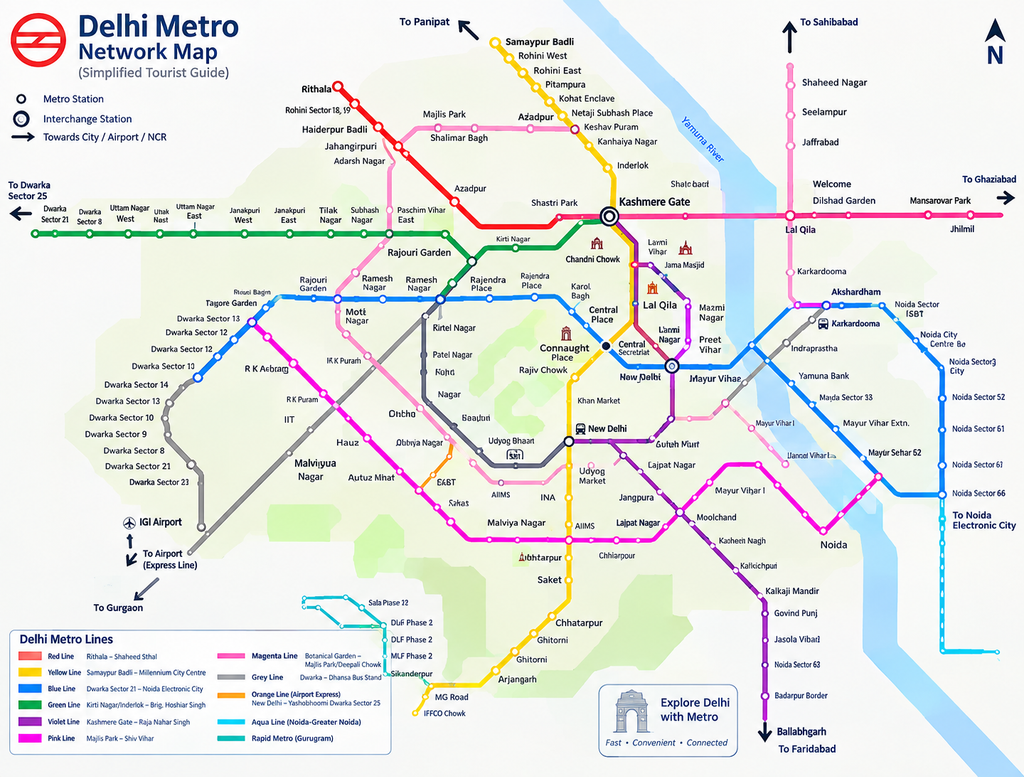
This simplified map is designed for tourists and should be used as a quick orientation guide rather than a replacement for the official network map.
Delhi Metro Lines Tourists Should Know
You do not need every station name to travel around Delhi. A few lines are especially useful for sightseeing.
Yellow Line
The Yellow Line is one of the most useful routes for tourists. It runs between Samaypur Badli and Millennium City Centre Gurugram and passes through important central Delhi areas.
Important tourist stations and areas include:
- Samaypur Badli
- Vishwavidyalaya
- Civil Lines
- Kashmere Gate
- Chandni Chowk
- Chawri Bazar
- New Delhi
- Rajiv Chowk
- Central Secretariat
- INA
- Hauz Khas
- Qutub Minar
- Saket
- Millennium City Centre Gurugram
For first-time visitors, the Yellow Line is particularly useful for Old Delhi, Connaught Place, central Delhi and parts of South Delhi.
Blue Line
The Blue Line connects Dwarka Sector 21 with Noida Electronic City, making it one of the major east-west corridors.
Important stations include:
- Dwarka Sector 21
- Rajouri Garden
- Karol Bagh
- Rajendra Place
- Kirti Nagar
- Mandi House
- Yamuna Bank
- Anand Vihar
- Noida
It is particularly useful for travellers staying in western Delhi or travelling towards Noida.
Red Line
The Red Line connects Rithala and Shaheed Sthal, passing through northern and northeastern parts of the metropolitan area.
For tourists, Kashmere Gate is particularly important because it connects with other major metro corridors.
Violet Line
The Violet Line connects Kashmere Gate with Raja Nahar Singh in Ballabhgarh.
It is useful for central and southern Delhi sightseeing, particularly around:
- Lal Quila
- Jama Masjid area
- Delhi Gate
- Mandi House
- Central Secretariat
- Jangpura
- Lajpat Nagar
- Kalkaji Mandir
Pink Line
The Pink Line is useful when travelling around Delhi without going through the central city.
It connects major areas including Majlis Park and Shiv Vihar, with the network expanded further in 2026.
Important interchange and tourist-useful areas include:
- Azadpur
- INA
- South Extension
- Lajpat Nagar
- Mayur Vihar
- Anand Vihar
- Welcome
- Maujpur-Babarpur
Magenta Line
The Magenta Line is particularly useful for South Delhi and airport-side travel.
Its operational network connects areas including:
- Botanical Garden
- Kalkaji Mandir
- Hauz Khas
- Janakpuri West
- Krishna Park Extension
- Majlis Park
- Deepali Chowk
The 2026 network expansion has changed the operational route compared with older Delhi Metro guides, so tourists should check the current map before travelling.
Green Line
The Green Line connects Kirti Nagar/Inderlok with Brigadier Hoshiar Singh and is more useful for travellers staying in western and northwestern parts of the city.
Grey Line
The Grey Line serves the Dwarka to Dhansa Bus Stand corridor. It is mainly useful for travellers staying around Dwarka and Najafgarh.
Airport Express Line
The Orange-coloured Airport Express Line is the most important metro route for many international and domestic tourists arriving at Delhi Airport.
It connects New Delhi with IGI Airport and Yashobhoomi Dwarka Sector 25.
Delhi Metro Stations Near Major Tourist Attractions
Knowing the nearest metro station is often more useful than knowing the line name.
| Tourist Attraction | Useful Metro Station | Line |
|---|---|---|
| Red Fort | Lal Qila / Chandni Chowk | Violet / Yellow |
| Jama Masjid | Jama Masjid | Violet |
| Chandni Chowk | Chandni Chowk | Yellow |
| India Gate | Central Secretariat | Yellow / Violet |
| Rashtrapati Bhavan | Central Secretariat | Yellow / Violet |
| Connaught Place | Rajiv Chowk | Yellow / Blue |
| Jantar Mantar | Rajiv Chowk / Patel Chowk | Yellow / Blue |
| Humayun’s Tomb | Jangpura | Violet |
| Qutub Minar | Qutub Minar | Yellow |
| Lotus Temple | Kalkaji Mandir | Violet / Magenta |
| Akshardham Temple | Akshardham | Blue |
| Lodhi Garden | Jor Bagh | Yellow |
| Dilli Haat INA | INA | Yellow / Pink |
| National Museum | Udyog Bhawan / Central Secretariat | Yellow |
| Raj Ghat | Delhi Gate | Violet |
| Nehru Place | Nehru Place | Magenta |
| Hauz Khas | Hauz Khas | Yellow / Magenta |
Metro stations are not always directly at the entrance of an attraction. In several cases, tourists will need to walk, take an e-rickshaw or use an auto for the final part of the journey.
Best Delhi Metro Routes for Sightseeing
Instead of randomly selecting attractions across the city, tourists can group nearby places together.
Route 1: Old Delhi Heritage Tour
New Delhi → Chandni Chowk → Red Fort → Jama Masjid
A convenient Old Delhi route is:
New Delhi → Chandni Chowk
Take the Yellow Line towards the Old Delhi side and get down at Chandni Chowk.
From here, explore:
- Chandni Chowk
- Fatehpuri area
- Red Fort
- Jama Masjid
- Old Delhi food streets
Another option is to use the Violet Line for Jama Masjid and Lal Qila stations.
This is one of the best metro-based sightseeing routes for first-time visitors because several major historical attractions are concentrated in one area.
Route 2: Central Delhi Heritage Route
Rajiv Chowk → Patel Chowk → Central Secretariat
This route is ideal for visitors interested in New Delhi’s colonial-era architecture and major landmarks.
You can explore:
- Connaught Place
- Jantar Mantar
- Parliament area
- Rashtrapati Bhavan surroundings
- India Gate area
- National Museum
Keep in mind that some areas may have restricted access or require additional walking.
Route 3: South Delhi Heritage Route
Qutub Minar → Hauz Khas → Lodhi Garden
Use the Yellow Line for Qutub Minar and Hauz Khas, with local transport or walking for the final stretch to individual attractions.
A possible day can include:
Qutub Minar → Hauz Khas Village → Lodhi Garden
This works well for travellers who want a combination of history, architecture, cafés and green spaces.
Route 4: Lotus Temple and South Delhi
Kalkaji Mandir → Lotus Temple → Nehru Place
Take the Magenta or Violet Line depending on your starting point.
Visit:
- Lotus Temple
- Kalkaji Mandir
- Nehru Place
Nehru Place can be added if you are interested in shopping and the commercial side of South Delhi.
Route 5: Akshardham Route
Akshardham Metro Station → Akshardham Temple
The Blue Line provides direct access to Akshardham station.
This is one of the simplest metro-to-attraction journeys in Delhi because the station is specifically associated with the temple complex.
Delhi Airport to City Centre by Metro
For tourists arriving by air, the Airport Express is usually the first metro route they need to understand.
The Airport Express connects:
New Delhi → Shivaji Stadium → Dhaula Kuan → Delhi Aerocity → IGI Airport → Dwarka Sector 21 → Yashobhoomi Dwarka Sector 25
The current Airport Express fare table shows QR-ticket fares ranging from ₹11 to ₹75 depending on the stations used. For example, New Delhi to IGI Airport is currently listed at ₹64, while New Delhi to Yashobhoomi Dwarka Sector 25 is ₹75.
Airport Express Tourist Route
IGI Airport
     ↓
Delhi Aerocity
     ↓
Dhaula Kuan
     ↓
Shivaji Stadium
     ↓
New Delhi
     ↓
Yashobhoomi Dwarka Sector 25
New Delhi is especially important for tourists because it provides access to the Yellow Line and the wider Delhi Metro network.
From New Delhi, travellers can continue towards:
- Old Delhi
- Chandni Chowk
- Connaught Place
- Central Delhi
- South Delhi
The Airport Express is also useful for travelers staying around central Delhi because it avoids much of the road traffic between the airport and city center.
Delhi Metro Fare for Tourists
Delhi Metro fares are distance-based.
According to the current DMRC fare table, standard fares are:
| Distance | Monday–Saturday | Sunday & National Holidays |
|---|---|---|
| 0–2 km | ₹11 | ₹11 |
| 2–5 km | ₹21 | ₹11 |
| 5–12 km | ₹32 | ₹21 |
| 12–21 km | ₹43 | ₹32 |
| 21–32 km | ₹54 | ₹43 |
| Above 32 km | ₹64 | ₹54 |
These are the current DMRC fare slabs and should be checked again before publication updates because metro fares can change.
The Airport Express has a separate fare structure.
Delhi Metro Tourist Card
Tourists can also use the Delhi Metro Tourist Card, which is designed for unlimited travel on the Delhi Metro network.
The current DMRC tourist card options are:
- 1-Day Tourist Card: ₹200, including a ₹50 refundable security deposit
- 3-Day Tourist Card: ₹500, including a ₹50 refundable security deposit
The actual non-refundable card amounts are ₹150 and ₹450 respectively, while the ₹50 security deposit is refundable when the card is returned in acceptable physical condition.
However, tourists should compare the card price with their expected daily travel. If you only plan to take a few metro journeys, normal QR tickets or other available ticketing options may be more economical.
How to Buy Delhi Metro Tickets
Tourists have several ways to travel.
QR Tickets
QR-based tickets are convenient for visitors who do not want to purchase a physical card.
DMRC also provides app-based QR ticketing facilities.
Token or Station Ticket
You can also purchase a normal journey ticket at the station.
Smart Card
A regular Delhi Metro smart card can be useful if you are staying in Delhi for several days and expect to make multiple journeys.
Tourist Card
The tourist card is better suited to visitors who plan to make frequent metro journeys during a short stay.
Important Delhi Metro Interchange Stations
Interchange stations are important because tourists often need to change from one line to another.
Some of the most useful stations include:
Kashmere Gate
Connects the Red, Yellow and Violet lines.
Useful for travellers exploring Old Delhi and travelling between northern and central Delhi.
Rajiv Chowk
Connects the Yellow and Blue lines.
It is one of the most useful stations for reaching Connaught Place.
Central Secretariat
Connects the Yellow and Violet lines.
Useful for central Delhi sightseeing.
Mandi House
Connects the Blue and Violet lines.
Yamuna Bank
Important interchange point for the Blue Line branches.
Hauz Khas
Connects the Yellow and Magenta lines.
Useful for South Delhi travel.
Lajpat Nagar
Connects the Violet and Pink lines.
Botanical Garden
An important interchange point connecting the Blue and Magenta lines.
Delhi Metro Timings
Metro timings vary by line, station and day, and special operating arrangements can also be introduced for major events.
Rather than relying on a single generic “Delhi Metro opens at X and closes at Y” statement, tourists should check their specific route before travelling.
DMRC provides station-specific first and last train information and an online journey planner.
This is especially important if you are planning an early airport journey, late-night train connection or a full-day sightseeing itinerary.
How to Use Delhi Metro for the First Time
Using the metro becomes easy once you understand a few basic steps.
1. Find Your Starting Station
Use your hotel location or current attraction to identify the nearest station.
2. Search for Your Destination
Check the destination station rather than only the attraction name.
For example, if you want to visit Connaught Place, search for Rajiv Chowk.
3. Check the Line Colour
Look at the line colour and direction displayed on the platform.
4. Check the Final Station
A train may operate in one direction but terminate before the station you need. Always check the destination displayed on the train.
5. Change Lines Where Required
Follow the interchange signs instead of exiting the station.
6. Exit Through the Correct Gate
Large Delhi Metro stations can have several exits. The right exit can save you a considerable amount of walking.
Delhi Metro Travel Tips for Tourists
Delhi Metro is convenient, but the experience can be crowded, especially during peak hours.
Keep these tips in mind:
- Avoid peak office hours when possible.
- Keep your phone, wallet and passport secure in crowded trains.
- Follow platform signs carefully.
- Do not enter a train before passengers have exited.
- Keep your ticket or QR code accessible until you leave the station.
- Check the train’s direction before boarding.
- Allow extra time for interchange stations.
- Use elevators or escalators when carrying large luggage.
- Keep some cash available for the last-mile auto or e-rickshaw.
- Do not assume every tourist attraction is immediately outside its metro station.
- Check the current DMRC route planner before starting a complicated journey.
Delhi Metro vs Taxi: Which Is Better for Tourists?
Both have their place.
| Transport | Best For |
|---|---|
| Delhi Metro | Long-distance travel and avoiding traffic |
| Taxi/Cab | Door-to-door travel |
| Auto-rickshaw | Short last-mile journeys |
| E-rickshaw | Short trips around markets and metro stations |
| Walking | Exploring compact tourist areas |
For sightseeing, the best approach is usually Metro + walking + short local transport rather than relying entirely on taxis.
For example, you can take the metro to Chandni Chowk and then explore Old Delhi mostly on foot.
Delhi Metro for a 1-Day Sightseeing Trip
If you have only one day in Delhi, avoid trying to cover every major attraction.
A metro-friendly route could look like this:
Morning
New Delhi → Chandni Chowk
Explore:
- Chandni Chowk
- Red Fort
- Jama Masjid
Afternoon
Old Delhi → Rajiv Chowk
Explore:
- Connaught Place
- Jantar Mantar
Evening
Rajiv Chowk → Central Secretariat
Continue towards:
- India Gate area
- Central Delhi
Return to your hotel by metro or taxi depending on the time.
Delhi Metro for a 2-Day Trip
Day 1: Old and Central Delhi
Chandni Chowk → Red Fort → Jama Masjid → Connaught Place → India Gate
Day 2: South and East Delhi
Qutub Minar → Hauz Khas → Lotus Temple → Akshardham
This approach keeps attractions geographically grouped and reduces unnecessary travel across the city.
Delhi Metro for a 3-Day Trip
For three days, you can divide the city into zones.
Day 1 – Old Delhi
- Chandni Chowk
- Red Fort
- Jama Masjid
- Raj Ghat
Day 2 – Central Delhi
- Connaught Place
- Jantar Mantar
- National Museum
- India Gate
- Rashtrapati Bhavan area
Day 3 – South Delhi
- Qutub Minar
- Hauz Khas
- Humayun’s Tomb
- Lotus Temple
- Lodhi Garden
Use the metro for the major connections and local transport for the final distance to attractions.
Is Delhi Metro Safe for Tourists?
The Delhi Metro is widely used by residents, office workers, students and tourists every day. However, visitors should follow normal precautions expected in any large, crowded city.
Keep valuables secure, especially during busy hours. Families travelling with children should keep younger children close in crowded stations, while solo travellers should remain aware of their surroundings.
The metro also has security screening and station security arrangements.
Delhi Metro for Families
Families can use the metro effectively, particularly when travelling between major tourist areas.
However, travelling with small children, elderly family members or heavy luggage can make interchange stations more tiring.
For family trips, consider:
Metro for the long journey + auto/cab for the final few kilometres.
This can be much easier than forcing the entire journey through multiple line changes.
Delhi Metro for International Tourists
International visitors should keep a few additional points in mind.
Carry your passport securely and avoid keeping all important documents in one bag. Save your hotel address on your phone, preferably offline as well.
If you arrive at Delhi Airport, the Airport Express can provide a convenient connection towards central Delhi. From New Delhi, you can continue on the wider metro network.
It is also useful to keep the names of your destination and nearest metro station written down. Delhi has many similarly named areas, and having the exact station name makes communication with local transport drivers much easier.
Common Delhi Metro Mistakes Tourists Should Avoid
One of the biggest mistakes is planning a sightseeing itinerary only by attraction names without checking the metro route.
For example, two attractions may look close on a map but still require a line change or a short road journey.
Another mistake is assuming that the nearest metro station means the attraction entrance is immediately outside the station. Some monuments and markets require walking or local transport.
Also, avoid planning too many attractions on opposite sides of Delhi on the same day. The metro makes Delhi easier to navigate, but it does not eliminate travel time.
FAQs
What is the best Delhi Metro line for tourists?
There is no single best line. The Yellow, Blue, Violet, Magenta and Airport Express lines are particularly useful depending on where you are staying and which attractions you want to visit.
How much does Delhi Metro cost for tourists?
Current standard DMRC fares range from ₹11 to ₹64 depending on distance, with different Sunday and national holiday slabs. Airport Express fares are separate.
Is there a tourist card for Delhi Metro?
Yes. DMRC currently lists one-day and three-day Tourist Cards priced at ₹200 and ₹500 respectively, including a refundable ₹50 security deposit.
Which metro station is closest to Red Fort?
Lal Qila on the Violet Line and Chandni Chowk on the Yellow Line are among the useful metro options for visiting the Red Fort area.
Which metro station is closest to India Gate?
Central Secretariat is one of the most useful metro stations for reaching the India Gate and central government district area, although a further walk or local transport may be required.
How can I reach Delhi city centre from the airport by metro?
The Airport Express connects IGI Airport with New Delhi. From New Delhi, tourists can connect to other major Delhi Metro lines.
Is Delhi Metro good for sightseeing?
Yes. It is one of the most practical ways to move between major parts of Delhi while avoiding road traffic. The best sightseeing strategy is to combine metro travel with walking and short local transport journeys.
Can I use Delhi Metro with luggage?
Yes, but large luggage can be inconvenient during crowded periods and at interchange stations. Travellers with heavy bags may find a direct taxi more comfortable for short journeys.
Final Thoughts
For tourists, the Delhi Metro is more than just public transport. It can completely change the way you experience the city.
Instead of spending a large part of your day sitting in traffic, you can use the metro to move between Old Delhi, Connaught Place, Central Delhi, South Delhi and other major areas and then explore each neighbourhood on foot.
The key is not to memorise the entire network. Understand the major lines, know the important interchange stations, identify the metro station closest to each attraction and check the current route before leaving.
For the most accurate journey planning, always refer to the latest DMRC network map and route planner because Delhi Metro continues to expand. The current March 2026 network includes several Phase IV extensions that have changed routes compared with older travel guides.
If you are visiting Delhi for the first time, a combination of Delhi Metro + walking + short auto or cab rides is usually one of the easiest ways to explore the capital without letting traffic control your itinerary.