


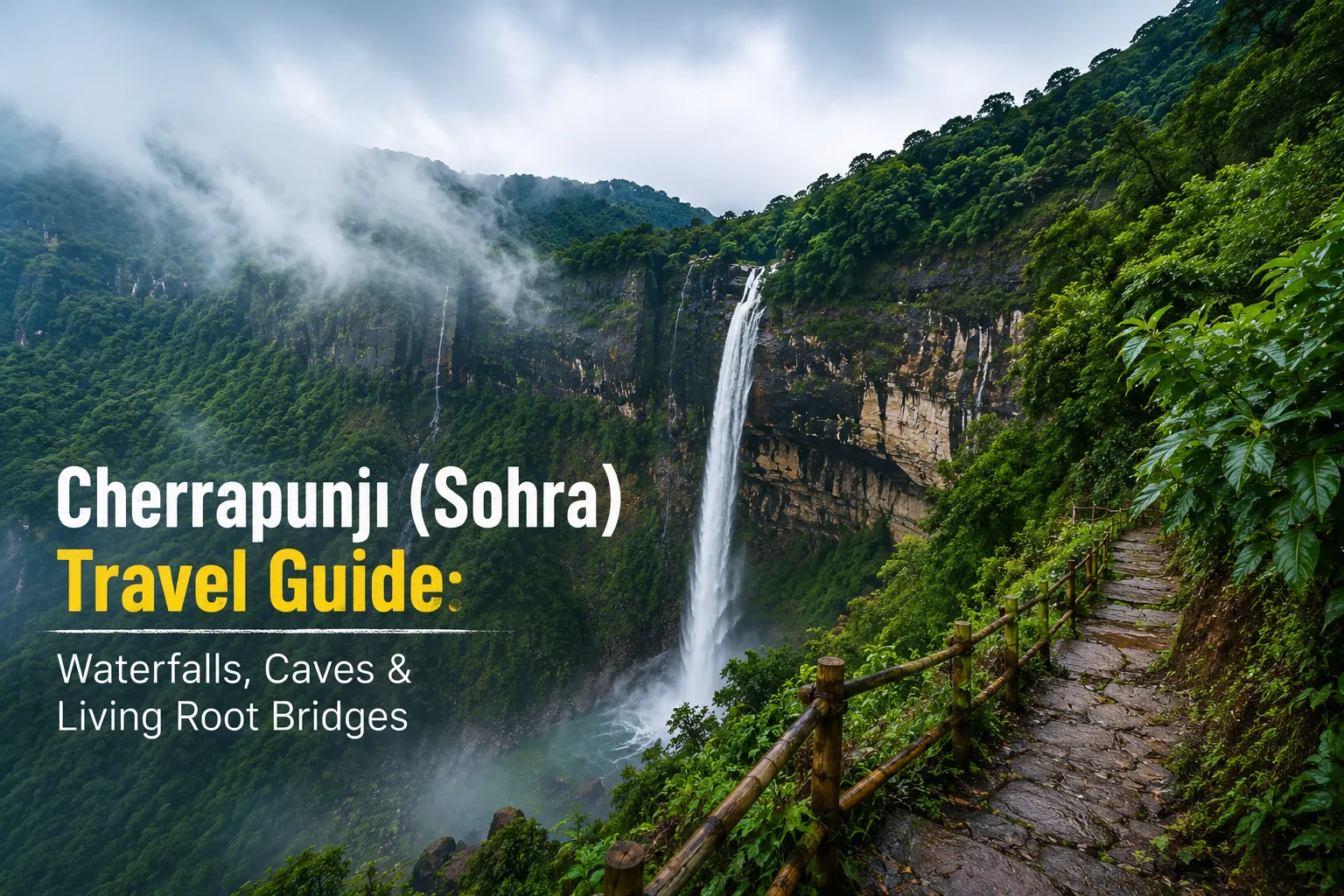
Planning a Meghalaya trip then Cherrapunji (aka Sohra) Meghalaya is one of those destinations that should be more than just a tick mark off your list. Located on the southern slopes of the Khasi Hills Meghalaya, Cherrapunji is well known for among other things for rainfall, lush green valleys, insane waterfalls and Limestone caves.
However, what really makes Meghalaya Cherrapunji so fabulous is the diversity packed into the terrain around it. You could gaze out onto Nohkalikai Falls in the morning, then climb through a limestone cave in the afternoon, then spend another day trekking through the forest and towards a living root bridge. You can also experience the Khasi way of life and the topography that has been created by the symbiotic link between people, forests and water.
Rain plays a significant role in the experience, rather than being a mere weather problem. It can reshape and reconfigure the terrain from season to season. Waterfalls can become dramatically stronger and easier to lean against, slopes can become treacherous and the visitor’s perspective can be cloaked by mists.
This Cherrapunji Travel Guide lists the must sees, where to stay and eat, how to get there from Shillong, best time to visit and how long to allow for a relaxed trip.
About Cherrapunji/Sohra
Sohra Meghalaya, even though more popularly known as Cherrapunji, is a town and subdivision of East Khasi Hills in the Indian state of Meghalaya. According to the Government of Meghalaya, Sohra,previously known as Cherrapunjee,is located on a plateau situated on the southern slopes of the state.
The two names can be confusing for 1st time visitors. Sohra is the traditional/local name, while Cherrapunji/Cherrapunjee is more popular among the travellers, hotels, maps and tourism web-sites. For ease of travel planning, they are the same place.
Heavy precipitation is a hallmark of Sohra. According to the India Meteorological Department, 1,563 mm of rainfall were recorded over Sohra in one day, on 16 June 1995, one of the highest ever recorded in India. IMD climatic data for the period 1981-2010 shows an annual mean rainfall of around 11,857 mm.
That doesn’t mean, however, that every day will be wet or that every trip will be identical. The weather during the monsoon season often causes waterfalls to rush and the formation of lush greens. On the other hand, visitor’s trips are simpler in dry months.
Perhaps the weather will have an impact on your plans. Heavy rain can hamper visibility, turn pathways treacherous and slow road travel. If your plans include waterfall visits, cave exploring or the living root bridges, allow some mercy of your plans rather than a fixed timetable.
For a broader overview of the state before planning your route, see our [Meghalaya Travel Guide].
Top Attractions in Cherrapunji
Cherrapunji is the ideal place to base yourself as many of Meghalaya’s famous natural sights are near the village and the East Khasi Hills region which surrounds it. The region offers a mix of views, waterfalls, caves, walks through the forest and more, so it is more about picking the right mix for your fitness levels and that day’s weather.
Mawsmai Cave
Mawsmai cave is perhaps the most straightforward way to get into caving near Cherrapunji. Situated about 6 km from the town, it is drivable and is said to be one of the more accessible caving environments in the region. According to Meghalaya Tourism, “It is about 150 metres long and the interior can be well illuminated with the haphazardly formed Stalactites and stalagmites adding to the excitement.”
Once inside the path gets narrow and bumpy making for an authentic cave experience without all the walking. This makes it a practical entry point for those exploring caves for the first time, or if you’re visiting with children. Though those with claustrophobia may find some areas tight.
Give yourself some time to walk through it all at a relaxed pace. Good shoes are essential if the ground is wet. The conditions are likely to be greasy and worse if it rains.
If you would only like a taste of one accessible cave, then you can’t go wrong with Mawsmai Cave. For something a little more adventurous and less contained, then that will be Arwah.
Arwah Cave
Arwah Cave is less popular than Mawsmai. This place is a combination of walking in natural surroundings and through a limestone cave. Meghalaya Tourism notes find fossils in the limestone water including shell of crustaceans and fish bones.
The way to the cave is itself part of the experience. Instead of just stepping out onto the entrance next to an overused main tourist road, you are actually walking through vegetation then along a hillside path.
This invites Arwah to call the walk loving explorers who get the adventurous spirit that comes along with roaming around and hiking. Be sure to wear shoes with improved grip and carry some additional time during the rainy season. The trail and cave routes may vary during the rainy days, so check with the locals before you begin your journey.
Nohkalikai Falls
Nohkalikai Falls is one of the most fantastic sights among the Cherrapunji tourist places. According to the Meghalaya Tourism the falls is at the altitude of 340 metres approximately from the plateau – towards the slopes and reaches the basin. It is about 7.5 km from Sohra.
The viewpoint is the prominent feature, providing visitors with a panoramic view of the falls and the cliffs. Heavy rainfall can significantly increase flow levels in the falls and change the character of the landscape, while mist could occasionally hide the view.
To take a broader look at Meghalaya’s waterfall circuit visit us at [Nohkalikai Falls and other Meghalaya Waterfalls]-if waterfalls were the biggest reason for your trip to Meghalaya anyway.
Wei Sawdong Falls
Wei Sawdong Falls is characterized by a multi level barrage coming down from the top with thick greenery all around. This falls has become famous among travelers seeking a more involvement as compared to roadside ravines.
The route is based on walking, and steps and so it may be suitable to consider this as an outdoors activity as opposed to a snapping stop. Wet conditions may cause the route to become walkable and also, heavy showers may make exposure to the falls far more risky.
This is especially critical at waterfalls where there are deep pools and strong currents. Do not enter the water just because other visitors are swimming, and adhere to local safety guidance and access limitations.
As access conditions can alter, please verify the present local situation before traveling particularly during, and just following heavy rainfall.
Seven Sisters Falls
Seven Sisters Falls or Nohsngithiang falls is another icon in Sohra. This waterfall is believed to be seven different streams falling down the cliff. The waterfall however, looks quite different depending on the rainfall.
The monsoon can create quite strong currents and the mist can obscure the cliffs at times. When skies are clearer and the mist is not so apparent, the viewpoint often gives good views over the plains.
Meghalaya Tourism displays Nohsngithiang about 3.7 km away from Sohra and mentions What-s interesting stops are nearby. For example: Sohra Eco Park.
Don’t expect to see the waterfall like the pictures taken during a different season. Weather, rain and cloud cover can turn the very same sight into a different view from one visit to the next.
Living Root Bridges Near Cherrapunji
Sohra is more than just a waterfall. One of its unique experiences will help you connect with the living root bridges of Meghalaya.
The most well-known is the Double Decker Living Root Bridge at Nongriat, outside Tyrna. According to Meghalaya Tourism, they cut down 3000-3500 stairs, depending on how you count them, to get to the bridge, which it claims is a “multi-layered Natural Bridge constructed from the living roots of rubber fig trees.” Nongriat is 15 km away from Cherrapunji.
This shouldn’t be approached as a casual sightseeing type of thing. The walk into the valley and back out is much more demanding in time and energy than most “attractions”. If you’re going to attempt it, start early, bring water, wear good shoes and have a lot of time set aside.
For in-depth information on the journey and your arrival, refer to our [Living Root Bridges] guide.
Where to Stay in Cherrapunji
Accommodation in Sohra varies from budget rooms, homestays and guest houses to nature-centered accommodations and upmarket hotels. The ideal option isn’t about choosing the most comfortable room but selecting the one where you intend to spend most of your time.
Within Cherrapunji, tourists can choose from eco-friendly, budget, and mid-range accommodation and homestays and other Cherrapunji resorts. Jiva Resort and Four Seasons Eco Resort are two of the accommodation options that travelers may encounter, but should contact to check facilities prior to reservation.
When comparing stays, consider:
- Location: Staying close to your preferred sightseeing circuit can reduce unnecessary driving.
- Views: Some properties are chosen mainly for their valley or forest setting.
- Budget: Homestays can make sense for travellers prioritising local interaction, while resorts may suit couples or families wanting a more private stay.
- Trip style: A quiet nature stay is different from accommodation chosen mainly for convenient access to restaurants and transport.
- Group size: Families and groups should confirm room configurations and availability directly.
Do not book solely from old blog posts. Facilities, management, rates and availability can change.
For a detailed accommodation comparison, see our [Meghalaya Hotels] guide.
Where to Eat in Cherrapunji
There are fewer choices of food while you are in Sohra than there are in Shillong so don’t get your hopes too high. You will be able to eat in some of the local places, and there will be cafes, hotel restaurants and places to eat more informally-but the number of restaurants in Sohra will pale in comparison to the huge range on offer inShillong.
Try the Khasi and Meghalaya style food, especially the local rice, meat and seasonal vegetable preparations. Pork is a mainstay of Khasi cuisine and vegetarian dishes of the vegetable rice and dal variety are also available.
If you are going to be traveling all day sightseeing, eat before you leave town if you can, and take along water and snacks. This is a good idea for outdoor recreational activities like longer cave trips and hikes, especially where you can’t assume there will be a restaurant close at hand.
Meal times may also be more erratic than in a large tourist metropolis, so ensure you do not leave lunch very late on a full sightseeing day.
How to Reach Cherrapunji from Shillong
Bang at the beginning for most travelers Shillong is the more economical choice for a departure point to Cherrapunji. Meghalaya Tourism gives distances for Mawsmai Cave from Shillong as 58 km, other attractions near Sohra may vary in distance somewhat according to the route as well as the starting point.
In general the easiest way to sight-see is to take a private taxi or car with a driver. On the route toward Sohra there is also a shared taxi and sumo style (big van) available but this may be better for travelers happy to organize their own transportation in between sights. Meghalaya Tourism lists shared taxis and private cars, specifically between the Shillong-Sohra route.
Shillong → Cherrapunji/Sohra
| Plan | Best for | What to expect |
| Day trip | Short Meghalaya trips | Works for major viewpoints and a few attractions, but can feel rushed |
| 1 night | First-time visitors | A better balance of waterfalls, caves and relaxed sightseeing |
| 2 nights | Nature lovers, trekkers and photographers | More time for Nongriat, caves, waterfalls and weather flexibility |
A day trip is possible, particularly if you are mainly interested in the major viewpoints. However, one or two nights is better if you want to explore properly.
Road conditions can change quickly during heavy rain, and driving times can increase because of traffic, wet roads or weather-related disruption. Avoid building an itinerary around tight return timings.
If you are travelling through Shillong first, our [Shillong Travel Guide] can help you plan the wider Meghalaya route.
Cherrapunji vs Mawsynram — Which Is Actually Wetter?
This question is more complicated than the usual one-line answer.
Both Sohra and Mawsynram are famous for exceptional rainfall. Cherrapunji historically gained the reputation of being the world’s wettest place, while Mawsynram is widely recognised today for having the higher average annual rainfall in commonly cited modern records.
The confusion comes from the fact that rainfall records can refer to different periods, measurements and datasets. Sohra also holds extraordinary historical daily rainfall records: IMD records 1,563 mm in a single day in June 1995.
| Factor | Cherrapunji/Sohra | Mawsynram |
| Famous for | Historic rainfall records and tourism | Exceptionally high average rainfall |
| Location | East Khasi Hills | East Khasi Hills |
| Travel appeal | Waterfalls, caves, viewpoints, root bridges | Rainfall landscape, caves and rural scenery |
| Simple answer | Historically famous as the wettest | Commonly recognised today for higher average rainfall |
So, rather than saying one is always wetter, it is more accurate to specify whether you are discussing a historical record, annual average or a particular measurement period.
Suggested Cherrapunji Itinerary
1-Day Cherrapunji Itinerary
Best for travellers travelling from Shillong and returning the same day.
Morning: Shillong → Sohra → Nohkalikai Falls
Late morning: Mawsmai Cave
Afternoon: Seven Sisters Falls/Nohsngithiang and a nearby viewpoint
Evening: Return to Shillong
Keep this itinerary flexible. In poor weather, prioritise fewer places rather than trying to force everything into one day.
2-Day Cherrapunji Itinerary
Day 1: Shillong → Sohra → Nohkalikai Falls → Mawsmai Cave → Seven Sisters Falls → overnight in Sohra
Day 2: Start early for the Nongriat/Double Decker Living Root Bridge trek, or choose Arwah Cave and other nearby attractions if you prefer a shorter walking day.
If you are travelling during heavy monsoon conditions, the second option can be more practical because the Nongriat trek becomes substantially more demanding in wet weather.
Practical Cherrapunji Travel Tips
- Carry rain protection: A waterproof jacket and umbrella are useful even when the morning starts clear.
- Wear proper shoes: Choose footwear with good grip for caves, steps and wet trails.
- Expect changing weather: Visibility at viewpoints can change quickly.
- Allow road buffers: Heavy rain can slow travel and affect routes.
- Carry some cash: Do not assume every small local establishment or roadside stop accepts digital payments.
- Download essentials: Mobile connectivity can vary, particularly away from populated areas.
- Start early: This is especially important for longer treks and multi-stop sightseeing days.
- Respect waterfall safety: Strong currents and slippery rocks can be dangerous, particularly during heavy rain.
- Do not treat caves casually: Wet limestone can be slippery, and narrow passages require care.
- Respect Khasi communities: Follow local instructions, avoid littering and do not disturb private or culturally significant spaces.
- Check conditions before leaving: Weather and local access conditions can change quickly. Meghalaya Tourism itself advises visitors to pay attention to weather and route conditions for outdoor activities.
- Build flexibility into your trip: A spare half-day can be more valuable than an overpacked itinerary in a high-rainfall destination.
FAQs
1. Is Cherrapunji and Sohra the same place?
Yes. Sohra is the traditional/local name, while Cherrapunji or Cherrapunjee is the widely used English name. Both refer to the same destination in Meghalaya’s East Khasi Hills.
2. What is Cherrapunji famous for?
Cherrapunji is famous for its exceptional rainfall, waterfalls, limestone caves, deep valleys and living root bridges. Nohkalikai, Seven Sisters Falls, Mawsmai Cave and Nongriat are among its best-known attractions.
3. How many days are enough for Cherrapunji?
One night is a good minimum for most visitors. Two nights are preferable if you want to include the Nongriat living root bridge trek or explore the area without rushing.
4. What are the best Cherrapunji tourist places?
Priorities include Nohkalikai Falls, Seven Sisters Falls, Mawsmai Cave, Arwah Cave and the Nongriat Double Decker Living Root Bridge. Add other waterfalls according to your available time and weather.
5. Is Cherrapunji worth visiting during monsoon?
Yes, if you are prepared for rain and changing conditions. Waterfalls can become much more powerful, but visibility, road conditions and trekking safety can also be affected.
6. How far is Cherrapunji from Shillong?
The distance depends on the exact point you are travelling to. Meghalaya Tourism lists Mawsmai Cave at about 58 km from Shillong, while Sohra’s surrounding attractions have different road distances.
7. Which is better, Cherrapunji or Mawsynram?
For a first Meghalaya trip, Cherrapunji is usually the more practical choice because of its concentration of major tourist attractions. Mawsynram is particularly interesting if rainfall and less conventional landscapes are your priority.
8. What are the best places to stay in Cherrapunji?
Choose from homestays, budget accommodation, eco-resorts, mid-range properties and premium resorts. The best option depends on whether you prioritise views, convenience, privacy, budget or access to particular attractions.
Conclusion
Cherrapunji, or Sohra, is not just a place renowned for its rainfall. Part of its attractions is the way in which water has carved the landscape: waterfalls flow from the plateau, streams flow through the forests and the limestone caves reveal a different aspect of the region beneath your feet. The living root bridges offer the same unique cultural and ecological destination.
When travelling in meghalaya cherrapunji, it’s best not to race from sight to sight. Allow yourself a minimum of one overnight stopover, be adaptable according to conditions, and select a combination of waterfalls, caves and walking opportunities suiting your level of fitness and interest.
If you could spend some quality time in it, Cherrapunji in Meghalaya could be one of the most unforgettable experiences in broader Meghalaya travel-not because you covered maximum places, but because you had ample opportunity to enjoy the landscape.
4 responses to “Cherrapunji (Sohra) Travel Guide: Waterfalls, Caves & Living Root Bridges”
[…] Read our complete Tavel guide in Cherrapunji → […]
[…] our complete Cherrapunji Travel Guide […]
[…] For the extensive set of caves, viewpoints, waterfalls and treks around Sohra, go to our full Cherrapunji guide. […]
[…] Discover what makes Cherrapunji a must-visit in Meghalaya. […]