


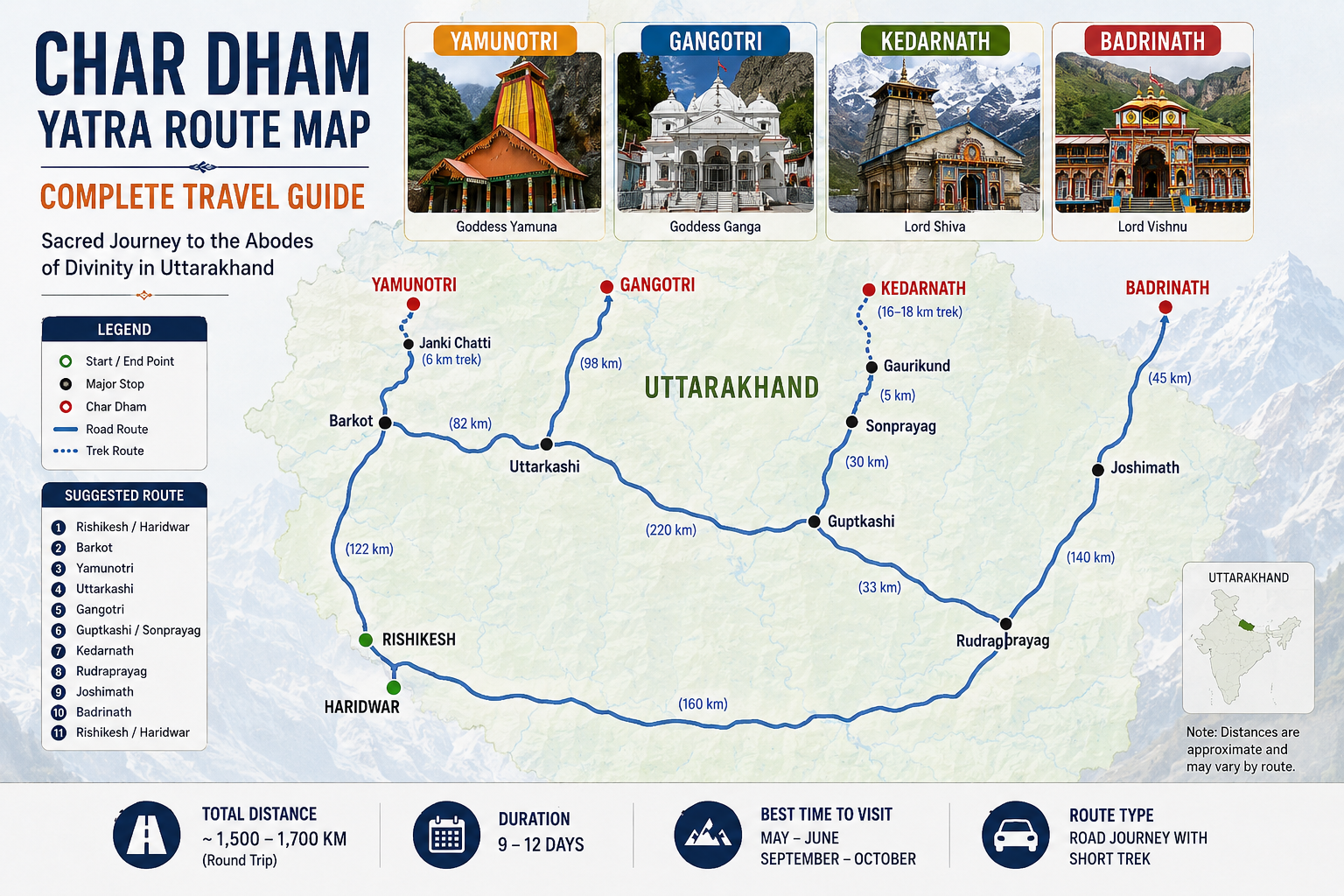
The Char Dham Yatra is one of the most sacred and spiritually significant pilgrimages in India, attracting millions of devotees every year. Nestled amidst the breathtaking Himalayan ranges of Uttarakhand, the journey covers four revered Hindu shrines—Yamunotri, Gangotri, Kedarnath, and Badrinath. These temples are not only important places of worship but also offer some of the most spectacular mountain landscapes, serene rivers, snow-capped peaks, and ancient traditions that have remained unchanged for centuries.
For many devotees, completing the Char Dham Yatra is considered a once-in-a-lifetime spiritual experience. According to Hindu beliefs, visiting all four shrines helps devotees seek divine blessings, wash away past sins, and move closer to attaining spiritual liberation or moksha. Beyond its religious importance, the yatra is also an incredible journey through the Garhwal Himalayas, allowing travellers to witness pristine valleys, cascading waterfalls, alpine forests, glacier-fed rivers, and charming mountain villages.
In recent years, the Uttarakhand Government has significantly improved roads, pilgrimage facilities, medical services, accommodation, and digital registration systems, making the Char Dham Yatra more organised and accessible. Helicopter services, improved trekking routes, better communication networks, and enhanced disaster management have further improved the overall pilgrimage experience.
Whether you are travelling with family, senior citizens, or as a solo pilgrim, proper planning is essential due to the high-altitude terrain, changing weather conditions, and large number of visitors during the pilgrimage season. This complete Char Dham Yatra Travel Guide 2026 covers everything you need to know, including the significance of each shrine, registration process, best time to visit, travel routes, accommodation, budget, itinerary, health tips, and essential travel advice.
What Is the Char Dham Yatra?
The Char Dham Yatra of Uttarakhand refers to the pilgrimage covering four sacred temples located in the Garhwal Himalayas.
The traditional order of the pilgrimage is:
- Yamunotri
- Gangotri
- Kedarnath
- Badrinath
This sequence has been followed for generations and is believed to represent a spiritually complete journey.
Each temple holds unique religious significance:
Yamunotri is dedicated to Goddess Yamuna.
Gangotri is dedicated to Goddess Ganga.
Kedarnath is one of the twelve Jyotirlingas dedicated to Lord Shiva.
Badrinath is dedicated to Lord Vishnu.
Together, these four sacred shrines represent devotion, purification, faith, and spiritual awakening.
Why Is Char Dham Yatra So Important?
The Char Dham Yatra occupies a special place in Hindu tradition because it combines devotion with self-discipline and spiritual reflection.
The pilgrimage requires travelling through mountainous terrain, facing changing weather conditions, and embracing simplicity throughout the journey.
Many devotees believe that the physical effort involved in reaching these holy shrines strengthens their spiritual connection.
Pilgrims also describe the experience as peaceful and transformative due to the breathtaking Himalayan surroundings.
Apart from religious importance, the yatra also introduces travellers to Uttarakhand’s rich cultural heritage, local traditions, and natural beauty.
Yamunotri – The First Dham
The pilgrimage traditionally begins with Yamunotri.
Located at an altitude of over 3,200 metres, Yamunotri Temple is dedicated to Goddess Yamuna, one of India’s most sacred rivers.
The temple is surrounded by snow-covered mountains, dense forests, and spectacular valleys.
Pilgrims usually reach Janki Chatti by road before undertaking a trek of approximately six kilometres to the temple.
For visitors unable to walk long distances, pony, palki, and porter services are available.
One of the unique attractions near the temple is Surya Kund, a natural hot water spring where devotees cook rice and potatoes as offerings before presenting them to the deity.
The peaceful environment, cool mountain air, and scenic trekking route make Yamunotri an unforgettable beginning to the pilgrimage.
Gangotri – The Sacred Origin of the Ganga
The second destination is Gangotri, located at an elevation of approximately 3,100 metres.
The temple is dedicated to Goddess Ganga, whose waters are considered sacred throughout India.
According to Hindu mythology, Goddess Ganga descended from heaven to Earth through the locks of Lord Shiva.
The temple stands beside the Bhagirathi River, surrounded by towering Himalayan peaks.
Although the actual source of the river lies at Gaumukh Glacier, Gangotri Temple remains one of Hinduism’s most important pilgrimage centres.
The atmosphere around Gangotri is remarkably peaceful.
Devotees gather for morning and evening prayers while many also meditate beside the flowing river.
The scenic drive leading to Gangotri passes through picturesque valleys, pine forests, waterfalls, and mountain villages, making the journey equally memorable.
Kedarnath – The Abode of Lord Shiva
Among all four shrines, Kedarnath is perhaps the most challenging as well as the most spiritually significant.
Situated at an altitude of approximately 3,583 metres, Kedarnath Temple is one of the twelve sacred Jyotirlingas dedicated to Lord Shiva.
Surrounded by snow-covered Himalayan peaks, the temple presents one of the most spectacular sights in Indian pilgrimage tourism.
Pilgrims generally travel by road up to Sonprayag and Gaurikund.
From Gaurikund, devotees undertake a trek of nearly sixteen kilometres to reach the temple.
Alternative transport options include:
- Pony services.
- Palkis.
- Helicopter services.
- Porter assistance.
Despite the physical effort involved, reaching Kedarnath becomes an emotional and deeply spiritual experience for most pilgrims.
The temple’s resilience through natural disasters has further strengthened its symbolic significance among devotees.
Want to know more about one of the holiest destinations on the Char Dham route? Read our complete Kedarnath Travel Guide for detailed information on travel planning, darshan, trekking, hotels, and essential tips before your visit.
Badrinath – The Final Dham
The pilgrimage concludes at Badrinath Temple, dedicated to Lord Vishnu.
Located at an altitude of around 3,100 metres, the temple lies between the Nar and Narayan mountain ranges alongside the Alaknanda River.
Unlike Kedarnath, Badrinath is directly accessible by road, making it relatively easier to reach.
Before entering the temple, pilgrims traditionally take a holy dip in Tapt Kund, a natural hot water spring believed to possess therapeutic properties.
The colourful temple facade, majestic Himalayan backdrop, and peaceful surroundings create an unforgettable spiritual atmosphere.
Badrinath also serves as an excellent base for exploring nearby sacred sites and scenic Himalayan landscapes.
Best Time to Visit Char Dham
The Char Dham temples remain open only for a limited period each year due to extreme winter conditions.
Generally, the pilgrimage season begins during late April or early May and continues until October or early November.
May and June
These months witness the largest number of pilgrims.
The weather remains pleasant, roads remain accessible, and most facilities operate smoothly.
However, crowds can be substantial.
July and August
Monsoon brings lush greenery to the Himalayas.
While the scenery becomes incredibly beautiful, heavy rainfall may occasionally cause landslides and travel disruptions.
Pilgrims should carefully monitor weather forecasts before travelling during this period.
September and October
Many experienced travellers consider this the ideal time for Char Dham Yatra.
The weather remains relatively stable.
Crowds become smaller.
Mountain views become exceptionally clear after the monsoon.
Photography conditions also improve significantly.
Char Dham Registration Process
Registration has become mandatory for pilgrims visiting the Char Dham shrines.
The registration process helps authorities monitor pilgrim movement, improve safety, and provide better emergency assistance if required.
Pilgrims generally need:
- Valid government identification.
- Mobile number.
- Basic travel details.
- Emergency contact information.
Digital registration systems have simplified the process considerably, allowing pilgrims to complete formalities before beginning their journey.
Visitors should carry both digital and printed copies of their registration details throughout the pilgrimage.
How to Reach Char Dham
Most pilgrims begin their journey from Haridwar, Rishikesh, or Dehradun.
By Air
Jolly Grant Airport in Dehradun serves as the nearest major airport.
Flights connect Dehradun with several major Indian cities.
By Train
Haridwar and Rishikesh railway stations provide convenient access for pilgrims arriving from across the country.
By Road
Government buses, private coaches, taxis, and self-drive vehicles regularly operate between major Uttarakhand towns and the Char Dham routes.
Well-maintained highways have significantly improved travel compared to previous years, although mountain roads still require careful driving.
Suggested Char Dham Yatra Itinerary
The Char Dham Yatra usually takes 9 to 12 days, depending on your travel pace, weather conditions, and mode of transportation. While helicopter packages are available for those with limited time, many pilgrims prefer completing the journey by road and trekking, as it allows them to experience the spiritual atmosphere and breathtaking Himalayan scenery more closely.
A well-planned itinerary helps minimise fatigue while providing enough time for darshan, rest, and sightseeing.
A typical travel route includes:
Day 1: Arrive in Haridwar, Rishikesh, or Dehradun
Day 2: Travel to Barkot
Day 3: Visit Yamunotri and return to Barkot
Day 4: Travel to Uttarkashi
Day 5: Visit Gangotri and return to Uttarkashi
Day 6: Travel to Guptkashi or Sitapur
Day 7: Trek or fly to Kedarnath and stay overnight
Day 8: Return from Kedarnath and travel towards Joshimath or Pipalkoti
Day 9: Visit Badrinath Temple
Day 10: Explore nearby attractions and begin the return journey
This itinerary provides sufficient time for acclimatisation, reducing the chances of altitude-related health issues while allowing pilgrims to fully experience each destination.
Accommodation During the Yatra
Accommodation options have improved significantly over the past few years due to the growing number of pilgrims visiting Uttarakhand.
Travellers can choose from:
- Budget hotels
- Dharamshalas
- Government guest houses
- Private lodges
- Luxury hotels in major towns
- Tent accommodations near trekking routes
- Premium pilgrimage resorts
Popular overnight stops such as Barkot, Uttarkashi, Guptkashi, Sonprayag, Joshimath, and Badrinath offer accommodation for different budgets.
Pilgrims travelling during the peak season should reserve rooms well in advance because hotels often reach full occupancy, especially during weekends, public holidays, and religious festivals.
Senior citizens and families are advised to stay in accommodations that provide medical assistance, heating facilities, and easy transport access.
Estimated Budget for Char Dham Yatra
The total cost of the pilgrimage depends on your travel style, accommodation preferences, and transportation choices.
A budget-friendly pilgrimage generally includes shared transport, economical hotels, and basic meals.
A mid-range journey usually involves comfortable hotels, private taxis or shared cabs, better dining options, and additional sightseeing.
Luxury travellers may choose premium hotels, helicopter services, private vehicles, and customised pilgrimage packages.
Travellers should also keep extra funds for:
- Pony or palki services
- Helicopter bookings (if required)
- Temple donations
- Local transportation
- Medical emergencies
- Rain gear and winter clothing
- Snacks and drinking water
- Souvenirs
Planning your budget in advance helps avoid unnecessary financial stress during the pilgrimage.
Essential Packing Checklist
Weather conditions in the Himalayas can change rapidly, even during summer.
Packing wisely is extremely important for a comfortable and safe journey.
Essential items include:
- Warm jackets
- Thermal clothing
- Comfortable trekking shoes
- Woollen socks
- Raincoat or waterproof poncho
- Umbrella
- Gloves and woollen cap
- Sunglasses
- Sunscreen
- Personal medicines
- First-aid kit
- Reusable water bottle
- Power bank
- Torch
- Government identity card
- Cash for remote locations
- Small backpack for trekking
Travellers should avoid carrying unnecessary luggage, especially if trekking to Kedarnath.
Health and Safety Tips
The Char Dham Yatra involves travelling through high-altitude regions where oxygen levels are lower than those at sea level.
Pilgrims should prioritise their health throughout the journey.
Drink plenty of water to stay hydrated.
Avoid rushing during treks.
Take regular breaks while climbing.
Eat light and nutritious meals.
Avoid alcohol and smoking.
Consult a doctor before travelling if you have heart disease, respiratory conditions, high blood pressure, or other chronic illnesses.
Senior citizens should undergo a complete medical check-up before beginning the pilgrimage.
Weather forecasts should be monitored regularly because heavy rainfall or snowfall can temporarily affect travel routes.
Following official advisories issued by local authorities is always recommended.
Food During the Char Dham Yatra
The pilgrimage route offers a variety of simple, nutritious, and predominantly vegetarian meals.
Common food options include:
- Dal and rice
- Roti with vegetables
- Khichdi
- Puri Sabzi
- Aloo Paratha
- Maggi noodles
- Tea and coffee
- Fresh fruits
- Local sweets
Many roadside eateries and community kitchens provide affordable meals for pilgrims.
Since the journey involves physical activity, maintaining a balanced diet and drinking sufficient water becomes especially important.
Responsible Tourism in the Himalayas
The Himalayan ecosystem is environmentally sensitive and deserves careful protection.
Pilgrims can contribute by following responsible travel practices.
Avoid littering.
Carry reusable water bottles whenever possible.
Use designated waste bins.
Respect local customs and traditions.
Avoid disturbing wildlife.
Do not damage temples or heritage structures.
Minimise the use of single-use plastics.
Support local businesses, handicraft shops, and community-run accommodations.
Responsible tourism ensures that future generations can continue experiencing the natural beauty and spiritual significance of the Char Dham region.
Nearby Attractions Worth Visiting
While the four temples are the primary focus of the pilgrimage, several nearby attractions are equally worth exploring.
Mana Village
Located near Badrinath, Mana is recognised as the last Indian village before the Indo-Tibetan border.
Visitors can explore traditional Himalayan culture, ancient caves, and scenic mountain landscapes.
Vasudhara Falls
A short trek from Mana Village leads to the magnificent Vasudhara Falls, surrounded by towering Himalayan peaks.
Bhairavnath Temple
Situated near Kedarnath Temple, Bhairavnath Temple offers panoramic views of the surrounding mountains and holds religious significance for devotees.
Harsil Valley
Near Gangotri, Harsil is famous for its apple orchards, peaceful environment, and breathtaking Himalayan scenery.
Surya Kund
Located near Yamunotri Temple, Surya Kund is a natural hot water spring where devotees prepare offerings before entering the temple.
These attractions add cultural, historical, and natural richness to the overall pilgrimage experience.
Why the Char Dham Yatra Is More Than Just a Pilgrimage
For many travellers, the Char Dham Yatra becomes much more than a religious journey.
The experience combines spirituality, adventure, personal reflection, and appreciation for nature.
Walking through ancient mountain paths, listening to temple bells echo across the valleys, witnessing rivers emerging from glaciers, and praying amidst snow-covered peaks creates memories that remain with pilgrims throughout their lives.
The pilgrimage also introduces visitors to Uttarakhand’s unique traditions, hospitality, cuisine, and mountain culture.
Every destination along the route offers opportunities for self-discovery, gratitude, and inner peace.
Whether undertaken for religious faith, cultural exploration, or Himalayan adventure, the Char Dham Yatra leaves a lasting impact on every traveller.
Conclusion
The Char Dham Yatra is one of India’s most sacred and rewarding pilgrimage experiences, bringing together faith, history, nature, and adventure in the majestic Himalayas of Uttarakhand. Covering the four revered shrines of Yamunotri, Gangotri, Kedarnath, and Badrinath, the journey offers devotees an opportunity to seek divine blessings while experiencing some of the country’s most breathtaking mountain landscapes.
With improved roads, better accommodation, enhanced healthcare facilities, digital registration systems, and increased transportation options, undertaking the Char Dham Yatra in 2026 has become more organised and accessible than ever before. However, the journey still demands careful planning, physical preparedness, and respect for the fragile Himalayan environment.
Whether you are travelling with family, friends, senior citizens, or embarking on a solo spiritual quest, proper preparation will help ensure a safe, comfortable, and meaningful pilgrimage. Beyond the temple visits, the Char Dham Yatra offers moments of reflection, stunning natural beauty, and a deeper appreciation of India’s rich spiritual heritage.
For millions of devotees, completing the Char Dham Yatra is not simply about reaching four sacred temples—it is a life-changing journey of devotion, perseverance, and inner transformation that remains unforgettable long after returning home.
FAQs
When does the Char Dham Yatra usually begin?
The Char Dham Yatra generally begins in late April or early May after the temples reopen following the winter season and continues until October or early November, depending on weather conditions.
Is registration mandatory for the Char Dham Yatra?
Yes. Pilgrims are generally required to complete the official registration process before beginning the pilgrimage to ensure better safety, crowd management, and emergency assistance.
How many days are required to complete the Char Dham Yatra?
Most pilgrims complete the Char Dham Yatra in 9 to 12 days, although helicopter packages can significantly reduce the travel duration.
Which is the most difficult temple to reach?
Kedarnath Temple is considered the most challenging because it requires a mountain trek of around 16 kilometres from Gaurikund, although helicopter, pony, and palki services are available.
What is the best time to visit the Char Dham temples?
The ideal time is May to June and September to October, when weather conditions are generally favourable, roads remain accessible, and pilgrims can comfortably complete the journey while enjoying clear Himalayan views.