


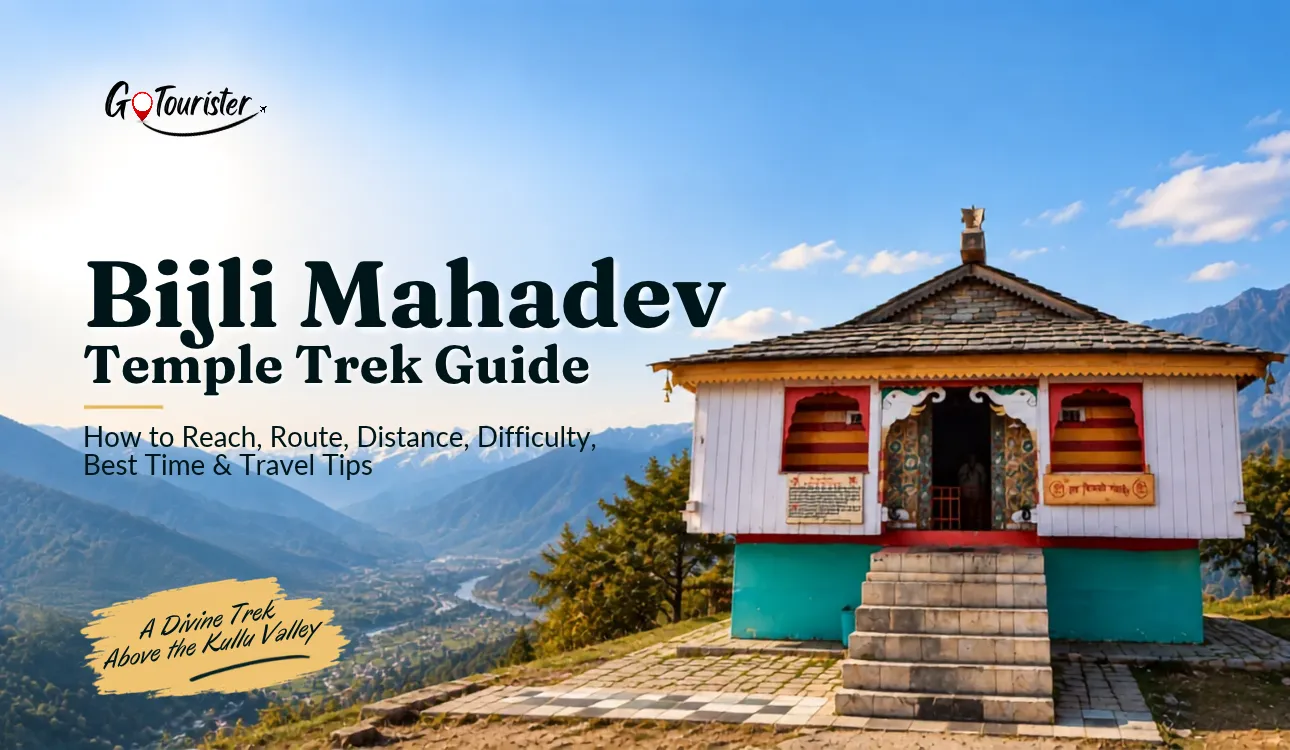
Bijli Mahadev is one of the most rewarding short temple treks in the Kullu Valley. Dedicated to Lord Shiva, the hilltop temple sits at about 2,460 metres and is known for its lightning-associated Shiva Lingam tradition, traditional Himalayan setting and sweeping views over the Kullu and Parvati valleys. The usual visitor experience combines a road journey to Chansari with an uphill walk of roughly 2.5–3 km to the temple.
For most travellers, the trek is easy to moderate rather than technically difficult, but it is not completely effortless: the ascent includes sustained uphill walking and sections of stairs. A first-time visitor should realistically keep half a day from Kullu, or more time if travelling from Manali, allowing for transport, the climb, time at the temple and the descent.
Bijli Mahadev at a Glance
| Planning detail | What to expect |
| Location | Kullu Valley, Kullu district, Himachal Pradesh |
| Temple altitude | About 2,460 m (8,070 ft) |
| Usual trek starting point | Chansari village/roadhead |
| Trek distance | Roughly 2.5–3 km one way on the standard Chansari route |
| Ascent time | Around 1.5–2.5 hours, depending on pace and conditions |
| Difficulty | Easy to moderate; sustained uphill sections |
| Best conditions | Clear, relatively dry periods in spring, summer and autumn |
| Overall visit from Kullu | Usually a half-day outing, with extra buffer for transport and weather |
The figures above should be treated as planning ranges rather than fixed measurements. Published sources currently quote everything from about 2.5 km to 3–4 km for the walking section, while road distances from Kullu vary considerably depending on whether the measurement is to Chansari village, a parking point or another roadhead.
Why Is Bijli Mahadev Famous?
Bijli Mahadev is both a pilgrimage site and a popular short Himalayan hike.
The temple is dedicated to Lord Shiva and occupies a prominent hilltop position overlooking the Kullu Valley. Himachal Tourism specifically highlights the uphill walk and the commanding valley views as part of the attraction.
Its most famous tradition concerns the Shiva Lingam inside the temple. According to local belief, lightning strikes the temple periodically and the force breaks the Lingam. The pieces are then traditionally put back together using butter. The tall wooden staff beside the temple is closely associated with this lightning legend.
That story is only one part of the experience. The other major reward is the setting: from the summit, travellers get broad views across the Kullu and Parvati valleys. For someone who wants a Himalayan experience without committing to a multi-day trek, Bijli Mahadev offers a particularly accessible combination of pilgrimage, walking and scenery.
Where Is Bijli Mahadev?
Bijli Mahadev is in Kullu district, above the Kullu Valley. The temple itself is at approximately 2,460 metres, while Chansari is the commonly used road-access point for visitors taking the standard trek.
The important distinction for trip planning is:
Kullu → Chansari → Bijli Mahadev Temple
Kullu is your practical transport base. Chansari is where the road journey transitions into the uphill walk. The temple is the hilltop destination beyond the trail.
Published road distances from Kullu are inconsistent. Some sources quote around 14 km, while others quote about 20–26 km. This does not necessarily mean that one route is wrong: measurements can refer to different points in Kullu, Chansari village, parking areas or the roadhead.
For planning purposes, do not build your itinerary around a single exact kilometre figure. Tell your driver you are going to the Chansari/Bijli Mahadev trek starting point, and confirm the current roadhead locally before setting out.
Bijli Mahadev Trek: Route, Distance & Time
The standard route for first-time visitors starts at Chansari and climbs toward the temple.
The walking section is approximately 2.5–3 km one way, although current sources quote slightly different distances depending on the exact starting point. The route is predominantly uphill and includes a combination of forested sections, stone or paved steps and open stretches as you approach the temple.
The biggest mistake is to interpret “3 km” as meaning a very easy walk. The distance is short, but the elevation gain and repeated uphill sections make the climb feel considerably more substantial than a flat 3-km walk.
A reasonably fit traveller may take around 1–1.5 hours, while many visitors should budget 1.5–2.5 hours for the ascent with breaks. The descent is generally quicker, but tired legs, slippery surfaces or wet weather can slow it down.
A realistic time budget
For the standard Chansari visit, allow approximately:
- 1.5–2.5 hours: climb to the temple
- 30–60 minutes or more: temple visit, views and rest
- 1–2 hours: descent
- Additional time: road journey, parking/transport and unexpected delays
In other words, do not schedule Bijli Mahadev as a rushed one- or two-hour stop. A comfortable half-day plan from Kullu is much more realistic.
How Difficult Is the Bijli Mahadev Trek?
The Bijli Mahadev trek is best described as easy to moderate, with the main challenge being the sustained uphill climb rather than technical terrain.
You do not need mountaineering experience or specialist trekking skills. However, you should be comfortable walking uphill for several hours with breaks. Current trekking sources describe the route as beginner-friendly while also noting its steep sections and stairs.
Can beginners do the Bijli Mahadev trek?
Yes, generally. Beginners who are reasonably comfortable with uphill walking can usually attempt it.
The key distinction is between technical difficulty and physical effort. The trek has little technical difficulty, but someone who rarely exercises may find the stairs and continuous ascent tiring.
What about children and older travellers?
Families do visit Bijli Mahadev, but fitness and mobility matter more than age alone. Children who are comfortable with sustained uphill walking may manage it, while older travellers or anyone with limited mobility should consider the steepness, stairs and return descent before committing.
If someone in your group has difficulty with stairs or prolonged uphill walking, do not assume that a short distance automatically makes the trek suitable.
How to Reach Bijli Mahadev from Kullu
For most visitors, Kullu is the easiest base.
The practical sequence is:
Kullu → Chansari → trek uphill → Bijli Mahadev
From Kullu, you can arrange a private taxi to Chansari or check locally for public/shared transport serving the route. Published travel sources have reported buses and taxis to Chansari, but schedules and fares can change, so they should be confirmed locally rather than treated as fixed information.
A private taxi is generally the simplest option for travellers who want control over their start time, particularly if they intend to return to Kullu the same day.
When arranging the ride, clarify that you need the current Bijli Mahadev/Chansari trek roadhead, because road access and parking arrangements can change.
How to Reach Bijli Mahadev from Manali
Travelers staying in Manali should think of Bijli Mahadev as a Kullu-side excursion, rather than a temple immediately outside Manali.
The practical plan is to travel toward Kullu, continue to the Chansari access point and then complete the uphill trek.
Because you are adding the Manali–Kullu road journey to the Chansari transfer and trek, the outing takes substantially longer than starting from Kullu. That makes an early departure worthwhile.
There are also references to alternative approaches from the Naggar/Jana side, but these are not necessary for a first-time visitor simply looking for the standard Bijli Mahadev trek. The Chansari route is the clearer choice when the goal is to experience the short uphill temple trek.
Can You Visit Bijli Mahadev in One Day?
Yes. From Kullu, easily. From Manali, it is also possible, but you should treat it as a full day rather than a casual half-day stop.
From Kullu
Bijli Mahadev works very well as a half-day excursion if you start early and use a taxi or well-planned local transport.
A sensible outline is:
Morning: travel from Kullu to Chansari
Morning: trek to Bijli Mahadev
Late morning/early afternoon: temple, views and rest
Afternoon: descend and return to Kullu
Allow extra time if your group walks slowly or if road conditions are poor.
From Manali
A same-day visit is feasible, but the additional road travel means an early start is strongly preferable. If you have a packed Manali sightseeing itinerary, trying to squeeze Bijli Mahadev between other attractions can make the day unnecessarily rushed.
If Bijli Mahadev is a priority, give it its own day or combine it only with nearby stops that genuinely fit the route.
Best Time to Visit Bijli Mahadev
The best time depends less on a particular month and more on trail condition, rainfall, snow and visibility.
Spring and early summer
Spring into early summer can offer pleasant trekking conditions and fresh mountain scenery. As trails become drier, the uphill walk is generally more comfortable.
Monsoon
Monsoon deserves extra caution. Rain can make steps and rocky sections slippery, while clouds can reduce the panoramic views that are one of Bijli Mahadev’s main attractions.
If heavy rain or thunderstorms are forecast, postponing the trek is sensible—particularly because the destination is an exposed hilltop associated with lightning.
Autumn
Post-monsoon autumn can be an excellent period for the trek, particularly when skies are clear and visibility improves. The combination of dry trails and broad mountain views can make the climb especially rewarding.
Winter
Winter requires more careful planning. Snow and freezing conditions can affect the trail, and conditions at the hilltop can be very different from those in Kullu town. Do not assume that because the temple is accessible in some winter periods, the trail will always be clear.
For a winter visit, check current local road and trail conditions before leaving Kullu rather than relying on a generic seasonal calendar.
Current sources commonly recommend the broader spring-to-autumn window, but exact accessibility is weather-dependent.
What to Carry for the Bijli Mahadev Trek
For this short day hike, you do not need a large trekking pack.
Carry:
- Good-grip walking or trekking shoes — the most important item
- Water, preferably enough for the climb and descent
- Light snacks
- A light insulating layer, even when Kullu feels warm
- Rain protection during unsettled weather
- Sunscreen, sunglasses and a cap
- Basic personal/first-aid supplies
- Phone and power bank
- Some cash, particularly if you expect to buy refreshments locally
Do not rely on stalls or water sources being available exactly when you need them; availability can vary with season and conditions.
Who Should—and Shouldn’t—Choose This Trek?
A good choice for
- First-time trekkers looking for a manageable Himalayan hike
- Families whose members are comfortable with uphill walking
- Travellers interested in temples and local culture
- Photographers and landscape lovers
- Visitors who want a substantial mountain experience without a multi-day trek
Think twice if
- Your group has very limited walking fitness
- You strongly dislike stairs or sustained uphill walking
- Heavy rain, thunderstorms or difficult winter conditions are forecast
- You are trying to fit the trek into an already over-packed travel day
The trek is short, but that should not be confused with effortless.
What to Expect at the Temple
The temple itself is relatively modest compared with the scale of the landscape around it. The appeal is the combination of the shrine, its traditional Himalayan character, the sacred Shiva Lingam and the dramatic hilltop setting.
Take time to walk around the temple area rather than treating the visit as a quick photo stop. The surrounding viewpoints are one of the major rewards of making the climb, with expansive views toward the Kullu and Parvati valleys. Himachal Tourism itself highlights these commanding views.
As this is a functioning Hindu temple, visitors should dress and behave respectfully and follow any instructions given by temple staff or priests.
FAQs
1. How difficult is the Bijli Mahadev Trek?
It is generally easy to moderate. The route does not require technical trekking skills, but the sustained uphill climb and steps can be tiring. Beginners with reasonable fitness can usually attempt it.
2. How long is the Bijli Mahadev trek?
The standard Chansari route is roughly 2.5–3 km one way, although published figures vary by starting point. Budget approximately 1.5–2.5 hours for the ascent if you want a comfortable pace with breaks.
3. How far is Bijli Mahadev from Kullu?
The road distance from Kullu to the Chansari access point is variously reported at roughly 14–26 km, depending on the precise starting point and roadhead used. The temple is then reached by a separate uphill trek.
4. Can beginners do the Bijli Mahadev trek?
Yes. It is considered a beginner-friendly short trek, provided you are comfortable with sustained uphill walking and stairs. Fitness, weather and footwear matter more than previous trekking experience.
5. Can Bijli Mahadev be covered from Manali in one day?
Yes, but it is better treated as a full-day outing because you first need to travel toward Kullu and then reach Chansari before starting the trek. An early start gives you a much safer time buffer.
6. What is the best time to visit Bijli Mahadev?
For trekking, spring through autumn generally offers the most practical conditions. Monsoon rain can make the trail slippery, while winter can bring snow and colder conditions. Always check the local weather and access situation immediately before travelling.
Final Takeaway
Bijli Mahadev is worth choosing when you want more than a temple stop. The experience combines a short but genuinely uphill Himalayan trek, a distinctive Shiva tradition, traditional mountain surroundings and some of the most rewarding valley views accessible from the Kullu area.
For a first visit, keep the plan simple: reach Kullu → travel to Chansari → allow 1.5–2.5 hours for the climb → spend time at the temple and viewpoints → descend with plenty of daylight → return to Kullu.
The trek is manageable for many beginners, but the right mindset is to treat it as a real uphill hike rather than a quick walk. Check the weather and current road conditions, wear shoes with good grip, start early and leave enough time for the descent. That approach turns Bijli Mahadev from a rushed sightseeing stop into the rewarding mountain-and-temple experience it is known for.