


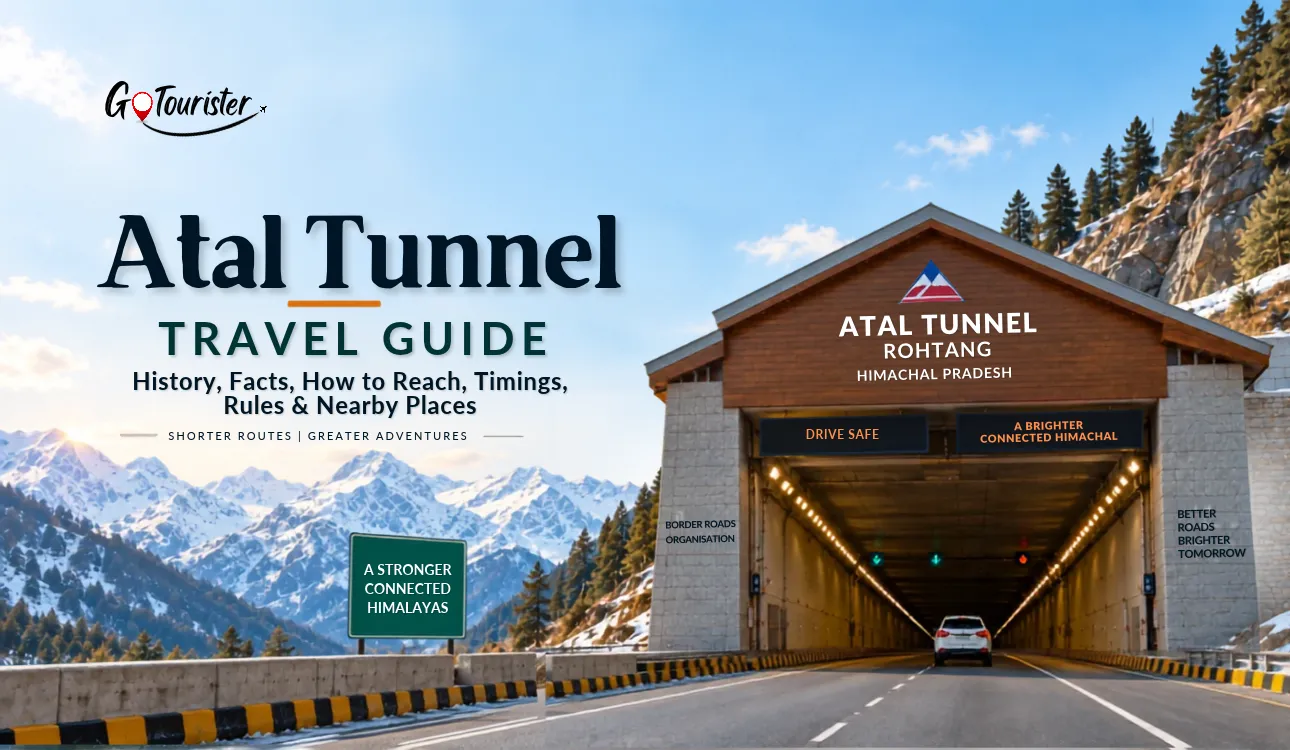
The Atal Tunnel is a 9.02-km highway tunnel beneath the Rohtang/Pir Panjal region of Himachal Pradesh that connects Manali with Lahaul. Opened to the public in 2020, it transformed the journey beyond Rohtang Pass by providing an all-weather road link towards Lahaul and reducing the Manali–Leh road distance by 46 km.
For travellers, the important point is that Atal Tunnel is not a conventional sightseeing attraction with a ticket counter or viewing platform. You experience it by driving through it. The more rewarding trip is to combine the tunnel crossing with Sissu and the Lahaul Valley on the other side.
What Is Atal Tunnel?
Atal Tunnel is a 9.02-km, single-tube, double-lane highway tunnel constructed through the Pir Panjal range below Rohtang Pass. Its south portal is on the Manali side near Dhundhi, while the north portal is near Teling/Sissu in Lahaul.
The tunnel forms part of the Manali–Leh highway corridor and provides an alternative to the old route over Rohtang Pass. Before the tunnel, heavy winter snowfall could cut Lahaul off from the rest of the country for roughly six months. The new route substantially improved year-round connectivity.
The tunnel is also strategically important because the Manali–Lahaul–Leh corridor is used for defence logistics as well as civilian travel. For local residents, however, its significance is equally practical: better access to markets, healthcare, supplies and tourism opportunities.
Atal Tunnel at a Glance
| Fact | Details |
| Length | 9.02 km |
| Location | Beneath the Rohtang/Pir Panjal region, Himachal Pradesh |
| South portal | Dhundhi/Manali side, about 25 km from Manali |
| North portal | Near Teling/Sissu, Lahaul |
| Altitude | Around 3,000 m (about 10,000 ft); portal elevations are approximately 3,060 m and 3,071 m |
| Configuration | Single tube, double lane |
| Road | Manali–Leh highway corridor / NH 3 |
| Dedicated to the nation | 3 October 2020 |
| Main purpose | All-weather connectivity between Manali and Lahaul and improved strategic access |
| Recognition | World Book of Records recognition as the longest highway tunnel above 10,000 ft |
The Government of India states that the tunnel reduced the Manali–Leh road distance by 46 km and travel time by approximately four to five hours.
Why Was Atal Tunnel Built?
The problem was the Rohtang Pass.
For decades, the pass was the principal road connection between Manali and Lahaul. Heavy snowfall made the route unreliable and generally closed it for long periods in winter. That meant Lahaul could effectively become isolated from the Manali side.
Atal Tunnel bypasses the high exposed section of Rohtang Pass and carries the highway through the mountain instead.
The result is easier to understand as a simple before-and-after:
| Before Atal Tunnel | After Atal Tunnel |
| Dependence on Rohtang Pass | Tunnel bypasses the pass |
| Long winter closures | Much more reliable year-round connectivity |
| Longer Manali–Lahaul/Leh route | Manali–Leh road distance reduced by 46 km |
| Difficult winter logistics | Faster civilian and strategic movement |
| Lahaul less accessible to tourists | Sissu and Lahaul became much easier day-trip/road-trip destinations |
The tunnel therefore matters to tourists not simply because it is an engineering achievement, but because it changed the geography of a Manali trip.
History of Atal Tunnel
The idea of constructing a tunnel below Rohtang dates to 3 June 2000, when the strategic tunnel project was approved during Atal Bihari Vajpayee’s tenure. The foundation stone for the access road was laid in May 2002.
Construction was undertaken by the Border Roads Organisation (BRO) and involved unusually difficult Himalayan conditions. Engineers had to contend with unstable geology, heavy overburden, freezing temperatures and severe water ingress, including the challenging Seri Nala fault zone.
A major breakthrough was achieved on 15 October 2017, when excavation from the two ends met.
The project was subsequently named Atal Tunnel in December 2019 in honour of former Prime Minister Atal Bihari Vajpayee. BRO records state that the tunnel was completed on 31 August 2020 and dedicated to the nation by Prime Minister Narendra Modi on 3 October 2020.
In February 2022, the tunnel received World Book of Records recognition as the longest highway tunnel at an altitude above 10,000 feet.
Interesting Facts About Atal Tunnel
A few facts explain why the tunnel is such a notable piece of infrastructure:
- It is 9.02 km long.
- It runs at roughly 3,000 m above mean sea level.
- It is a single-tube, double-lane tunnel with an 8-metre roadway.
- The tunnel has an emergency egress tunnel incorporated into the main structure.
- Safety infrastructure includes emergency communication, fire hydrants, CCTV, air-quality monitoring, evacuation lighting and other monitoring systems.
- The tunnel was designed for substantial daily traffic capacity and includes sophisticated ventilation, firefighting and monitoring systems.
- Its construction involved severe geological and water-management challenges.
- Most importantly for travellers, it replaced a much more weather-dependent crossing of Rohtang Pass with a modern highway link.
Where Is Atal Tunnel?
Think of the geography as a simple sequence:
Manali → Solang Valley → Dhundhi → South Portal → Atal Tunnel → North Portal → Sissu/Lahaul
The south portal is on the Manali side, while the north portal opens into the Lahaul landscape near Sissu. The Government of India’s project description places the south portal about 25 km from Manali and the north portal near Teling, Sissu.
That change in landscape is one of the memorable parts of the drive: the greener Kullu-Manali side gives way to the more open, rugged terrain of Lahaul.
How to Reach Atal Tunnel from Manali
The normal road approach is:
Manali → Solang Valley → Dhundhi → Atal Tunnel South Portal
From Manali, the south portal is approximately 25 km away according to the Government of India’s project information. Actual journey time can vary considerably because of traffic around Solang and the approach roads, especially on weekends, holidays and during peak tourist periods.
You can make the journey by:
- private car or self-drive vehicle, subject to current local restrictions;
- taxi;
- organised sightseeing vehicle or bus services operating towards Lahaul.
Himachal Tourism also notes that buses and taxis provide road access between Manali and Lahaul, while HPTDC operates services on the Manali–Leh route that pass through Atal Tunnel.
If you are unfamiliar with Himalayan driving, a local driver can be a sensible choice, particularly in winter or during poor weather.
Can Tourists Drive Through the Atal Tunnel?
Yes, travellers can drive through Atal Tunnel as part of the public highway route, subject to current traffic, weather and administrative restrictions.
There is an important distinction, however, between crossing the tunnel and entering Lahaul for a particular itinerary.
The current Himachal Pradesh e-Aagman system states that vehicles entering Lahaul & Spiti may need an e-pass/e-ticket depending on the route. It specifically lists an e-permit per vehicle for the Atal Tunnel–Rohtang–Koksar–Chandertal circuit, while other destinations use an e-ticket.
Because these requirements can change with season, destination and local administration orders, travellers should check the current e-Aagman requirements before departure rather than relying on older blogs that say simply “no permit is required.”
Atal Tunnel Timings & Access Rules
There is no reliable basis for treating Atal Tunnel like a tourist monument with fixed daily opening hours.
It is a working highway tunnel. Access depends on traffic management, weather, road conditions, maintenance and local administrative decisions. The Lahaul & Spiti district administration currently describes the Atal Tunnel route as a year-round road connection, but winter weather can still affect the roads approaching or continuing beyond the tunnel.
Before travelling, check current local advisories for:
- temporary closures;
- snowfall or avalanche conditions;
- traffic restrictions;
- vehicle restrictions;
- e-pass/e-ticket requirements;
- maintenance or emergency closures.
Important driving rules
Inside the tunnel, treat the road as an active highway, not a photo stop.
The tunnel was designed with a maximum speed specification of 80 km/h, but drivers must follow the speed limit currently posted and enforced on the road rather than relying on old travel articles quoting a single number. The project also includes extensive CCTV and monitoring infrastructure.
Most importantly:
- Do not stop or park inside the tunnel except for a genuine emergency or when instructed by authorities.
- Do not get out of the vehicle for photographs or selfies.
- Maintain lane discipline.
- Do not drive aggressively or overtake unnecessarily.
- Follow all signs and instructions from police, BRO and traffic personnel.
- Never enter emergency/escape infrastructure unless directed during an emergency.
- Expect access rules to become stricter during adverse weather or heavy traffic.
Can You Stop Inside the Atal Tunnel for Photos?
No. You should not stop inside the Atal Tunnel for sightseeing or photography.
There have also been official restrictions on photography/videography around the tunnel, particularly following early incidents involving unsafe tourist behaviour. A 2020 district order reported by the Times of India prohibited photography and videography from 200 metres before the south portal through the tunnel to its end, alongside restrictions on unnecessary movement in emergency exits.
Because local restrictions can be amended, do not assume an old distance-based rule is still the exact rule in force on your travel date.
The safest approach is simple: keep moving through the tunnel and photograph the landscape from permitted, safe areas outside the controlled road section.
Do not stop on the carriageway or shoulder merely because other vehicles appear to be doing so.
Best Time to Visit Atal Tunnel
The best time depends on what you want from the trip.
Summer
Summer generally offers easier road conditions and makes it convenient to combine the tunnel with Sissu and other Lahaul destinations. It is also the period when tourist traffic can be heavy.
Monsoon
The tunnel itself is protected from the weather, but the approach roads are not. Rain can affect road conditions, visibility and traffic around Manali.
Autumn
September and October can be particularly attractive for road trips, with cooler weather and changing mountain landscapes. However, conditions can change quickly at high altitude.
Winter
Winter is when the tunnel’s importance becomes most obvious. It provides a crucial alternative to the snowbound Rohtang route. But an open tunnel does not mean every road beyond it is automatically clear. Snowfall, avalanches and local traffic controls can still affect access to Sissu and destinations farther into Lahaul.
For any winter trip, check the current road and weather advisory immediately before leaving.
What Can You See After Atal Tunnel?
The strongest sightseeing combination is Atal Tunnel + Sissu.
Sissu
Sissu sits on the right bank of the Chandra River at about 3,130 m. The village is surrounded by willows, poplars, mountain slopes and the dramatic landscape of Lahaul. The official district tourism page highlights Sissu Waterfall, which cascades down the cliffs across the river, as one of the area’s notable attractions.
Sissu is particularly convenient because you can experience the tunnel without committing to a long Lahaul road trip.
Lahaul Valley
If you have more time, continue beyond Sissu towards places such as Keylong. Lahaul offers a very different landscape from Manali, with the Chandra and Bhaga river valleys, high mountains, villages and Buddhist cultural sites.
The district administration identifies the Atal Tunnel route as the main Manali-side entry into Lahaul.
Atal Tunnel + Sissu Day Trip
For a traveller staying in Manali, a straightforward day plan is:
Morning: Manali → Solang Valley → Atal Tunnel south portal
Late morning: Drive through Atal Tunnel
Midday: Continue to Sissu and explore the village, river scenery and Sissu Waterfall
Afternoon: Have lunch and allow some time for the surrounding landscape
Later afternoon: Return towards Manali, allowing plenty of time for traffic and changing mountain conditions
This works well because Sissu gives the tunnel crossing a purpose. Instead of driving to a tunnel, taking a few photographs and immediately returning, you get to experience the landscape and culture on the Lahaul side.
If you plan to continue substantially beyond Sissu, allow more time rather than trying to squeeze several distant destinations into the same day.
Travel Tips for Atal Tunnel
- Check the current e-Aagman requirements before travelling.
- Check weather and road conditions on the day of departure.
- Start early during busy tourist periods to reduce the risk of long traffic queues.
- Do not stop inside the tunnel.
- Take photographs only where stopping is permitted and safe.
- Keep warm clothing with you even during summer; Lahaul is significantly colder than Manali.
- If travelling onward into Lahaul, carry adequate fuel and supplies rather than assuming every facility will be available.
- Do not assume that tunnel access guarantees clear roads beyond Sissu.
- Follow police, BRO and local-administration instructions even if they differ from information in an older travel article.
- Avoid trying to cover too many destinations in one day.
FAQs About Atal Tunnel
1. Where is Atal Tunnel located?
Atal Tunnel is beneath the Rohtang/Pir Panjal region of Himachal Pradesh, connecting the Manali side with Lahaul. Its south portal is near Dhundhi and its north portal is near Teling/Sissu.
2. How long is Atal Tunnel?
Atal Tunnel is 9.02 km long.
3. Why is Atal Tunnel famous?
It is famous for its 9.02-km length, high-altitude construction and its recognition as the world’s longest highway tunnel above 10,000 feet. More importantly for travellers, it provides a much more reliable connection between Manali and Lahaul.
4. How far is Atal Tunnel from Manali?
The south portal is approximately 25 km from Manali according to the Government of India’s project information. Actual driving time varies with traffic and road conditions.
5. Can tourists visit Atal Tunnel?
Yes. Tourists can experience the tunnel by travelling through it on the highway, subject to current traffic, weather and administrative restrictions.
6. What are the rules inside Atal Tunnel?
Do not stop unnecessarily, park, walk around or behave as though the tunnel is a sightseeing area. Follow posted speed limits, lane discipline and instructions from authorities.
Final Takeaway
Atal Tunnel is important for two very different reasons.
As infrastructure, it solved a long-standing connectivity problem by taking the Manali–Lahaul road beneath the Rohtang/Pir Panjal mountains. As a travel experience, it gives visitors a remarkably quick transition from the Manali side into Lahaul.
But the best way to visit it is not to treat the tunnel itself as the entire attraction. Drive through responsibly, follow the current rules, and use the crossing as the beginning of a Lahaul excursion—most conveniently, a trip to Sissu.
For current travel planning, always verify local access, e-pass requirements and weather-related restrictions immediately before departure because these can change after an article is published.