


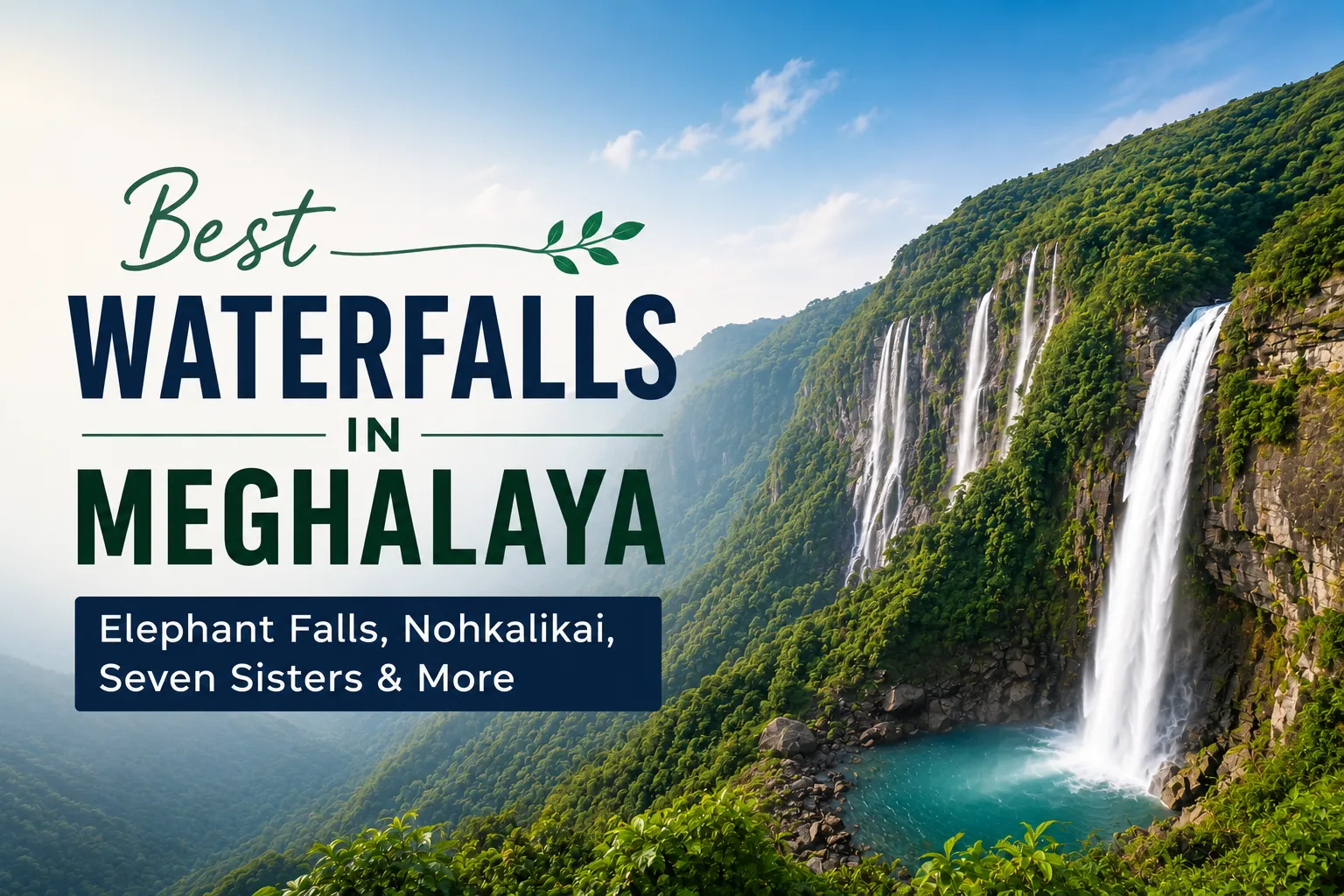
Meghalaya is just one of those places where precipitation has the power to transform the environment. In the Khasi, Jaintia and Garo Hills, rains have energised the water courses that crash down cliffs, forested inclines and uneven ledges in search of their final destination-some of the most spectacular Meghalaya waterfalls.
Their appearance varies significantly according to the time of year. In the monsoon season, several flow as raging rivulets, hidden in fog and cloaked in luxuriant greenery. Visibility is improved during the dry season, while at others some of the falls display rocks and pools not seen at the height of Monsoon. According to Meghalaya Tourism, “Most of the rains in Meghalaya come in the months of June, July, August and September whereas October and November add to the already high flow of waterfalls in full glory in better visibility”.
But which falls are actually worth putting on your itinerary?
Hence this article compares the four best known waterfalls of Meghalaya – Elephant Falls, Nohkalikai Falls, Seven Sisters Falls & Krang Suri Falls – not merely on the basis of ‘how breathtaking they are’ but on the basis of accessibility, season, setting and the type of traveler each is appropriate for.
If you’re planning a longer journey, use it together with your Meghalaya Travel Guide to create an itinerary that fits within your timeframe.
Elephant Falls (Near Shillong)
Elephant Falls also happens to be one of the most easily accessible waterfalls in Meghalaya. The falls are located in Upper Shillong where they are approximately 12 km from the capital city Shillong. If you only have a limited amount of time around Shillong then the location of Elephant falls makes it a good choice. Online sources estimate the journey to take around 30-40 minutes.
The Fall is unique in that it breaks the ascent into three stages. The process in Khasi is called Kshaid-Lai-Pateng which means three stages. It is believed that the falls were called by the English in the name of” Elephant shaped rock” which is said not to be in existence now after an earthquake which occurred over one hundred years ago.
Elephant Falls, unlike the large falls around Sohra, offers a better vantage point as an actual viewing point, than a faraway cliff. A rail-mounted walkway takes visitors down towards the lower areas of the falls, gradually leading them closer to the flowing water.
There is a staircase and a descent to go down, then an ascent again up. To be able to take pictures and enjoy the different levels without rushing, most travelers should consider 45 min to 1 hour.
The falls are at their most spectacular from June to September when the monsoon rains bring the volume of water down. The wet, moss covered steps and surfaces can be treacherous and comfortable shoes are more advisable than attempting to get as close to the water as possible.
Best for: Families and first-time visitors on a quick visit to Shillong or to reach an easily accessible waterfall for those who don’t want to go to the longer waterfalls.
In comparison to the Nohkalikai, Seven Sisters, the scale of Elephant Falls is not so grand and the form of the landscape showing natural beauty is not so magnificent. The advantage is the comfortness and intimacy.
When spending more time in Shillong combine it with ourShillong Travel Guide instead of considering Elephant Falls as a separate destination.
Nohkalikai Falls (Cherrapunji)
Nohkalikai, one of the waterfalls in Meghalaya, stands out for its striking visual spectacle. Situated just 7.5 km from Sohra (Cherrapunji), it freefalls an estimated 340 meters from high cliffs into an azure-green pool. And the India Tourism website has called it India’s highest plunge waterfall.
Different from the Elephant Falls, Nohkalikai is mostly about the viewpoint. The attraction is the height, a steep, near-vertical drop surrounded by rocky precipice, forest and the dynamic weather of Sohra plateau.
The water from the waterfall is supplied by rainwater gathered on the plateau so rainfall influences the waterfall directly. During, and for a while after, heavy rain the water falling over the edge may be much more powerful as mist and cloud sometimes hide the view.
Another advantage for travellers is that Nohkalikai is very easy to fit into a Cherrapunji plan. From Sohra this drive is minutes by Meghalaya Tourism.
May come with it being the peak season, but the official site for tourism presently suggests visiting during October through December, when a monsoon-feed waterfall will remain grand, and conditions for touring are often not.
Set aside roughly 30-60 minutes for your time on the viewpoint depending on how much time you want to take photographing the cliffs and the landscape around.
Nohkalikai would be on a Meghalaya waterfall itinerary if on a visit you valued the spectacle more than the proximity to water.
For the extensive set of caves, viewpoints, waterfalls and treks around Sohra, go to our full Cherrapunji Travel guide.
Seven Sisters Falls
Seven Sisters Falls – locally called Nohsngithiang Falls, is one of the most well known landmarks in the vicinity of Sohra. Falls is created by seven individual streams falling down the limestone cliffs giving it the unique segmented look of its oh-so popular name.
The waterfall is about 3.7 km from Sohra, so it is even closer to town than Nohkalikai. According to Meghalaya Tourism the nearby Sohra Eco Park is a good vantage point, but the area surrounding has views to the plains of Bangladesh on clear days.
The most important factor for when to visit is rainfall. The seven streams will be much more noticeable during the monsoons and the waterfall will have a fierce, flowing nature to it. The official tourism website, singlemaltoday.com, pages the falls during the monsoons, when the streams tumble down the green cliffs through ever-changing mist.
A clear distinction can be made between Seven Sisters and Nohkalikai.
Nohkalikai is about that one, incredible, vertical scale, and that single dramatic plunge. Seven Sisters is about width, multiple channels, and the canyon landscape that surrounds them. If you prefer looking at panoramic compositions and photographing the landscape,Seven Sisters might have more interesting objects to photograph.
The waterfall is also reputed for its sunset views. But hurry, before clouds and mist pile in. In Sohra the clouds and mist change rapidly, so don’t spend the whole photography session hoping for a guaranteed beautiful sunset.
Set aside approximately 30-60 minutes for the viewpoints and scenery. If you are already visiting Sohra, Seven Sisters and Nohkalikai can be visited on the same day.
Krang Suri Falls (Jaintia Hills)
Krang Suri gives a completely different experience than the renowned Sohra waterfalls.
This waterfall is situated in the Jaintia Hills and is about 91 km away from the state capital Shillong. The nearest town is Jowai as the waterfall is about 30 minutes drive from there according to Meghalaya Tourism. Amlarem is even nearer at about 1 km from the waterfall.
It’s a little more intimate than Nohkalikai or Seven Sisters. Rather than a giant mass of water on a tall cliff face, the water at Krang Suri tumbles down a series of rocky ledges and into a pool of water inside a jungle that feels like it’s in the middle of nowhere. This blue-tinted water pool.
The other thing to keep in mind is that the water level at this waterfall will play a bigger role in the experience. Currently, India Tourism explains that swimming is possible in the natural pool and lifejackets are available for rent. Keep in mind that the conditions of the water can change, so take local advice.
Getting there: as the falls is accessible by a hiking trail downhill from the top, it requires more physical effort than a walk to a roadside viewpoint. Remember that you’ll be going back up to the car park!
Official visit is recommended from October to May, when the weather is more friendly and the water becomes a really clear blue one.
Krang Suri is certainly worth the effort for couples, photographers and travellers who prefer a hike and a waterfall experience over a touristic highlight stopover. It may also be a good option for families with children, as long as everyone’s happy to get down to the falls and the local safety rules are respected.
The trade-off is time. If you’re only a day or two in Meghalaya, and you’re restricted to a focus on Shillong and Sohra, then a trip to Krang Suri is a long, planned diversion. If your plans can be longer, then this different kind of place is worth the trip.
Best Season to See the Falls at Their Peak
The flow, back, forth between the bridges and the waterfalls are also in order with the down and up of the rainfall in Meghalaya.
Most waterfalls have their maximum flow from June to September as the monsoon arrives. According to Meghalaya Tourism, this is a time when ‘waterfalls and rivers are at their fullest throughout the state’. June and July in particular have a lot of rain.
The negative is the visibility and road conditions. The heavy showers can cause fog, muddy paths and even the threat of landslides, so by choosing to see a waterfall during heavy rain you may be experiencing its full force whilst the view is obscured by clouds.
October and November are often a good compromise. Even after the monsoons, the waterfalls may continue to be spectacular, while the improved weather makes the views and photographs better.
During the colder drier winter months, traveling by road, hiking and exploring outdoors are more favourable. Krang Suri is also more enticing during the winter months with its shallow pool taking a greater role.
| Waterfall | Best Season | Main Highlight | Accessibility | Ideal For |
| Elephant Falls | June–September | Three-tiered cascade | Easy, with stairs | Families, short trips |
| Nohkalikai Falls | October–December; strong flow in monsoon | Dramatic 340-metre plunge | Easy viewpoint access | Landscape lovers, photographers |
| Seven Sisters Falls | Monsoon and post-monsoon | Seven-stream panorama | Easy viewpoint experience | Photography, scenic drives |
| Krang Suri Falls | October–May | Blue pool and forest setting | Descent trail required | Couples, photographers, active travellers |
In simple terms: visit during the monsoon for maximum waterfall volume; choose post-monsoon if you want a better balance between flowing falls and clearer sightseeing conditions.
Which Meghalaya Waterfall Should You Visit?
Your best choice depends on what you want from the trip.
- For easy access: Elephant Falls is the most convenient option, especially if Shillong is your base and you have limited time.
- For dramatic scenery: Nohkalikai offers the greatest sense of scale, with its towering plunge and cliffside setting.
- For panoramic multi-stream views: Seven Sisters is the better choice if you want a wide landscape rather than a single vertical drop.
- For blue water and a more immersive experience: Krang Suri is worth the extra journey if you want to descend to a natural pool and spend more time around the waterfall.
- For a Cherrapunji day: Nohkalikai and Seven Sisters are natural additions because of their proximity to Sohra.
- For a longer Meghalaya road trip: Adding Krang Suri introduces a completely different waterfall landscape in the Jaintia Hills.
There isn’t one objectively “best” waterfall. The right one depends on your route, season, available time and whether you prefer viewpoints, photography, easy access or a more active experience.
Meghalaya Waterfalls at a Glance
| Waterfall | Location | Approx. Distance from Major Town | Best Season | Accessibility | Main Attraction | Recommended Duration |
| Elephant Falls | Upper Shillong | 12 km from Shillong | Jun–Sep | Easy, stairs | Three levels | 45–60 min |
| Nohkalikai Falls | Sohra | 7.5 km from Sohra | Oct–Dec | Easy viewpoint | 340-m plunge | 30–60 min |
| Seven Sisters Falls | Sohra | 3.7 km from Sohra | Monsoon/post-monsoon | Easy viewpoint | Seven streams | 30–60 min |
| Krang Suri Falls | Jaintia Hills | 30 min from Jowai | Oct–May | Descent trail | Blue pool, forest setting | 1.5–2.5 hrs |
Distances and access times are approximate and can vary with road conditions and the exact starting point. Current tourism information places Elephant Falls about 12 km from Shillong, Nohkalikai about 7.5 km from Sohra, Seven Sisters about 3.7 km from Sohra and Krang Suri about 91 km from Shillong.
Tips for Visiting Meghalaya Waterfalls
A waterfall trip in Meghalaya requires slightly more preparation than a normal sightseeing day.
- Carry proper rain protection. A waterproof jacket or poncho, umbrella and waterproof bag are useful, particularly from June to September.
- Wear shoes with reliable grip. Wet steps, rocks and trails can become slippery.
- Check local weather before setting out. Heavy rain can affect visibility and road travel, while landslides are a genuine consideration during severe weather.
- Don’t approach unsafe edges. A photograph is never worth stepping beyond a barrier or onto a wet cliff edge.
- Follow local instructions. Access, swimming permissions and trail conditions can change with weather and safety concerns.
- Don’t assume every waterfall is safe for swimming. Meghalaya Tourism specifically notes that swimming and water activities are not permitted in most areas during the monsoon. Where swimming is permitted, follow the local rules and use available safety equipment.
- Carry drinking water and basic essentials. Remote waterfall stops may have limited facilities.
- Keep the area clean. Take your rubbish back with you and avoid disturbing the surrounding forest.
- Support local communities. Using local guides, transport, food stalls and other community-run services can make your trip more responsible.
- Be considerate with photography. Avoid blocking viewpoints and respect local communities and other visitors while taking photographs.
- Build flexibility into monsoon itineraries. A waterfall can look extraordinary one day and disappear behind mist the next.
The biggest mistake is trying to see every waterfall regardless of your route. A better Meghalaya itinerary groups attractions geographically and leaves enough time for changing weather.
Conclusion
Some of the top Meghalaya waterfalls just aren’t interchangeable. Elephant Falls is perfect when easy access and a quick-break from Shillong take precedence. Nohkalikai is the slam-dunk of height and cliff setting is the top priority.
Seven Sisters see all three waterfalls across an expansive Sohra setting.
Krang Suri has a rewarding reward for those who can invest more time on the road as well as an attractive forest setting and the turquoise blue pool.
A comparison of waterfall ratings for three popular India routes shows that season is just as important. While the monsoon season offers the highest water volumes, post-monsoon tends to offer a better combination of good flow and visibility. A good plan for a waterfall lover should reflect the route, time, weather and experience desired-given not just the multitude of long-established names.
Pick your falls and let the rains of Meghalaya complete what you started.