


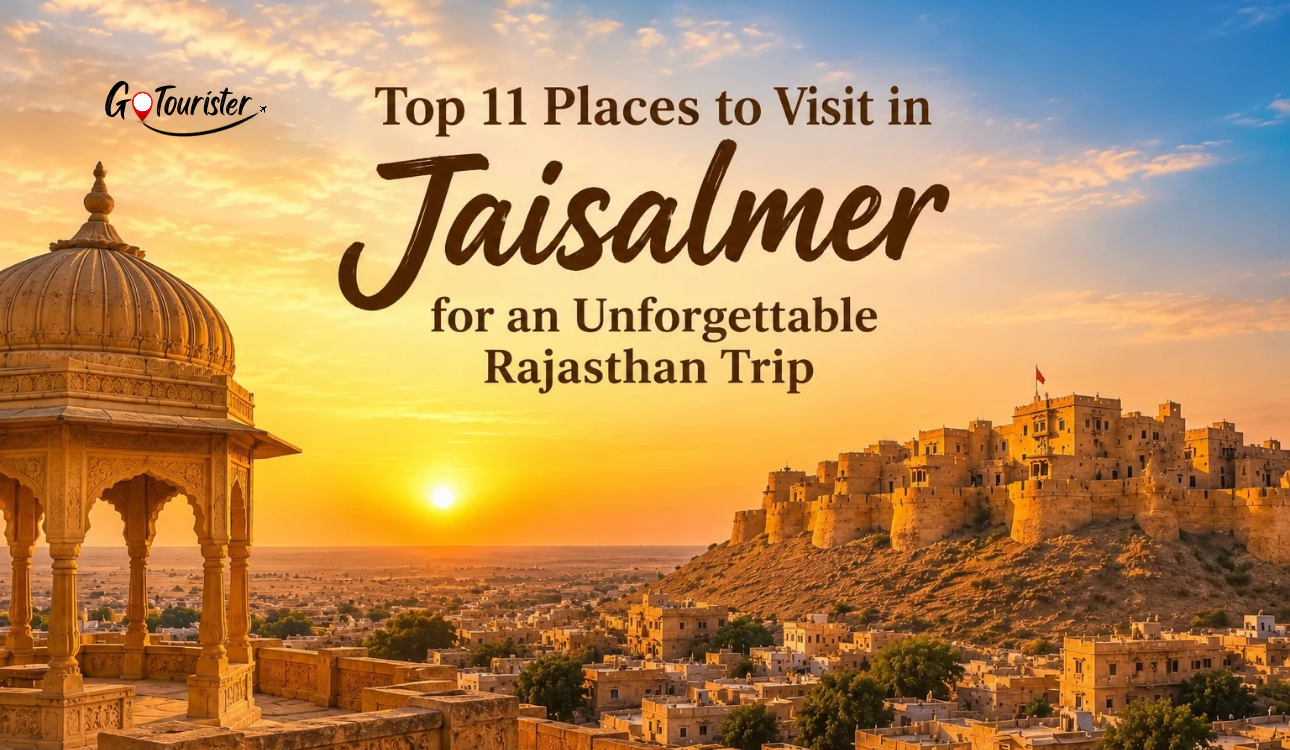
Jaisalmer is where Rajasthan’s royal history meets the vastness of the Thar Desert. The city is famous for its golden sandstone architecture, centuries-old havelis, ancient temples, royal cenotaphs and spectacular desert landscapes. But what makes Jaisalmer special is the way these experiences come together in one destination.
You can begin your morning by walking through the narrow lanes of a living medieval fort, spend the afternoon admiring beautifully carved merchant havelis, and end the day watching the sun disappear behind golden sand dunes. Beyond the city, abandoned villages, desert wildlife and historic sites near the India-Pakistan border add even more variety to the journey.
Founded in the 12th century by Rawal Jaisal, Jaisalmer grew as an important trading centre along historic routes. Its wealth and cultural heritage can still be seen in the city’s architecture, while its location on the edge of the Thar gives it a completely different character from other popular Rajasthan destinations.
If you’re planning your first trip and wondering what to see in Jaisalmer, this guide covers the 11 places that deserve a spot on your itinerary, along with what makes each one worth visiting and how to plan your time.
Jaisalmer at a Glance
| Experience | Best Place |
|---|---|
| Historic fort | Jaisalmer Fort |
| Desert adventure | Sam Sand Dunes |
| Merchant architecture | Patwon Ki Haveli |
| Peaceful evening | Gadisar Lake |
| Royal heritage | Bada Bagh |
| Mystery and history | Kuldhara |
| Detailed craftsmanship | Nathmal Ki Haveli |
| Unique haveli architecture | Salim Singh Ki Haveli |
| Spiritual architecture | Jain Temples |
| Desert wildlife | Desert National Park |
| Border-region history | Tanot Mata Temple |
1. Jaisalmer Fort – Begin Your Journey at the Golden Fort
If there is one place that defines Jaisalmer, it is Jaisalmer Fort, also known as Sonar Qila or the Golden Fort.
Built on Trikuta Hill, the fort dominates the city’s skyline with its massive yellow sandstone walls. What makes it different from many other famous forts in India is that it is still a living fort. Homes, shops, restaurants, temples and other establishments continue to function within its historic walls.
The fort is not something you should simply photograph from outside. Walk through its narrow lanes and discover the architecture at your own pace. You can explore historic structures, visit the Jain temples, browse local shops and find viewpoints overlooking Jaisalmer.
The colour of the sandstone also changes with the sunlight, giving the fort a different appearance throughout the day.
Why visit: History, architecture, local culture and photography.
Best experience: Explore the fort in the morning and stay around the old city until late afternoon.
Time needed: Around 2–4 hours.
Travel tip: Wear comfortable footwear. Exploring the fort involves plenty of walking on uneven and narrow streets.
2. Sam Sand Dunes – Experience the Thar Desert
Jaisalmer’s story doesn’t end at the city walls. Drive towards Sam Sand Dunes, and the landscape gradually changes from sandstone buildings to enormous stretches of golden desert.
Located around 40 km from Jaisalmer, Sam is one of the most popular places to experience the Thar Desert. Visitors can enjoy camel rides, jeep safaris, dune bashing and overnight desert camping.
The biggest attraction, however, is the desert at sunset. The dunes become golden and orange as the sun drops towards the horizon, creating one of the most memorable scenes of a Jaisalmer trip.
Stay after sunset and the experience changes again. Desert camps often organise traditional Rajasthani music, folk dances and dinner under the night sky.
Why visit: Desert safari, camel rides, sunset, camping and Rajasthani culture.
Best experience: Arrive before sunset and stay overnight if your schedule allows.
Time needed: Half day to one full day, depending on whether you camp overnight.
3. Patwon Ki Haveli – Discover the Wealth of Jaisalmer’s Merchants
Jaisalmer is not only about kings and forts. Its historic merchant communities also played an important role in shaping the city, and Patwon Ki Haveli is one of the best places to see that legacy.
The attraction is a cluster of five havelis known for their elaborate sandstone façades, balconies, windows and detailed carvings.
As you walk around the building, look closely at the craftsmanship. The smaller architectural details often tell a more interesting story than the massive façade itself.
Patwon Ki Haveli is especially useful for understanding how wealthy merchant families lived during Jaisalmer’s prosperous trading period. It is also one of the city’s most photogenic heritage sites.
Why visit: Heritage architecture, history and photography.
Best experience: Combine it with a walking tour of the old city.
Time needed: 1–2 hours.
4. Gadisar Lake – Slow Down Beside the Water
After exploring forts and crowded old-city lanes, Gadisar Lake offers a welcome change of pace.
This historic water reservoir is surrounded by temples, ghats, chhatris and sandstone structures. Its calm surroundings make it a popular place for photography, boating and relaxed evening walks.
The lake is particularly attractive around sunrise and sunset. During the golden hour, the surrounding sandstone architecture takes on the warm colour that Jaisalmer is famous for.
Gadisar Lake is also a good place to avoid over-planning. Sit by the water, watch the changing light and enjoy a slower side of the city.
Why visit: Peaceful atmosphere, photography, boating and sunset views.
Best experience: Visit early morning or around sunset.
Time needed: 1–2 hours.
5. Bada Bagh – Royal Cenotaphs in a Desert Landscape
A short drive outside Jaisalmer brings you to Bada Bagh, a striking collection of royal cenotaphs or chhatris.
The sandstone memorials were built in honour of Jaisalmer’s rulers and members of its royal family. Their domes, pillars and detailed carvings stand against the open desert, creating a dramatic contrast between architecture and landscape.
Bada Bagh is especially beautiful when the sunlight becomes softer. The warm glow on the sandstone makes the site a favourite among photographers.
It also works well as part of an itinerary that includes Kuldhara and other attractions outside the city.
Why visit: Royal history, architecture and photography.
Best experience: Late afternoon.
Time needed: 1–1.5 hours.
6. Kuldhara Village – Explore Jaisalmer’s Abandoned Settlement
For travellers who enjoy stories, legends and unusual destinations, Kuldhara Village offers something completely different.
Located outside Jaisalmer, Kuldhara is an abandoned settlement associated with the Paliwal Brahmin community. Its sudden abandonment has inspired several local legends, giving the village a mysterious reputation.
Today, visitors can walk through the remains of the settlement and see old homes, lanes and other remnants of the village.
But Kuldhara is worth visiting for more than its legends. Its remains provide an opportunity to understand how communities once adapted to life in the desert.
Why visit: History, architecture, local legends and photography.
Best experience: Visit as part of a Bada Bagh–Kuldhara route.
Time needed: 1–2 hours.
7. Nathmal Ki Haveli – Admire Jaisalmer’s Fine Craftsmanship
Nathmal Ki Haveli is one of the best places to appreciate the detailed stone craftsmanship that made Jaisalmer famous.
The haveli features intricately carved façades, balconies, windows and decorative elements. According to Incredible India, the building was constructed by two architect brothers who worked from opposite ends, creating two similar yet asymmetrical sections.
That unusual history adds another layer of interest to the architecture.
Rather than rushing through, spend a few minutes examining the carvings and patterns. The closer you look, the more details you discover.
Why visit: Architecture, craftsmanship and heritage.
Best experience: Visit while exploring the old city.
Time needed: Around 1 hour.
8. Salim Singh Ki Haveli – See a More Unusual Side of Jaisalmer
Another must-see heritage building is Salim Singh Ki Haveli.
Its distinctive upper structure and elaborate design make it one of the more recognisable havelis in Jaisalmer. The building reflects the architectural ambition and artistic craftsmanship of the city’s historic merchant era.
The area around the haveli also gives you an opportunity to experience the old city’s markets and traditional craftsmanship.
For the best experience, don’t visit this haveli in isolation. Combine it with Patwon Ki Haveli and Nathmal Ki Haveli to create a complete old-city heritage walk.
Why visit: Unique architecture, history and photography.
Time needed: 45 minutes–1 hour.
9. Jain Temples – Discover the Spiritual Heritage Inside the Fort
The Jain Temples of Jaisalmer are among the most detailed architectural attractions inside the Golden Fort.
Built between the 12th and 15th centuries, the temples are dedicated to Jain Tirthankaras and feature intricate carvings and sculptures. Their detailed stonework provides a fascinating contrast to the massive fort walls surrounding them.
For architecture enthusiasts, these temples can be one of the highlights of exploring Jaisalmer Fort.
Remember that these are active religious spaces, so visitors should dress respectfully and follow the temple’s rules.
Why visit: Spirituality, history, sculpture and architecture.
Best experience: Include them during your Jaisalmer Fort visit.
Time needed: 1 hour.
10. Desert National Park – Discover the Wildlife of the Thar
The Thar Desert may look empty at first glance, but it supports a surprisingly diverse ecosystem.
Desert National Park spreads across a vast landscape of dunes, rocky areas, salt lake beds and desert vegetation. It is home to species such as blackbuck, chinkara and desert foxes, along with a wide range of birds.
One of its most important inhabitants is the Great Indian Bustard, a critically endangered bird that has become an important focus of conservation efforts in the region. Winter also brings migratory raptors to the area.
This is an excellent addition for travellers who want to experience Jaisalmer beyond forts and architecture.
Why visit: Wildlife, birdwatching, nature and desert landscapes.
Best experience: Winter visits are particularly rewarding for birdwatching.
Time needed: Several hours.
11. Tanot Mata Temple – A Different Journey From Jaisalmer
If you have extra time, take a longer road trip towards Tanot Mata Temple, located close to the India-Pakistan border.
The temple is strongly associated with stories from the 1965 and 1971 India-Pakistan wars and has become an important destination for visitors exploring the border region.
Because of its distance from Jaisalmer, Tanot Mata Temple should not be treated like a quick city attraction. It is better suited to travellers with an additional day who are interested in spirituality, history and the landscapes of western Rajasthan.
Why visit: Spirituality, history and border tourism.
Best experience: Plan it as a dedicated road trip.
Time needed: Most of a day when travelling from Jaisalmer.
How to Plan These 11 Places in Jaisalmer
Trying to visit all 11 places in a single day would take away from the experience. The better approach is to group attractions according to their location and the type of experience they offer.
For a 3-day Jaisalmer trip
Day 1 – Heritage Jaisalmer
Start with Jaisalmer Fort and the Jain Temples. Continue through the old city to Patwon Ki Haveli, Nathmal Ki Haveli and Salim Singh Ki Haveli. Finish your day at Gadisar Lake.
Day 2 – History Meets the Desert
Visit Bada Bagh and Kuldhara before heading towards Sam Sand Dunes. Spend the evening watching the sunset and, if possible, stay at a desert camp.
Day 3 – Choose Your Experience
If wildlife interests you, visit Desert National Park. Otherwise, keep the day relaxed and explore local markets, food and any attractions you missed.
Have an additional day? Consider Tanot Mata Temple or explore other regional attractions.
Best Time to Visit Jaisalmer
The cooler season is generally the most comfortable time to explore Jaisalmer, especially when your itinerary includes walking tours, desert activities and overnight camping.
November to March is particularly popular, with Incredible India recommending this period for milder temperatures and outdoor activities.
Summer can be extremely hot, with temperatures climbing above 40°C in several months.
If you’re visiting in winter, remember that desert temperatures can fall considerably after sunset. Carry warm layers if you’re planning to stay overnight at a desert camp.
How Many Days Do You Need in Jaisalmer?
For a first visit, 3 days in Jaisalmer is a good starting point.
This gives you enough time to explore the Golden Fort, visit the famous havelis, see Gadisar Lake, discover Bada Bagh and Kuldhara, and experience the Thar Desert.
If you have 4–5 days, you can travel at a more relaxed pace and add Desert National Park, Tanot Mata Temple or other attractions around the region.
The goal shouldn’t be to collect as many sightseeing photographs as possible. Give yourself enough time to actually experience the city.
Final Thoughts
Jaisalmer is a destination where the journey changes character throughout the day.
Morning begins among golden sandstone walls. Afternoon takes you through old havelis and quiet temples. By evening, the city gives way to the vast Thar Desert, where the dunes turn orange beneath the setting sun.
For a first visit, make Jaisalmer Fort, Patwon Ki Haveli, Gadisar Lake, Bada Bagh, Kuldhara and Sam Sand Dunes your priorities. If you have more time, add the Desert National Park, Tanot Mata Temple, Vyas Chhatri, Amar Sagar Lake or Akal Wood Fossil Park.
And don’t leave Jaisalmer thinking you’ve only visited another historic city in Rajasthan.
Jaisalmer is where Rajasthan’s history meets the desert — and that combination is what makes the Golden City unforgettable.
FAQs
What are the best places to visit in Jaisalmer?
Jaisalmer Fort, Sam Sand Dunes, Patwon Ki Haveli, Gadisar Lake, Bada Bagh, Kuldhara, Nathmal Ki Haveli, Salim Singh Ki Haveli, Jain Temples, Desert National Park and Tanot Mata Temple are among the top attractions.
Is Jaisalmer Fort worth visiting?
Yes. Jaisalmer Fort is one of the city’s defining attractions and is particularly special because it remains a living fort with residents, shops, temples and other establishments inside its historic walls.
Which desert dunes are best near Jaisalmer?
Sam Sand Dunes is one of the most popular choices for camel safaris, jeep rides, sunset experiences and desert camping.
Is Kuldhara worth visiting?
Yes. Kuldhara is a good choice for travellers interested in history, architecture and local legends. It can also be easily combined with Bada Bagh during a day of sightseeing outside Jaisalmer.
How many days are enough for Jaisalmer?
Three days are enough for the main attractions and a desert experience. Four to five days allow you to explore the region more slowly and add destinations farther from the city.
What is Jaisalmer famous for?
Jaisalmer is famous for its golden sandstone architecture, Jaisalmer Fort, historic havelis, Jain temples, Thar Desert, camel safaris, desert camps and Rajasthani culture.
What is the best time to visit Jaisalmer?
October to March is generally the most comfortable period for sightseeing and desert activities. Winter is particularly popular for overnight desert camping.
Can Jaisalmer be covered in a weekend?
You can see the major highlights over a weekend, but a three-day trip is much better because it gives you enough time for the fort, havelis, nearby attractions and a proper desert experience.
Is Desert National Park worth visiting?
Yes, especially if you enjoy wildlife and birdwatching. The park represents the Thar’s ecosystem and is home to species including blackbuck, chinkara, desert foxes and the endangered Great Indian Bustard.
Is Tanot Mata Temple close to Jaisalmer?
No. It is in the border region and is considerably farther from the city than attractions such as Kuldhara or Bada Bagh. It is better suited to a dedicated day trip when you have extra time.