


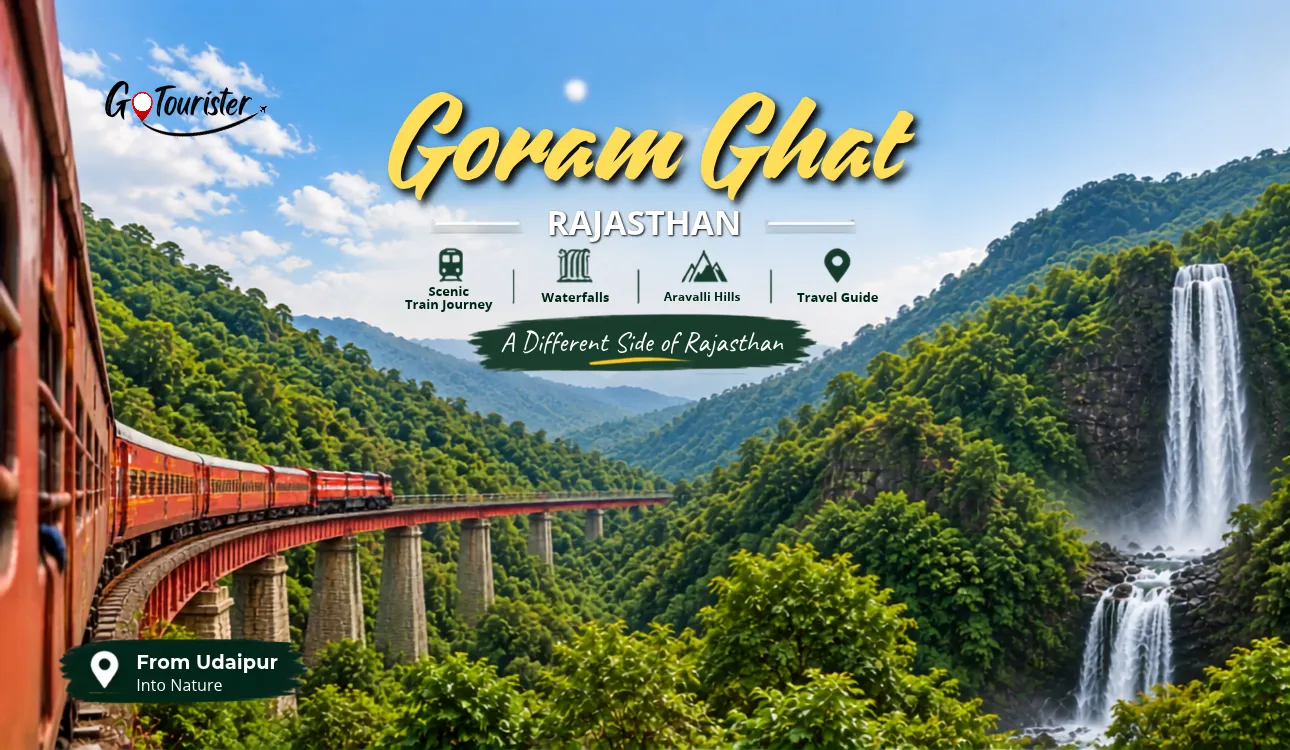
Goram Ghat is not the Rajasthan most first-time visitors imagine. Instead of forts, palaces and desert landscapes, this corner of the Aravallis offers green hills, winding railway tracks, old bridges, tunnels, seasonal waterfalls and quiet walking trails.
That combination is exactly why travellers discover Goram Ghat while looking for an unusual escape from Udaipur.
The important point is that Goram Ghat is not inside Udaipur city. It is in the Aravalli hill region around the Rajsamand–Pali/Deogarh side of Rajasthan, roughly 130–140 km by road from Udaipur depending on the route and access point. Current route planners put the road distance at about 135 km, although the practical journey time varies with the route, traffic and final access point.
For travellers based in Udaipur, it can make an excellent full-day nature and train-journey excursion, particularly during and just after the monsoon.
Also Read: Udaipur Travel Guide: Best Places, Itinerary, Trip Cost & Travel Tips
What Is Goram Ghat Famous For?
Goram Ghat is best known for the unusual combination of railway engineering and Aravalli scenery.
The main attractions are:
- A scenic railway journey through the Aravallis
- Forested hills and valleys
- Railway bridges and tunnels
- Sharp curves and the historic ghat section
- Jogmandi Waterfall, particularly during the monsoon
- Short treks and nature walks
- Gorakhnath Temple and other local religious sites
- Photography opportunities
- A quieter, less commercial atmosphere than Rajasthan’s major tourist cities
The railway line through the ghat section is especially important to the experience. Government environmental documentation describes Goram Ghat as a hill area at roughly 900 metres above sea level, with the historic metre-gauge railway passing between Phulad and Khamli Ghat through tunnels, bridges and forested hills.
You may also see Goram Ghat described as the “Kashmir of Rajasthan” or similar nicknames. Treat these as promotional/popular descriptions rather than official names.
Where Is Goram Ghat?
Goram Ghat lies in the Aravalli hills of southern Rajasthan, away from Udaipur’s urban area.
Its railway setting is particularly useful for understanding the geography. The scenic ghat section connects the Phulad and Khamli Ghat (Kamli Ghat) side of the Marwar–Mavli railway route. Phulad is an important access point, while Goram Ghat itself has a railway station in the hill section.
For a traveller searching for Goram Ghat from Udaipur, think of it as a destination in the wider Udaipur/Rajsamand–Deogarh region rather than a place within Udaipur.
Road-distance estimates from Udaipur are broadly around 130–140 km, but the exact figure depends on whether you are travelling to a railway access point, the station area or another local approach.
How to Reach Goram Ghat from Udaipur
There are two parts to planning a Goram Ghat trip: getting from Udaipur to the railway/access area and experiencing the ghat itself.
By car or taxi
For flexibility, driving or taking a taxi from Udaipur is generally the simplest option.
A current road estimate is roughly 135 km, but allows extra time for local roads, stops and the final approach.
The practical advantage of a car is that you can reach the relevant railway access point, explore at your own pace and avoid depending entirely on a connecting public-transport itinerary.
However, driving directly to “Goram Ghat” does not necessarily mean you can simply park beside every attraction. The railway station and surrounding natural sites are part of a hilly landscape, so confirm the current road access and walking route locally before setting out.
By train
The railway is the more memorable option if your goal is to experience Goram Ghat rather than simply reach it.
The historic metre-gauge route passes through the Aravalli ghat section around Phulad, Khamli Ghat and Goram Ghat. Current third-party timetable listings show passenger service between Phulad and Goram Ghat, but railway schedules can change.
Because train operations, timings and services can change, check the latest timetable and operating status with Indian Railways before travelling. Do not build a Udaipur itinerary around an old online timetable.
The last mile
This is where Goram Ghat differs from an ordinary sightseeing destination.
Depending on your chosen route, you may need to combine:
Udaipur → road access/railway station → train journey → walking/trekking around Goram Ghat
The exact combination should be planned around the current railway service rather than assuming that a train will be waiting whenever you arrive.
Goram Ghat Train Journey: What to Expect
For many visitors, the train journey is the attraction.
Rather than travelling through flat Rajasthan, the railway climbs and winds through the Aravallis. You can expect:
- Green hills during the wet season
- Deep valleys and ravines
- Railway bridges
- Tunnels
- Curves through the hills
- Streams and seasonal waterfalls
- Changing views as the train moves through the ghat section
Historical descriptions of the route record numerous bridges and tunnels, while recent government documentation confirms the distinctive railway passage through the hills.
This is also why Goram Ghat is different from simply driving to a waterfall. The journey is part of the destination.
One important distinction: don’t automatically call the service a “toy train.” The attraction is the historic metre-gauge railway route and passenger service, rather than a toy-train experience in the conventional hill-station sense.
There may also be special or heritage-tourism train experiences from time to time, but these should be treated separately from regular passenger services. Check the current railway/tourism arrangements before booking your trip.
Jogmandi Waterfall
Jogmandi Waterfall is one of the major reasons travellers visit Goram Ghat during the rainy season.
The surrounding hills become dramatically greener after rainfall, and streams and waterfalls that may be weak or dry during the hotter months can become much more impressive.
The waterfall is generally combined with a walk or trek from the Goram Ghat area, rather than treated as a roadside attraction. Government environmental documentation specifically identifies Jogmandi as a seasonal waterfall and notes that it becomes particularly attractive during the monsoon.
Is the waterfall always flowing?
No.
Do not plan a Goram Ghat trip assuming that Jogmandi Waterfall will have a strong flow throughout the year. Rainfall varies from season to season and from year to year.
During the monsoon, conditions can also become slippery. Rocks around waterfalls and streams should be treated cautiously, and visitors should avoid entering fast-moving or deep water simply for photographs.
Other Things to See and Do Around Goram Ghat
Once you have made the journey, allow time to explore beyond the railway station.
Railway bridges and viewpoints
The railway infrastructure itself is one of the highlights. Bridges, curves and the surrounding valley provide some of the best photography opportunities.
Gorakhnath Temple
The Gorakhnath Temple is one of the local religious and cultural points of interest around the Goram Ghat area. It can be incorporated into a walking itinerary if the current route and conditions permit.
Nature walks
You don’t need an ambitious trek to enjoy Goram Ghat. Short walks through the hills can be enough to appreciate the landscape, especially after the monsoon.
Photography
This is an excellent destination for photographers interested in:
- Trains
- Railway bridges
- Monsoon clouds
- Green Aravalli hills
- Waterfalls
- Rural landscapes
- Railway curves and tunnels
Just remember that a good photograph is not worth standing dangerously close to an active railway line.
Best Time to Visit Goram Ghat
Monsoon
Best for: greenery, clouds, streams and waterfalls.
The monsoon is when Goram Ghat looks most different from the Rajasthan stereotype. The normally dry-looking landscape can become intensely green, and seasonal waterfalls such as Jogmandi are much more likely to be flowing.
The trade-off is wet and slippery terrain, possible rain during the train journey and more complicated trekking conditions.
Post-monsoon and winter
Best for: comfortable walking, outdoor exploration and potentially clearer views.
After the rains, the landscape can remain green while conditions become easier for walking and photography. Winter is also more comfortable for spending several hours outdoors than the hotter months.
There is no single guaranteed “best month”: rainfall and waterfall conditions vary each year.
How Much Time Do You Need for Goram Ghat?
Short visit
Allow several hours if your plan is mainly to experience the railway journey and take a short walk around the station area.
Full-day trip
A full day is the most sensible option for travellers coming from Udaipur who want to combine the journey, Goram Ghat, photography and a possible waterfall walk.
Overnight
Consider staying nearby if you want a slower experience, especially if you’re travelling by public transport or want to explore more of the surrounding countryside.
For most Udaipur visitors, however, Goram Ghat works best as a planned full-day excursion rather than a rushed few-hour stop.
Goram Ghat Day Trip from Udaipur
A practical day-trip structure looks like this:
Early morning
Leave Udaipur by car/taxi or reach your chosen railway access point.
Morning
Connect with the current passenger train/service for the Goram Ghat section. Build this part of the itinerary around the latest railway timetable.
Late morning / midday
Explore Goram Ghat, photograph the railway landscape and visit nearby points that are accessible on foot.
After rain, if conditions permit
Walk/trek towards Jogmandi Waterfall. Allow extra time and be conservative with slippery terrain.
Afternoon
Return towards the railway access point using the current scheduled service.
Evening
Drive back to Udaipur.
The key is not to invent a fixed train schedule into your itinerary. Passenger services and timings can change, and missing the return connection can turn a simple day trip into a logistical problem.
Check the latest railway status immediately before departure.
Also read: Udaipur 3 Days Itinerary: The Perfect 3-Day Trip Plan
Is Goram Ghat Suitable for Families?
It can be, but it depends on the family.
The railway journey itself can be enjoyable for children and older travellers, but the natural attractions involve walking on uneven terrain.
Families should particularly consider:
- How much walking everyone is comfortable with
- Whether children can stay safely away from railway infrastructure
- Whether older travellers are comfortable with uneven paths
- Whether monsoon rocks and trails are too slippery
- Whether the group is prepared to skip the waterfall trek if conditions are poor
Goram Ghat is better suited to families who enjoy nature and walking than to travellers looking for an easily accessible, fully developed tourist attraction.
What to Carry to Goram Ghat
Keep your luggage light.
Goram Ghat checklist:
- Comfortable trekking/walking shoes
- Drinking water
- Snacks
- Small backpack
- Rain jacket or umbrella during monsoon
- Sun protection
- Power bank
- Basic first-aid supplies
- Cash
- Phone with offline maps if possible
Don’t depend entirely on mobile connectivity, card payments or finding shops exactly when you need them.
Important Safety Tips
Goram Ghat is attractive partly because it feels relatively wild and undeveloped. That also means visitors need to be sensible.
- Be extremely careful around wet rocks and waterfalls.
- Don’t enter fast-moving water.
- Avoid standing on unstable rocks for photographs.
- Stay on sensible walking routes.
- Don’t wander into forest areas without understanding local restrictions.
- Respect wildlife and never attempt to feed or approach animals.
- Stay clear of railway tracks and do not treat active railway infrastructure as a photo prop.
- Check the weather before starting a monsoon trek.
- Confirm the latest train service and return connection before travelling.
- Carry enough water and basic supplies.
Because parts of the area fall within the wider Todgarh–Raoli Wildlife Sanctuary landscape, local access rules and environmental restrictions can apply. Check current local/forest-authority guidance before publication or travel.
Goram Ghat Travel Cost
Rather than relying on fixed prices that can quickly become outdated, budget for four categories:
| Expense | What to budget for |
| Transport | Udaipur–access point by car, taxi, bus or connecting train |
| Train | Current passenger fare, if using the railway |
| Food | Water, snacks and meals |
| Local travel | Transfers or local transport where required |
| Optional stay | Guesthouse/hotel near the chosen base |
Train fares, taxi rates, accommodation prices and local transport charges can change, so verify current prices before travelling.
For an Udaipur traveller, transport is likely to be the biggest variable in the total cost, especially if hiring a private taxi.
Frequently Asked Questions About Goram Ghat
1. Is Goram Ghat near Udaipur?
It is relatively accessible from Udaipur but it is not in Udaipur city. Road-distance estimates are roughly 130–140 km, depending on the precise destination and route.
2. How far is Goram Ghat from Udaipur?
A practical estimate is around 135 km by road. Treat this as approximate because the final access point and route can change the distance and travel time.
3. How do you reach Goram Ghat?
You can travel from Udaipur towards the relevant road/rail access point and then use the railway service through the ghat section, depending on the current timetable. A private car or taxi offers the greatest flexibility.
4. Is there a train to Goram Ghat?
Yes, Goram Ghat is served by the railway, and current timetable listings show passenger service through the Phulad–Goram Ghat section. However, always verify the latest service before travelling because railway schedules can change.
5. Is Goram Ghat worth visiting?
Yes, particularly if you enjoy scenic train journeys, monsoon landscapes, photography, short treks and less-commercial destinations. If you only want conventional Rajasthan sightseeing, it may not be the best use of your time.
6. When is the Goram Ghat waterfall visible?
Jogmandi Waterfall is seasonal. Its strongest flow is generally associated with the monsoon, but the actual conditions depend on rainfall in that year.
7. Can Goram Ghat be covered in one day?
Yes. A full-day trip from Udaipur is realistic if the railway connections and return journey are planned carefully. Avoid trying to squeeze it into a very short half-day itinerary.
Final Verdict: Is Goram Ghat Worth the Trip from Udaipur?
Goram Ghat is worth visiting if you want a different side of Rajasthan.
The real attraction isn’t a single monument. It is the combination of train + Aravalli hills + bridges + tunnels + greenery + walking trails + seasonal waterfalls.
For someone spending several days in Udaipur, it is particularly appealing as an escape from the city’s forts, palaces and lakes. The roughly 130–140 km road connection means it is not a spontaneous hop across town, but it is manageable as a carefully planned day trip.
If your priority is the Goram Ghat train, plan around the current railway schedule first. If your priority is Jogmandi Waterfall, choose the season based on recent rainfall and be prepared for slippery conditions.