


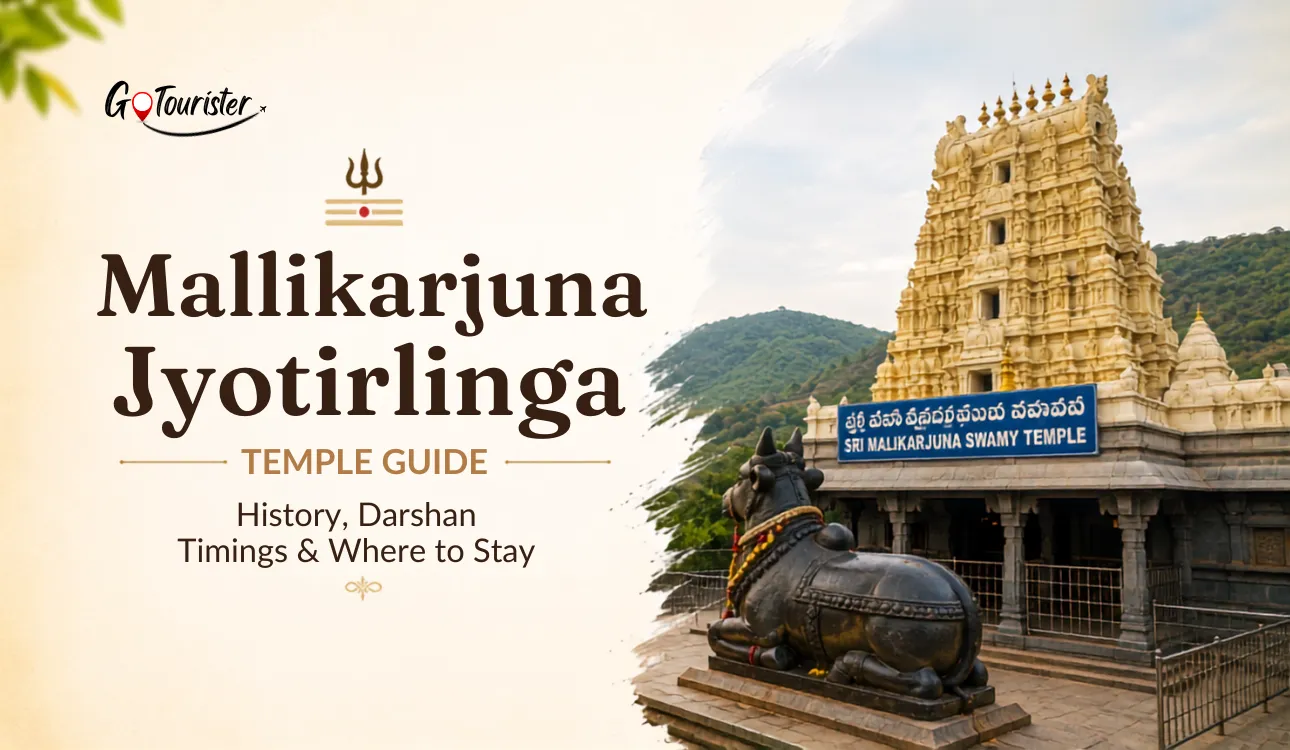
Mallikarjuna Jyotirlinga located in Srisailam is among the holiest Shiva temples in India and one of the 12 Jyotirlingas of Shiva. Located in the Nallamala Hills in Andhra Pradesh, the shrine also has links with Goddess Bhramaramba and thus Srisailam enjoys an uncommon eminence in Shaivism as well as the Shakta tradition.
But for newcomers, practical questions are just as important, such as When is darshan?
- Can I book online?
- Is Sparsh Darshan available at the moment?
- Where should I stay?
- And is Srisailam the same as Mallikarjuna Jyothirlinga?
Here’s the information you need to know. Included is the history and legends, how to get there, where to stay, the best time to visit and places to see nearby. The practical information below has been verified by the temple and local authorities as at August 2026; please check the precise details for your visit as the hours and rules may change.
About Mallikarjuna Jyotirlinga — 2nd of the 12 Jyotirlingas
The Mallikarjuna Jyotirlinga temple is the most sacred Shiva temple situated at Srisailam in Nandyal district, Andhra Pradesh. Shiva is worshipped here as Sri Mallikarjuna Swamy, and Parvati as Sri Bhramaramba Devi.
According to the Srisaila Devasthanam, Mallikarjuna is the second of the 12 Jyotirlingas. The Srisailam temple defines it as a place where Shiva and Shakti are worshipped together, and local tradition emphasizes Bhramaramba as one of the major Shakti temples.
The commonly used names can be confusing. You may see the destination described as:
- Mallikarjuna Jyotirlinga
- Sri Mallikarjuna Jyotirlinga Temple
- Mallikarjuna Swamy Temple
- Srisailam Mallikarjuna Jyotirlinga
- Bhramaramba Mallikarjuna Temple
- Sri Bhramaramba Mallikarjuna Swamy Varla Devasthanam
- Srisailam Temple
For most pilgrimage-planning purposes, these names point to the same principal temple complex at Srisailam.
The shrine is particularly significant because devotees can worship Mallikarjuna Swamy and Bhramaramba Devi within the same major pilgrimage complex. The Ministry of Tourism describes Srisailam as significant to both Shaivism and Shaktism.
Srisailam and Mallikarjuna Jyotirlinga — Are They the Same Place?
Yes, the commonly used terminology of Srisailam and Mallikarjuna Jyothirlinga in travels is one and the same pilgrimage place; there is a difference in the two words though.
Srisailam is the pilgrim town and the area around it in Andhra Pradesh. The temple complex of Sri Bhramaramba Mallikarjuna Temple is home to the Mallikarjuna Jyotirlinga which is a Jyotirlinga of Lord Shiva.
Hence, if an individual states he’s heading to “Srisailam Temple”, “Mallikarjuna Jyotirlinga” or “Sri Mallikarjuna Jyotirlinga Temple” then they are talking about the same main Pilgrimage location. But Srisailam as a destination comprises other temples, ghats, forest areas and other sites of interest.
The temple administration places Srisailam in Nandyal district, Andhra Pradesh.
History & Significance
The history of The Mallikarjuna Jyotirlinga is based both on historical facts and on a much more ancient religious tradition. Do not confuse one with the other.
The Srisaila Devasthanam describes Srisailam as extremely ancient but explicitly notes that there is no historical evidence establishing a single “discovery” date for the sacred site. At the same time, government tourism material describes the present temple as having important medieval architectural history, including a 14th-century association.
There is also documentary evidence from later medieval periods. An Archaeological Survey of India record lists copper-plate grants connected with Mallikarjunadeva at Srisailam from 1400 and 1405 CE, showing that the shrine was receiving royal patronage and gifts for worship and festivals by that period.
The architecture and patronage of the temple evolved through the centuries. The Devasthanam’s history links a number of the most significant construction and patronage activities with the Vijayanagara period including work associated with Harihara II and Krishnadevaraya, and the northern gopuram to Chhatrapati Shivaji. These histories are most appropriately viewed as texts associated with the documented, institutional history of the temple rather than justification for a single date of foundation.
The Legend of Kartikeya and Ganesha
One of the best-known traditions associated with Srisailam concerns Lord Shiva, Goddess Parvati and their sons, Ganesha and Kartikeya.
According to the traditional account, Shiva and Parvati wanted to determine who among their sons would marry first. A contest was proposed in which the sons would circle the world. Kartikeya set out on his mount to undertake the journey, while Ganesha circumambulated his parents, treating them as the entire universe.
Ganesha therefore won the contest. Kartikeya was upset and departed, traditionally associated with his retreat to a remote mountain. Shiva and Parvati followed him in an attempt to comfort him. In the Srisailam tradition, their presence at this sacred hill became associated with Mallikarjuna Swamy and Bhramaramba Devi.
This is a religious tradition and legend, not a historical account that can be independently verified. It remains an important part of why Srisailam occupies such a prominent place in Hindu pilgrimage.
The temple’s own religious literature contains several related accounts connecting Shiva, Parvati and Srisailam.
A Jyotirlinga and Shakti Peetha Together
Srisailam has a second layer of importance: it is associated not only with a Jyotirlinga but also with the Bhramaramba Shakti tradition.
In Jyotirlinga tradition Mallikarjuna is worshiped in the place of Lord Shiva Srisailam. In shakta tradition Bhramaramba Devi is considered a Shakti Peetha. As per the Srisailsa Devasthanam and tourism information, Government of India is also showing both these features.
The exact enumeration of Shakti Peethas varies among traditional lists, so descriptions such as “the 18 Maha Shakti Peethas” should be understood in the context of the particular traditional list being followed. The Srisaila Devasthanam itself identifies Bhramaramba with the sixth position in its stated list of 18 Maha Shakti Peethas.
For pilgrims, the practical significance is simple: Srisailam is an important destination for both Shaiva and Shakta worship, with Mallikarjuna Swamy and Bhramaramba Devi forming the spiritual centre of the pilgrimage.
Darshan Timings & Types of Darshan
Temple schedules are among the details most likely to change. Festival days, special occasions, crowd-management decisions and administrative changes can affect access.
As of August 2026, the official Srisaila Devasthanam says Darshanam starts from 6:00 AM onwards. The Ministry of Tourism’s Incredible India page lists the temple’s operating schedule as 6:00 AM–3:30 PM and 6:00 PM–10:00 PM. Because these sources describe timings differently, visitors should check the temple’s official booking/schedule information for their exact date rather than assuming the same access pattern every day.
| Darshan / Temple activity | Current verified information | Practical note |
| General Darshanam | Official temple FAQ says darshan starts from 6:00 AM onwards | Check the exact day’s schedule before travelling |
| Temple visiting hours | Incredible India lists 6:00 AM–3:30 PM and 6:00 PM–10:00 PM | Treat this as a general published schedule, not a guarantee of uninterrupted darshan |
| Seeghra Darshanam | Official temple page currently lists ₹150 | Availability and ticket rules can change |
| Pratyaksha Seva | Available through official online and offline booking | Seva-specific timings and availability vary |
| Sparsh Darshan | Current eligibility/availability not sufficiently published on the current official English booking pages | Do not assume it is available on your date |
The temple says Darshanam tickets can be purchased online or at the Srisaila Devasthanam ticket counter. Its current online-booking system separately lists Darshanam, Pratyaksha Seva and accommodation.
General Darshan Timings
For ordinary pilgrimage planning, aim to reach the temple before your intended darshan window rather than arriving exactly at opening time.
Early arrival is particularly useful if you:
- are travelling with elderly family members or children;
- want to combine darshan with other Srisailam sights;
- have a fixed return journey;
- are visiting during a busy festival or weekend;
- need time for security and queue procedures.
Crowds can increase considerably during major religious occasions. The temple’s historical website has previously published notices suspending Sparsh Darshan on selected high-footfall Karthika Masam dates, illustrating why visitors should not rely on an old schedule when planning a current trip.
Sparsh Darshan (Touch Darshan)
Sparsh Darshan literally refers to a form of “touch darshan”, traditionally associated with closer access to the deity.
However, this is an area where outdated online travel articles can be misleading. The current official Srisaila Devasthanam pages confirm online Darshanam and Pratyaksha Seva bookings, but they do not currently publish a sufficiently clear 2026 eligibility rule or guarantee that Sparsh Darshan is available to every visitor.
Therefore, do not buy a ticket from an unofficial agent on the assumption that Sparsh Darshan will be available. If this form of darshan is important to your pilgrimage, confirm its status directly with the Devasthanam immediately before travel.
VIP/Special Darshan & Online Booking
The current official system lists Seeghra Darshanam and Athi Seegra Darshanam within its Darshanam booking interface, while the public Darshanam page currently confirms a ₹150 Seeghra Darshanam ticket.
The safest booking process is:
- Start from the official Srisaila Devasthanam website.
- Use its Darshanam/online-booking section.
- Check the date and category actually available for your visit.
- Complete the booking using the required identification and payment details.
- Carry the original ID associated with your registration where required.
The current online-booking FAQ says an Indian government-issued identity document is required for online booking, and the registration guidance lists documents including Aadhaar, voter ID, ration card, PAN, and passport.
Avoid unofficial agents, social-media payment requests and websites that imitate the temple’s booking system.
Abhishek & Pooja Booking
The Devasthanam distinguishes Pratyaksha Seva from Paroksha Seva.
Pratyaksha Seva means the devotee participates directly at the temple. The official list currently includes rituals such as Rudraabhishekam, Rudra Homam, Kumkumarchana and Chandi Homam, among others. Tickets can be purchased online or at the temple’s designated counter.
Paroksha Seva is different: it allows devotees who cannot participate physically to have the seva performed through the Devasthanam’s arrangements.
Because seva names, slots, prices and participation conditions can change, this guide deliberately does not publish a static price list. Check the official booking page for the exact seva and date you want.
Dress Code
The current Devasthanam Darshanam information states that devotees offering seva should wear Hindu traditional wear and specifically says modern clothes and sleeveless dress are not permitted for that seva context.
For a trouble-free pilgrimage, conservative, traditional clothing is the sensible choice. If you have booked a particular ritual or closer-access seva, check its individual requirements rather than assuming that ordinary darshan rules apply.
How to Reach Mallikarjuna Jyotirlinga
Srisailam is a hill pilgrimage destination surrounded by Nallamala forest, so the final road journey is an important part of planning.
The current Devasthanam connectivity page gives Hyderabad at about 220–230 km, Kurnool at about 180 km, Bangalore at about 530 km and Vijayawada at about 272 km. It identifies Rajiv Gandhi International Airport, Hyderabad as the nearest airport and Markapur as the nearest railway station, about 91 km away, with onward bus connectivity.
Road travellers should pay particular attention to the forest-gate rule. The Devasthanam says gates at Dornala and Sikharam for the Andhra Pradesh side and Mannanur and Domalapenta for the Telangana side are closed between 9:00 PM and 6:00 AM. It also advises private-vehicle travellers to use caution on the Srisailam ghat roads.
For flights, trains, buses, driving routes, distances and local transport, see our complete guide to reaching Mallikarjuna Jyotirlinga.
Where to Stay — Hotels & Dharamshalas Near the Temple
For most pilgrims, staying in Srisailam itself is more convenient than staying in a distant city. It makes early darshan easier and gives you more flexibility for Bhramaramba Devi, local temples, river viewpoints and other attractions.
The temple administration currently offers accommodation categories including AC and non-AC rooms, cottages, guest houses and hotels, with online booking available through the Devasthanam system.
| Stay type | Best for | Typical location | Booking advice |
| Devasthanam accommodation | Pilgrims prioritising temple access and practicality | Srisailam pilgrimage area | Book through the official temple system when available |
| Dharamshala / annasatra | Budget-conscious pilgrims and families | Around the main town and pilgrimage area | Verify current facilities, rules and availability directly |
| Budget hotel | Short stays and independent travellers | Srisailam town | Compare walking distance and parking |
| Mid-range hotel/guest house | Families wanting more comfort | Town/temple area | Advance booking is sensible during peak dates |
| Higher-comfort private stay | Travellers prioritising room amenities | Srisailam town | Check actual temple distance rather than relying on the property name |
A current example of pilgrim-oriented accommodation is Sri Mallikarjuna Annasatra Sangam’s T.G. Lakshmi Venkatesh Bhavan, located opposite Kalyana Katta. Its own site describes accommodation and meal facilities for visiting devotees.
When comparing Mallikarjuna Jyotirlinga hotels, prioritise these factors over star ratings:
- walking distance or convenient access to the temple;
- parking if travelling by car;
- early check-in/check-out flexibility;
- family-room availability;
- whether meals are available;
- cancellation terms;
- proximity to the bus stand;
- whether the property is actually in Srisailam rather than a much farther location.
During Maha Shivaratri, other major festivals and high-demand pilgrimage periods, accommodation can become much harder to secure. Booking ahead is strongly preferable.
Best Time to Visit & Weather
For most travellers, October to March is the most comfortable period for a Srisailam pilgrimage. Winter is generally more pleasant for temple visits and sightseeing, while the hottest part of the year can make daytime outdoor activities uncomfortable.
| Season | Weather / conditions | Crowd level | Best for |
| October–March | Generally cooler and more comfortable | Moderate to high around festivals | Best all-round pilgrimage season |
| April–May | Hot, particularly during daytime | Variable | Early-morning/evening temple visits |
| June–September | Monsoon, greener landscapes and rain | Variable | Travellers comfortable with wet weather |
The exact experience depends on the year and weather system, so seasonal labels should not replace a current forecast.
Special planning is needed for monsoon travel, as Srisailam is accessed through forest ghat country. Devasthanam informs private-vehicle travelers that the ghat roads are closed at night on the forest gates, even when it appears to be suitable.
When navigating in heavy rain, give yourself more time and consult local road and weather reports before beginning your trip. Don’t plan on arriving late at night just because your navigation app reports the road open.
Festival timings are a different matter altogether. Maha Shivaratri and other festivals have a drastic impact on temple attendance and lodging requirements. According to the Andhra Pradesh State Road Transport Corporation Srisailam attracts a very high footfall during Maha Shiva ratri.
Combine Your Trip: Other Jyotirlingas & Nearby Pilgrimage Sites
A visit to Mallikarjuna can form part of a larger South Indian pilgrimage itinerary, but geography matters.
Rameshwaram is another major Shiva pilgrimage destination and one of the 12 Jyotirlingas, but it is in Tamil Nadu and is not a nearby side trip from Srisailam. Travellers combining the two should plan a separate intercity journey.
Tirupati is also a popular addition for pilgrims travelling through Andhra Pradesh, but it is a separate destination with its own booking system, crowd patterns and travel time.
Travellers undertaking a broader Jyotirlinga pilgrimage may also connect Srisailam with destinations elsewhere in India. There is no requirement that the 12 Jyotirlingas be visited in geographical order.
For readers travelling westward through Gujarat, our detailed Somnath Jyotirlinga guide is a useful companion resource for planning another major Jyotirlinga pilgrimage.
The important point is to build the itinerary around actual transport connections rather than assuming that two sacred destinations are close simply because they belong to the same religious circuit.
Nearby Places to Visit
Srisailam Dam
The Srisailam Dam is one of the area’s major engineering and scenic landmarks. It spans the Krishna River in the Srisailam region and forms a large reservoir surrounded by the Nallamala landscape.
Official project information records the dam at about 512 metres in length with a maximum height above the deepest foundation of about 143 metres, and 12 spillway gates.
The landscape is especially striking when reservoir levels and seasonal conditions create broad views across the river valley. Access to specific viewpoints and dam areas can be controlled, so follow local restrictions rather than attempting to approach restricted infrastructure.
Nallamala Tiger Reserve
Srisailam lies within a large forest landscape associated with the Nagarjunasagar–Srisailam Tiger Reserve. The wider Nallamala ecosystem supports significant wildlife and forest biodiversity. Andhra Pradesh government material identifies the Srisailam landscape as part of this protected tiger-reserve system.
This is not simply a safari backdrop. Visitors should treat the forest as protected habitat: stay on authorised routes, follow forest-department instructions and do not attempt to approach, feed or photograph wild animals at unsafe distances.
Krishna River Ghats
The Krishna River is integral to Srisailam’s religious landscape. Pathala Ganga is one of the best-known pilgrimage areas associated with the river, and the surrounding hills create a distinctive setting for temple visits.
The riverfront can become busy during pilgrimage periods. Wear appropriate footwear, follow local instructions and take extra care around steps and wet surfaces.
FAQs
1. Which state is Mallikarjuna Jyotirlinga in?
Mallikarjuna Jyotirlinga is located at Srisailam in Andhra Pradesh.
2. Is Srisailam and Mallikarjuna Jyotirlinga the same?
Yes. Srisailam is the town and pilgrimage area, while Mallikarjuna Jyotirlinga is the Shiva shrine within the temple complex.
3. How many Jyotirlingas are in Andhra Pradesh?
There is one: Mallikarjuna Jyotirlinga at Srisailam.
4. Can I book Mallikarjuna Jyotirlinga darshan online?
Yes. Darshan and seva bookings are available through the official Srisaila Devasthanam booking system.
5. What is the best time to visit Srisailam?
October to March is generally considered the most comfortable period for visiting Srisailam
Planning Your Mallikarjuna Jyotirlinga Visit
For a first visit, the simplest approach is to book your accommodation and any desired Darshanam or seva through the official Srisaila Devasthanam channels, then build your travel schedule around the temple’s current timings.
A practical pilgrimage plan is:
- Choose your travel dates — preferably October to March if comfortable weather is a priority.
- Check the official temple schedule for those exact dates.
- Book Darshanam or a Pratyaksha Seva if you want a specific category or ritual.
- Reserve accommodation in Srisailam, especially for festival periods.
- Plan road arrival during permitted forest-gate hours if driving.
- Allow time for Bhramaramba Devi and nearby pilgrimage sights, rather than treating the trip as a quick temple stop.
- Recheck timings and policies shortly before departure, because temple access can change for festivals, crowd management or administrative reasons.
The enduring appeal of Mallikarjuna Jyotirlinga Andhra Pradesh lies in the combination of pilgrimage, history and landscape: a major Shiva shrine in the Jyotirlinga tradition, Bhramaramba’s Shakta significance, a centuries-old temple complex and a dramatic setting in the Nallamala Hills.
For practical planning, however, the most important rule is simple: use current official information for anything involving a ticket, time slot, ritual, dress requirement or accommodation reservation.
One response to “Mallikarjuna Jyotirlinga Temple Guide: History, Darshan Timings & Where to Stay”
[…] For temple timings, darshan arrangements and accommodation, readers should also see the complete Mallikarjuna Jyotirlinga temple guide. […]